


A randomized trial of functional electrical stimulation for walking in incomplete spinal cord injury: Effects on walking competency
- PMID: 25229735
- PMCID: PMC4166186
- DOI: 10.1179/2045772314Y.0000000263
A randomized trial of functional electrical stimulation for walking in incomplete spinal cord injury: Effects on walking competency
Abstract
Background: Multi-channel surface functional electrical stimulation (FES) for walking has been used to improve voluntary walking and balance in individuals with spinal cord injury (SCI).
Objective: To investigate short- and long-term benefits of 16 weeks of thrice-weekly FES-assisted walking program, while ambulating on a body weight support treadmill and harness system, versus a non-FES exercise program, on improvements in gait and balance in individuals with chronic incomplete traumatic SCI, in a randomized controlled trial design.
Methods: Individuals with traumatic and chronic (≥18 months) motor incomplete SCI (level C2 to T12, American Spinal Cord Injury Association Impairment Scale C or D) were recruited from an outpatient SCI rehabilitation hospital, and randomized to FES-assisted walking therapy (intervention group) or aerobic and resistance training program (control group). Outcomes were assessed at baseline, and after 4, 6, and 12 months. Gait, balance, spasticity, and functional measures were collected.
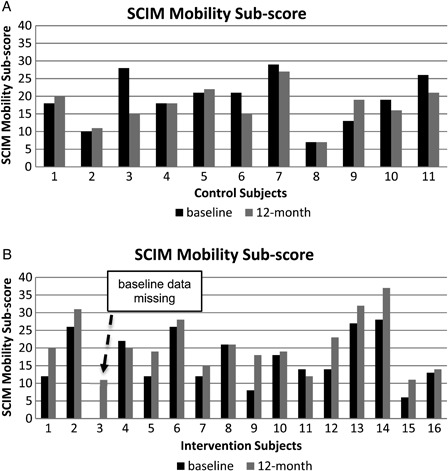
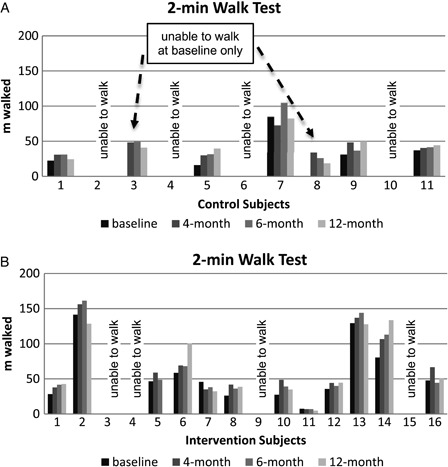
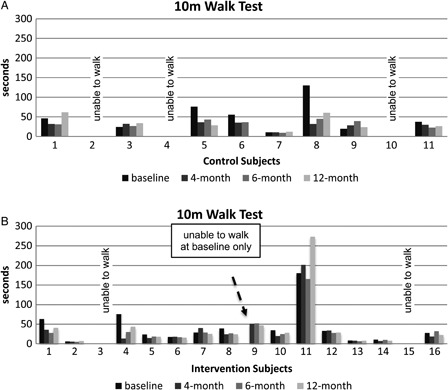
Results: Spinal cord independence measure (SCIM) mobility sub-score improved over time in the intervention group compared with the control group (baseline/12 months: 17.27/21.33 vs. 19.09/17.36, respectively). On all other outcome measures the intervention and control groups had similar improvements. Irrespective of group allocation walking speed, endurance, and balance during ambulation all improved upon completion of therapy, and majority of participants retained these gains at long-term follow-ups.
Conclusions: Task-oriented training improves walking ability in individuals with incomplete SCI, even in the chronic stage. Further randomized controlled trials, involving a large number of participants are needed, to verify if FES-assisted treadmill training is superior to aerobic and strength training.
Trial registration: ClinicalTrials.gov NCT00201968.
Keywords: Balance; Chronic; Functional electrical stimulation; Incomplete; Physiotherapy; Spinal cord injury; Therapy; Walking.
Figures
References
-
- Rick Hansen Institute and Urban Futures Dec 2010 The Incidence and Prevalence of Spinal Cord Injury in Canada Overview and estimates based on current evidence. Available at: http://fecst.inesss.qc.ca/fr/archives/nouvelle/article/the-incidence-and... Accessed September 5, 2014.
-
- Ditunno PL, Patrick M, Stineman M, Ditunno JF. Who wants to walk? Preferences for recovery after SCI: a longitudinal and cross-sectional study. Spinal Cord. 2008; 46(7):500–6 - PubMed
-
- Fawcett JW, Curt A, Steeves JD, Coleman WP, Tuszynski MH, Lammertse D, et al. Guidelines for the conduct of clinical trials for spinal cord injury as developed by the ICCP panel: spontaneous recovery after spinal cord injury and statistical power needed for therapeutic clinical trials. Spinal Cord 2007;45(3):190–205 - PubMed
-
- Curt A, van Hedel HJA, Klaus D, Dietz V. Recovery from a spinal cord injury: Significance of compensation, neural plasticity, and repair. J Neurotrauma 2008;25(6):677–85 - PubMed
-
- Harkema SJ, Schmidt-Read M, Lorenz D, Edgerton VR, Behrman AL. Balance and ambulation improvements in individuals with chronic incomplete spinal cord injury using locomotor training-based rehabilitation. Arch Phys Med Rehabil 2012;93(9):1508–17 - PubMed
Publication types
MeSH terms
Associated data
LinkOut - more resources
Full Text Sources
Other Literature Sources
Medical
Miscellaneous
