Review
. 2014 Sep 18:2:135.
doi: 10.1186/s40478-014-0135-5.

Inconsistencies and controversies surrounding the amyloid hypothesis of Alzheimer's disease

Affiliations
Review

Inconsistencies and controversies surrounding the amyloid hypothesis of Alzheimer's disease

Gary P Morris et al. Acta Neuropathol Commun. .

Abstract

The amyloid hypothesis has driven drug development strategies for Alzheimer's disease for over 20 years. We review why accumulation of amyloid-beta (Aβ) oligomers is generally considered causal for synaptic loss and neurodegeneration in AD. We elaborate on and update arguments for and against the amyloid hypothesis with new data and interpretations, and consider why the amyloid hypothesis may be failing therapeutically. We note several unresolved issues in the field including the presence of Aβ deposition in cognitively normal individuals, the weak correlation between plaque load and cognition, questions regarding the biochemical nature, presence and role of Aβ oligomeric assemblies in vivo, the bias of pre-clinical AD models toward the amyloid hypothesis and the poorly explained pathological heterogeneity and comorbidities associated with AD. We also illustrate how extensive data cited in support of the amyloid hypothesis, including genetic links to disease, can be interpreted independently of a role for Aβ in AD. We conclude it is essential to expand our view of pathogenesis beyond Aβ and tau pathology and suggest several future directions for AD research, which we argue will be critical to understanding AD pathogenesis.


Figures

Figure 1
Figure 1
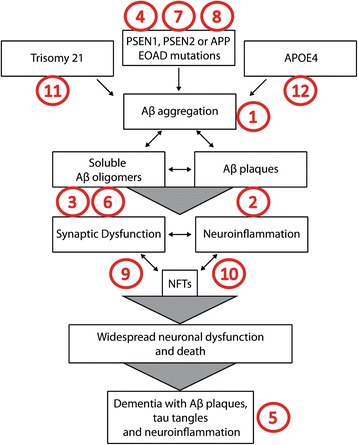
The Amyloid Hypothesis. The amyloid hypothesis postulates that Aβ aggregation triggers a cascade of events ultimately resulting in AD. Familial mutations in PSEN1, PSEN2 or APP are associated with early-onset AD (EOAD). These genetic risk factors are postulated to impact the cleavage of Aβ from APP, leading to oligomerisation and eventual Aβ plaque formation. Individuals with trisomy 21 (Down’s Syndrome), and therefore a triple copy of APP, suffer EOAD. The strongest genetic risk factor for late-onset AD (LOAD) is the presence of at least one APOE4 allele. It is unclear as to what triggers Aβ accumulation in LOAD, though it is suggested that there may be a number of contributing factors such as reduced Aβ clearance due to APOE genotype. Aβ oligomerisation is proposed to trigger a cascade involving the formation of neurofibrilliary tangles (NFTs) composed of hyperphosphorylated tau, synapse loss, neuron death and widespread neuroinflammation, particularly in brain regions involved in learning and memory, such as the hippocampus. As the amyloid burden increases, the ongoing catastrophic loss of synapses and neurons is thought to lead to progressive dementia.
Figure 2
Figure 2
Cleavage of APP and Physiological roles of APP and APP Fragments. Amyloid precursor protein (APP) can be cleaved via two mutually exclusive pathways. Importantly, various studies have suggested that these various fragments of APP processing, including Aβ, can have a number of possible roles in normal brain physiology, shown in the boxes. In the so-called amyloidogenic pathway APP is cleaved by β-secretase (beta-site APP cleaving enzyme 1 (BACE1)) and γ-secretase enzymes (PSEN1 is the catalytic core of the multiprotein γ-secretase complex). The initial β-secretase cleavage produces a large soluble extracellular domain, secreted amyloid precursor protein-β (sAPPβ). The remaining membrane bound C99 stud is then cleaved by multiple sequential γ-secretase cleavages. These begin near the inner membrane at a γ-secretase cleavage site epsilion (the ε-site) to produce the APP intracellular domain (AICD), and then subsequent sequential γ-secretase cleavages trim the remaining membrane bound component to produce different length Aβ peptides including Aβ43, Aβ42, Aβ40 and Aβ38 [17]. In the so-called non-amyloidogenic pathway APP is processed consecutively by α- and γ-secretases to produce secreted amyloid precursor protein α (sAPPα), p3 (which is in effect Aβ17-40/42) and AICD. The major α-secretase enzyme is A Disintegrin and metalloproteinase domain-containing protein 10 (ADAM10). Cleavage via amyloidogenic and non-amyloidogenic pathways depends on the cellular localisation of cleavage enzymes, and of full-length APP, which are expressed and trafficked in specific sub-cellular locations.
Figure 3
Figure 3
Controversies and Inconsistencies Within the Current Amyloid Hypothesis. 1. Aβ deposition occurs in cognitively normal individuals; 2. There is a weak correlation between plaque load and cognition; 3. The biochemical nature and presence of Aβ oligomeric assemblies in vivo is unclear; 4. Pre-clinical AD models based on EOAD-linked mutations are biased toward the amyloid hypothesis; 5. Pathological heterogeneity and comorbidities are unexplained by the amyloid hypothesis; 6. Aβ has a normal physiological role and targeting Aβ may disrupt these roles over the long term; 7. Genetic factors linked to AD can be interpreted independently of amyloid; 8. APP cleavage and function is more complex than solely the production of Aβ, indicating other APP family members may play a role in disease progression; 9. The triggers of synapse loss, neuronal loss and neuroinflammation in AD are still unclear; 10. The relationship between Aβ and tau pathologies is unclear; 11. The onset of dementia in Down’s Syndrome is highly variable, despite the presence of fibrillar plaques in 100% of Down’s individuals by the fifth decade; 12. The APOE4 genotype has numerous functional effects, rather than solely relating to reduced Aβ clearance, including links to enhanced inflammatory phenotypes. Each of these points are discussed in detail in the text.

References

    1. Glenner GG, Wong CW. Alzheimer's disease: initial report of the purification and characterization of a novel cerebrovascular amyloid protein. Biochem Biophys Res Commun. 1984;120:885–890. - PubMed
    1. Masters CL. Etiology and pathogenesis of Alzheimer's disease. Pathology. 1984;16:233–234. - PubMed
    1. Hardy J, Mayer J. The amyloid cascade hypothesis has misled the pharmaceutical industry. Biochem Soc Trans. 2011;39:920–923. - PubMed
    1. Masters CL, Gajdusek DC, Gibbs CJ., Jr The familial occurrence of Creutzfeldt-Jakob disease and Alzheimer's disease. Brain. 1981;104:535–558. - PubMed
    1. Prusiner SB, McKinley MP, Bowman KA, Bolton DC, Bendheim PE, Groth DF, Glenner GG. Scrapie prions aggregate to form amyloid-like birefringent rods. Cell. 1983;35:349–358. - PubMed

Publication types

MeSH terms