Review
. 2014 Oct;223(1):T25-35.
doi: 10.1530/JOE-14-0404.

20 years of leptin: connecting leptin signaling to biological function

Affiliations
Review

20 years of leptin: connecting leptin signaling to biological function

Margaret B Allison et al. J Endocrinol. 2014 Oct.

Abstract

Hypothalamic leptin action promotes negative energy balance and modulates glucose homeostasis, as well as serving as a permissive signal to the neuroendocrine axes that control growth and reproduction. Since the initial discovery of leptin 20 years ago, we have learned a great deal about the molecular mechanisms of leptin action. An important aspect of this has been the dissection of the cellular mechanisms of leptin signaling, and how specific leptin signals influence physiology. Leptin acts via the long form of the leptin receptor LepRb. LepRb activation and subsequent tyrosine phosphorylation recruits and activates multiple signaling pathways, including STAT transcription factors, SHP2 and ERK signaling, the IRS-protein/PI3Kinase pathway, and SH2B1. Each of these pathways controls specific aspects of leptin action and physiology. Important inhibitory pathways mediated by suppressor of cytokine signaling proteins and protein tyrosine phosphatases also limit physiologic leptin action. This review summarizes the signaling pathways engaged by LepRb and their effects on energy balance, glucose homeostasis, and reproduction. Particular emphasis is given to the multiple mouse models that have been used to elucidate these functions in vivo.

Keywords: hypothalamus; leptin; obesity; signal transduction.


Figures

Figure 1
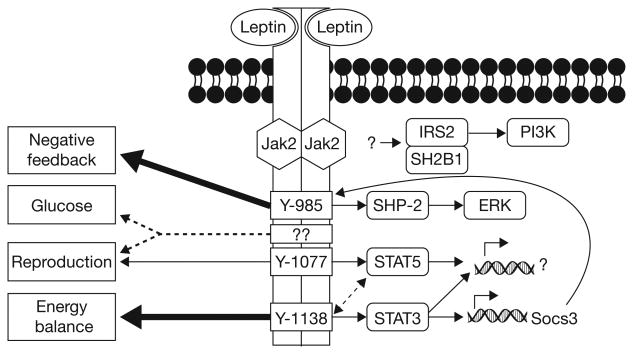
Figure 1. Leptin signaling and biological function
Leptin binds to LepRb, activating the associated JAK2 tyrosine kinase. Activated JAK2 phosphorylates the intracellular tail of LepRb on 3 tyrosine residues. Phosphorylated Tyr985 recruits SHP2, which participates in ERK signaling; Tyr985 also serves as a binding site for the negative feedback regulator, SOCS3. Phosphorylated Tyr1077 partially mediates leptin's control of reproduction; while STAT5 binds this site, STAT5 does not appear to participate in this effect of leptin. Phosphorylated Tyr1138 engages the STAT3 transcription factor. LepRb→STAT3 signaling represents the primary mechanism by which leptin regulates energy balance, although the target genes of STAT3 in LepRb neurons remain undiscovered. Leptin also recruits the IRS2→PI3K and SH2B1 pathways, although the mechanism of their recruitment to LepRb remains unclear. Some glucoregulatory and reproductive actions of LepRb appear to be mediated by unknown signals that function independently of LepRb tyrosine phosphorylation sites.
Figure 2
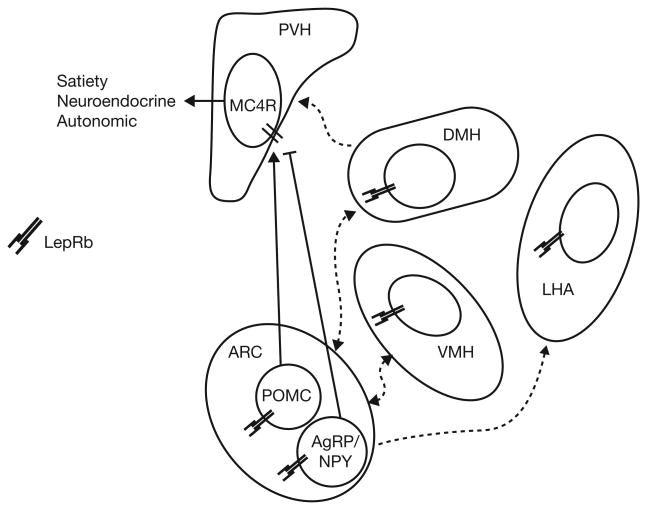
Figure 2. Hypothalamic leptin action
Leptin acts on its receptor (LepRb) on neurons in a series of interconnected hypothalamic nuclei to regulate satiety, neuroendocrine function, and autonomic tone. In the arcuate nucleus, leptin controls the melanocortin system through its opposing actions on POMC and AgRP neurons. ARC, arcuate nucleus; VMH, ventromedial hypothalamic nucleus; DMH, dorsomedial hypothalamic nucleus; LHA, lateral hypothalamic area; PVH, paraventricular hypothalamic nucleus; MC4R, melanocortin 4 receptor; POMC, pro-opiomelanocortin; AgRP, agouti-related peptide.

References

    1. Ahima RS, Dushay J, Flier SN, Prabakaran D, Flier JS. Leptin accelerates the onset of puberty in normal female mice. J Clin Invest. 1997;99:391–395. - PMC - PubMed
    1. Al-Qassab H, Smith MA, Irvine EE, Guillermet-Guibert J, Claret M, Choudhury AI, Selman C, Piipari K, Clements M, Lingard S, et al. Dominant role of the p110beta isoform of PI3K over p110alpha in energy homeostasis regulation by POMC and AgRP neurons. Cell Metab. 2009;10:343–354. - PMC - PubMed
    1. Banks AS, Davis SM, Bates SH, Myers MG., Jr Activation of downstream signals by the long form of the leptin receptor. J Biol Chem. 2000;275:14563–14572. - PubMed
    1. Banno R, Zimmer D, De Jonghe BC, Atienza M, Rak K, Yang W, Bence KK. PTP1B and SHP2 in POMC neurons reciprocally regulate energy balance in mice. J Clin Invest. 2010;120:720–734. - PMC - PubMed
    1. Bates SH, Dundon TA, Seifert m, Carlson M, Maratos-Flier E, Myers MG., Jr LRb-STAT3 signaling is required for the neuroendocrine regulation of energy expenditure by leptin. Diabetes. 2004;53:3067–3073. - PubMed

Publication types