. 2014 Sep 17;6(254):254ra126.
doi: 10.1126/scitranslmed.3009845.

Single-molecule sequencing to track plasmid diversity of hospital-associated carbapenemase-producing Enterobacteriaceae

Affiliations

Single-molecule sequencing to track plasmid diversity of hospital-associated carbapenemase-producing Enterobacteriaceae

Sean Conlan et al. Sci Transl Med. .

Abstract

Public health officials have raised concerns that plasmid transfer between Enterobacteriaceae species may spread resistance to carbapenems, an antibiotic class of last resort, thereby rendering common health care-associated infections nearly impossible to treat. To determine the diversity of carbapenemase-encoding plasmids and assess their mobility among bacterial species, we performed comprehensive surveillance and genomic sequencing of carbapenem-resistant Enterobacteriaceae in the National Institutes of Health (NIH) Clinical Center patient population and hospital environment. We isolated a repertoire of carbapenemase-encoding Enterobacteriaceae, including multiple strains of Klebsiella pneumoniae, Klebsiella oxytoca, Escherichia coli, Enterobacter cloacae, Citrobacter freundii, and Pantoea species. Long-read genome sequencing with full end-to-end assembly revealed that these organisms carry the carbapenem resistance genes on a wide array of plasmids. K. pneumoniae and E. cloacae isolated simultaneously from a single patient harbored two different carbapenemase-encoding plasmids, indicating that plasmid transfer between organisms was unlikely within this patient. We did, however, find evidence of horizontal transfer of carbapenemase-encoding plasmids between K. pneumoniae, E. cloacae, and C. freundii in the hospital environment. Our data, including full plasmid identification, challenge assumptions about horizontal gene transfer events within patients and identify possible connections between patients and the hospital environment. In addition, we identified a new carbapenemase-encoding plasmid of potentially high clinical impact carried by K. pneumoniae, E. coli, E. cloacae, and Pantoea species, in unrelated patients and in the hospital environment.


Figures

Fig. 1
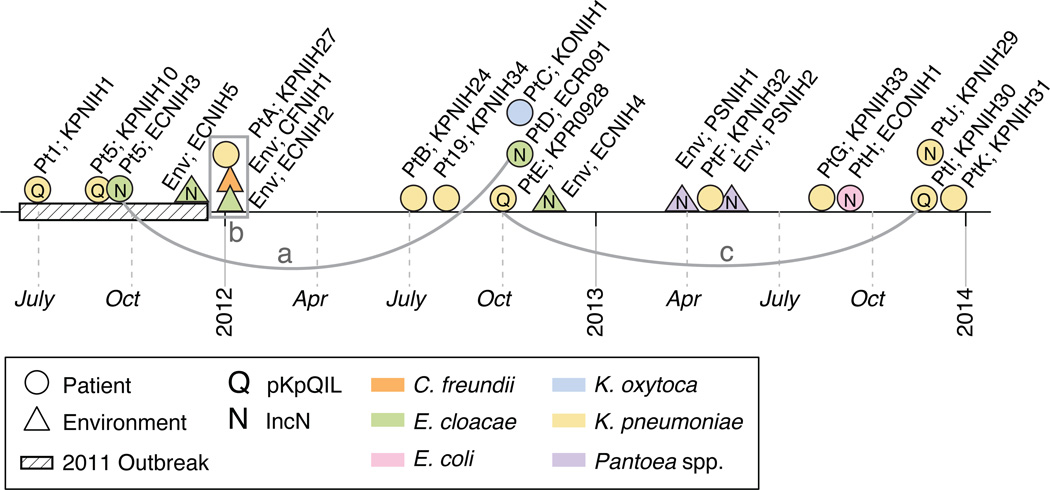
Fig. 1
Timeline of KPC+ Enterobacteriaceae organisms identified and sequenced from 2011–2013. Patient code, genus, species and strain denoted in label; for example, Pt1; KPNIH1 is Patient 1;Klebsiella pneumoniae NIH1 strain and Env;ECNIH5 is Environmental; Enterobacter cloacae NIH5 strain. Detailed data are presented in Table 1. The isolate source is denoted by shape and the bacterial species is denoted by color. Isolates carrying a variant of the plasmid pKpQIL are marked with a “Q”. Isolates carrying the pKPC-47e backbone (IncN, this study) are marked with an “N”. Isolates connected by lines a and c share genetic similarity, without epidemiologic linkage. Isolates in box b show evidence of an inter-genus exchange of a pR55-like plasmid. The 2011 KPC+ K. pneumoniae outbreak is denoted with a hashed line.
Fig. 2
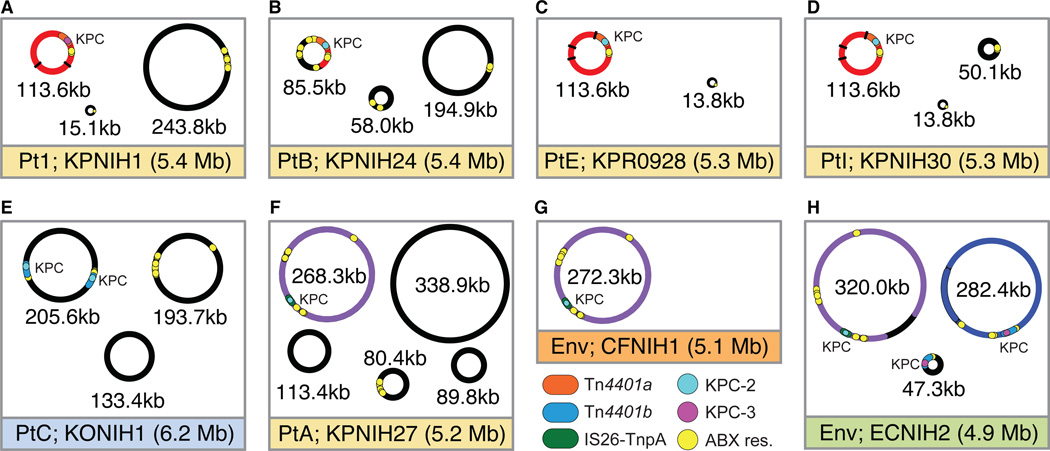
Fig. 2
Genome sequencing and plasmid composition of Klebsiella isolates (A–E) and isolates associated with an inter-genus plasmid transfer (F–H). The color of title bar corresponds to the bacterial species from Fig. 1. Patient code or environmental isolate code and chromosome size denoted in each title bar. Detailed patient code, genus and species described in Table 1. Plasmids are colored to highlight three common backbones across isolates (red, pKpQIL; blue, pEC-IMP-like; purple, pR55-like). The blaKPC genes are colored by allele type, KPC-2 is cyan and KPC-3 is magenta. Flanking sequences are colored to differentiate the bla gene context (red, Tn4401a; blue, Tn4401b; green, IS26-TnpA). Additional antibiotic resistance genes are marked in yellow. The positions of SNVs in pKpQIL plasmids, relative to the reference (NC_014016), are marked as black tick marks in panels A, C and D.
Fig. 3
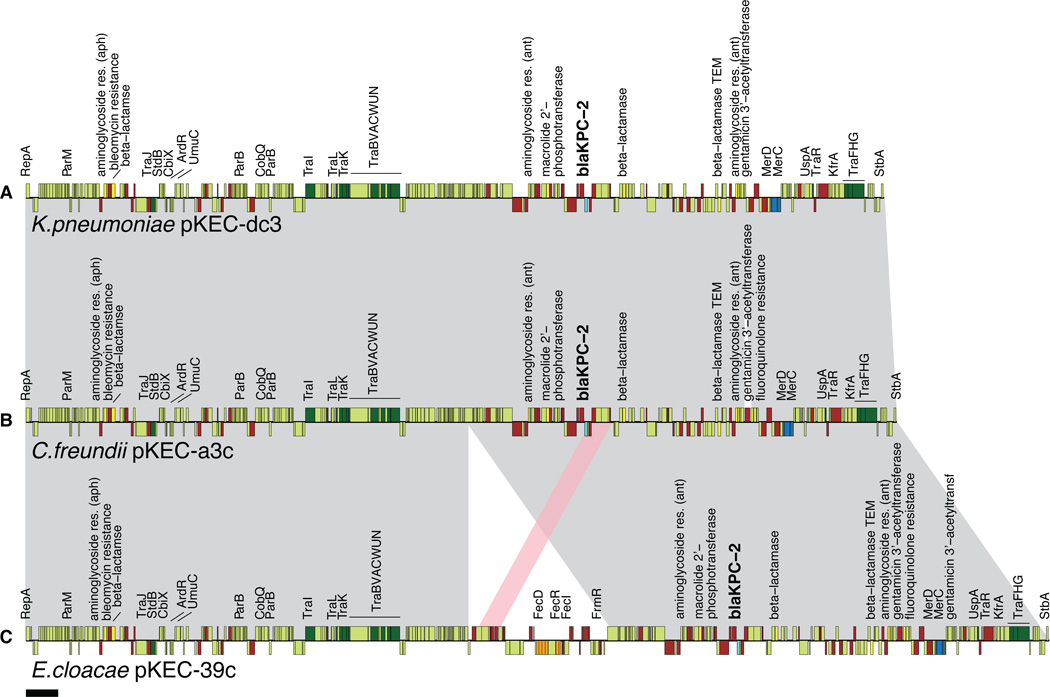
Fig. 3
Genetic tracking of plasmid transfer between Enterobacteriaceae genera. (A) KPC+K. pneumoniae plasmid pKEC-dc3 from patient A. (B) C. freundii plasmid pKEC-a3c from sink aerator. (C) E. cloacae plasmid pKEC-39c from sink drain. Transposase and resolvase genes are brown, tra genes are dark green, blaKPC-2 is cyan, other antibiotic resistance genes are yellow, mercury resistance genes are blue and iron acquisition genes are orange. Shared regions of homology are indicated in gray shading with a duplication event indicated in pink. Scale bar is 10 kb.
Fig. 4
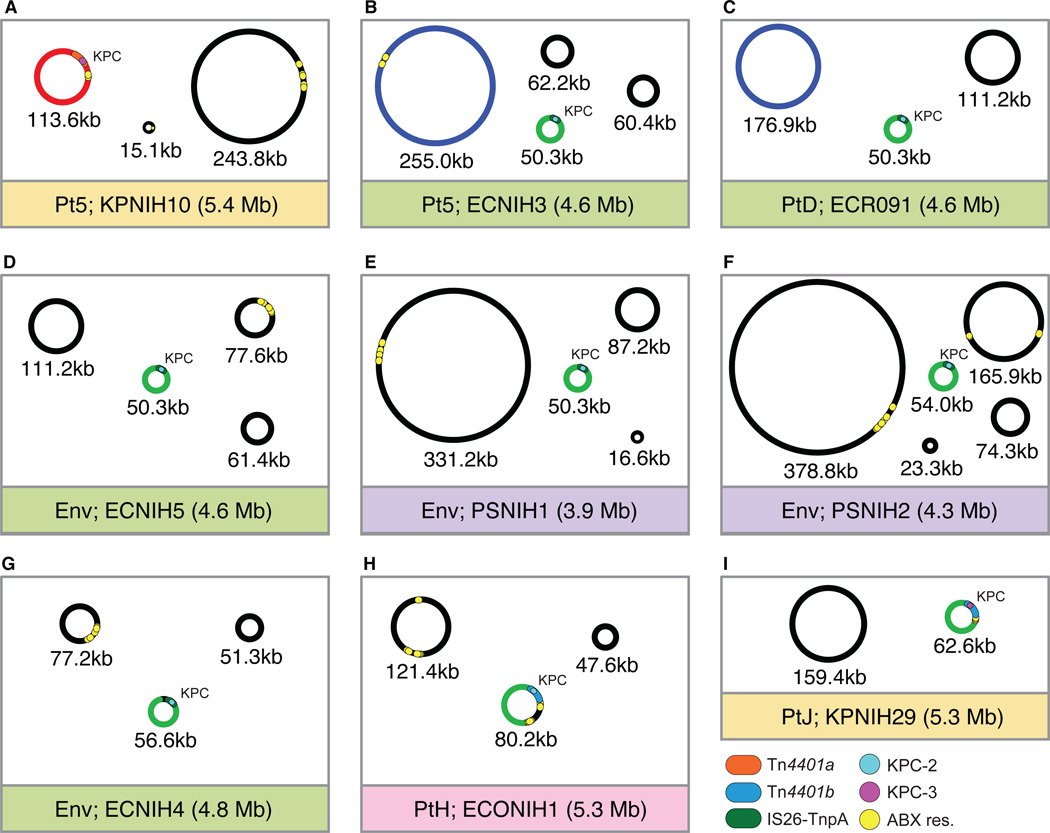
Fig. 4
Genome sequencing of isolates with a broad host range IncN plasmid. Color of title bar corresponds to the bacterial species from Fig. 1. Patient code or environmental isolate code and chromosome size denoted in each title bar. Detailed patient code, genus and species described in Table 1. Plasmids are colored to highlight three common backbones across isolates (red, pKpQIL; blue, pEC-IMP-like; green, pKPC-47e). The blaKPC genes are colored by allele type, KPC-2 is cyan and KPC-3 is magenta. Flanking sequences are colored to differentiate the bla gene context (red, Tn4401a; blue, Tn4401b; green, IS26-TnpA). Additional antibiotic resistance genes are marked in yellow.
Fig. 5
Fig. 5
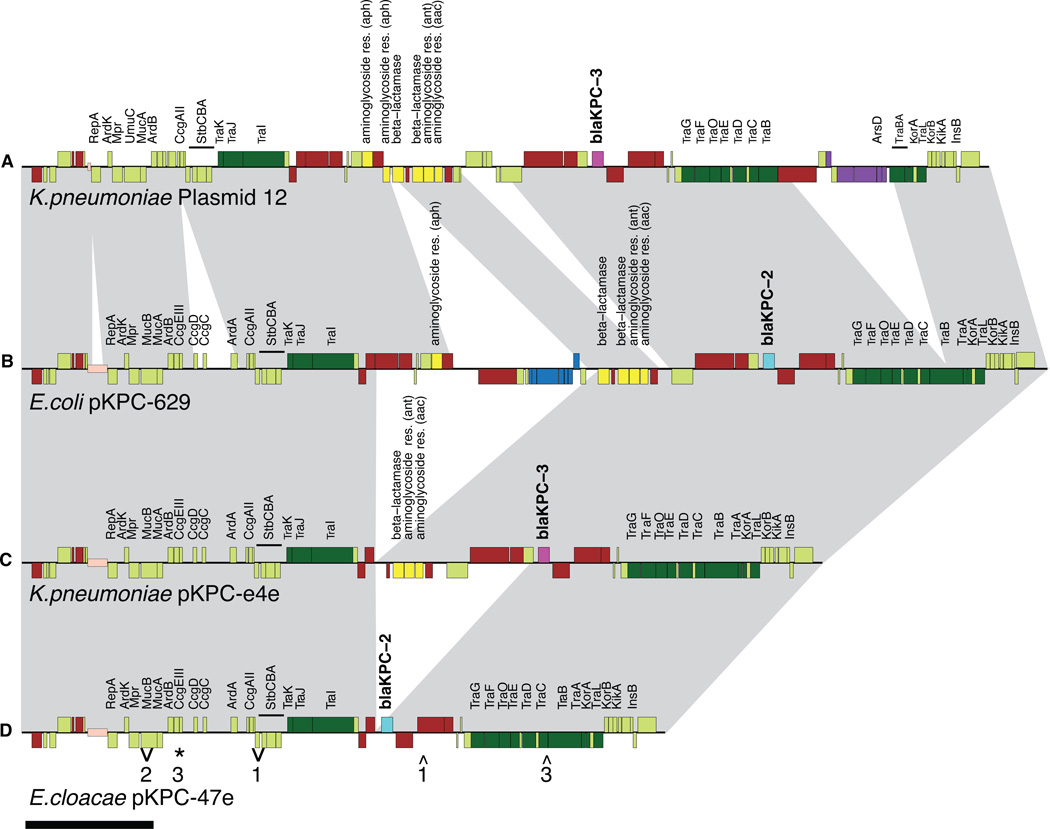
Genetic similarity of IncN plasmids identified across KPC+E. coli, K. pneumoniae, E. cloacae and Pantoea sp. Gray ribbons between panels mark regions of >99% sequence similarity. (A) Reference KPC+K. pneumoniae plasmid 12. (B) KPC+E. coli, ECONIH1, plasmid pKPC-629. (C) KPC+K. pneumoniae, KPNIH29, plasmid pKPC-e4e. (D) KPC+E. cloacae plasmid pKPC-47e. ECR091, ECNIH3, and ECNIH5 have identical sequences. Small insertion and deletions are marked with arrows for ECNIH4 (1), PSNIH1(2), and PSNIH2(3). SNVs are marked with *. Transposase and resolvase genes are colored brown, tra genes are dark green, blaKPC-2 is cyan, blaKPC-3 is magenta, other antibiotic resistance genes are yellow, mercury resistance genes are blue and arsenic resistance genes are purple. The expanded iteron repeat is indicated in beige. Scale bar is 10 kb.

Comment in

References

    1. Mathers AJ, et al. Molecular dissection of an outbreak of carbapenem-resistant enterobacteriaceae reveals Intergenus KPC carbapenemase transmission through a promiscuous plasmid. MBio. 2011;2:e00204–e00211. - PMC - PubMed
    1. Satlin MJ, et al. Emergence of carbapenem-resistant Enterobacteriaceae as causes of bloodstream infections in patients with hematologic malignancies. Leuk. Lymphoma. 2013;54:799–806. - PubMed
    1. Ben-David D, et al. Outcome of carbapenem resistant Klebsiella pneumoniae bloodstream infections. Clin. Microbiol. Infect. 2012;18:54–60. - PubMed
    1. Snitkin ES, et al. Tracking a Hospital Outbreak of Carbapenem-Resistant Klebsiella pneumoniae with Whole-Genome Sequencing. Sci Transl Med. 2012;4 148ra116. - PMC - PubMed
    1. CDC Vital Signs. available at http://www.cdc.gov/vitalsigns/hai/cre/index.html.

Publication types