


Effect of a care transition intervention by pharmacists: an RCT
- PMID: 25234932
- PMCID: PMC4262237
- DOI: 10.1186/1472-6963-14-406
Effect of a care transition intervention by pharmacists: an RCT
Abstract
Background: Pharmacists may improve medication-related outcomes during transitions of care. The aim of the Iowa Continuity of Care Study was to determine if a pharmacist case manager (PCM) providing a faxed discharge medication care plan from a tertiary care institution to primary care could improve medication appropriateness and reduce adverse events, rehospitalization and emergency department visits.
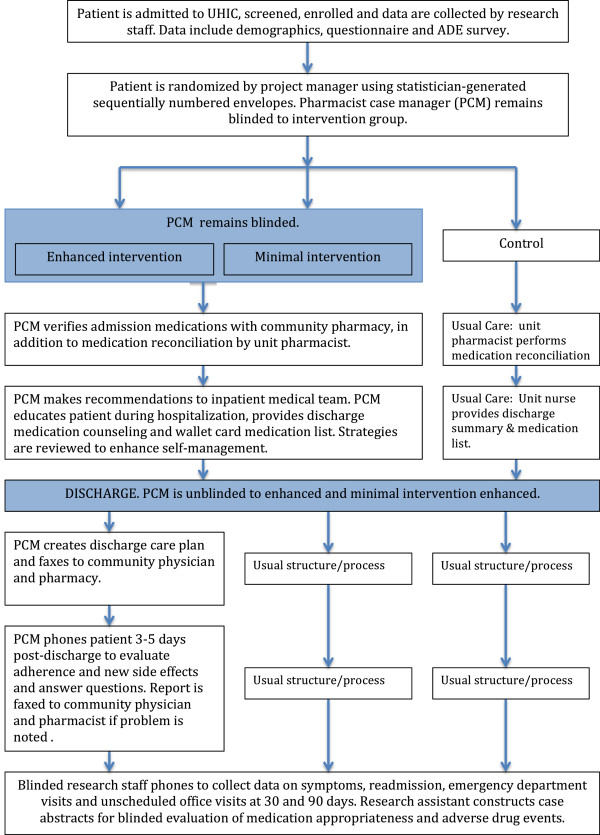
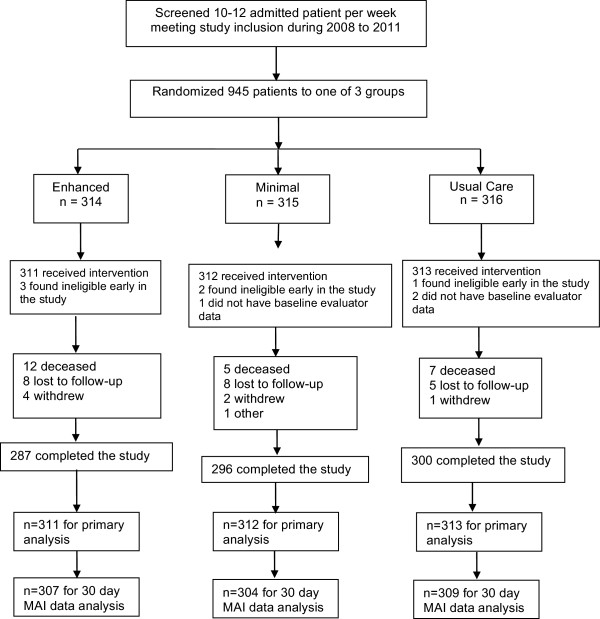
Methods: Design. Randomized, controlled trial of 945 participants assigned to enhanced, minimal and usual care groups conducted 2007 to 2012. Subjects. Participants with cardiovascular-related conditions and/or asthma or chronic obstructive pulmonary disease were recruited from the University of Iowa Hospital and Clinics following admission to general medicine, family medicine, cardiology or orthopedics. Intervention. The minimal group received admission history, medication reconciliation, patient education, discharge medication list and medication recommendations to inpatient team. The enhanced group also received a faxed medication care plan to their community physician and pharmacy and telephone call 3-5 days post-discharge. Participants were followed for 90 days post-discharge. Main Outcomes and Measures. Medication appropriateness index (MAI), adverse events, adverse drug events and post-discharge healthcare utilization were compared by study group using linear and logistic regression, as models accommodating random effects due to pharmacists indicated little clustering.
Results: Study groups were similar at baseline and the intervention fidelity was high. There were no statistically significant differences by study group in medication appropriateness, adverse events or adverse drug events at discharge, 30-day and 90-day post-discharge. The average MAI per medication as 0.53 at discharge and increased to 0.75 at 90 days, and this was true across all study groups. Post-discharge, about 16% of all participants experienced an adverse event, and this did not differ by study group (p > 0.05). Almost one-third of all participants had any type of healthcare utilization within 30 days post-discharge, where 15% of all participants had a 30-day readmission. Healthcare utilization post-discharge was not statistically significant different at 30 or 90 days by study group.
Conclusion: The pharmacist case manager did not affect medication use outcomes post-discharge perhaps because quality of care measures were high in all study groups.
Trial registration: Clinicaltrials.gov registration: NCT00513903, August 7, 2007.
Figures
References
-
- Flora DS, Parsons PL, Slattum PW. Managing medications for improved care transitions. Generations. 2011;35:37–42.
Pre-publication history
-
- The pre-publication history for this paper can be accessed here: http://www.biomedcentral.com/1472-6963/14/406/prepub
Publication types
MeSH terms
Associated data
Grants and funding
LinkOut - more resources
Full Text Sources
Other Literature Sources
Medical
Miscellaneous
