Review
doi: 10.1101/cshperspect.a017244.
Common and rare genetic risk factors for glaucoma
Affiliations
- PMID: 25237143
- PMCID: PMC4292091
- DOI: 10.1101/cshperspect.a017244
Item in Clipboard
Review
Common and rare genetic risk factors for glaucoma
Cold Spring Harb Perspect Med.
.
Abstract
The characterization of genes responsible for glaucoma is the critical first step toward the development of gene-based diagnostic and screening tests, which could identify individuals at risk for disease before irreversible optic nerve damage occurs. Early-onset forms of glaucoma affecting children and young adults are typically inherited as Mendelian autosomal dominant or recessive traits whereas glaucoma affecting older adults has complex inheritance. In this report, we present a comprehensive overview of the genes and genomic regions contributing to inherited glaucoma.
Copyright © 2014 Cold Spring Harbor Laboratory Press; all rights reserved.
Figures
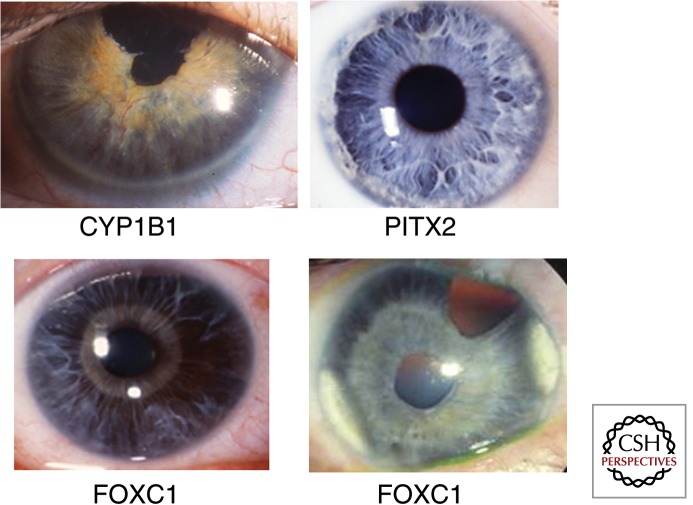
Anterior segment phenotypes in patients with developmental glaucoma. Anterior segment photographs taken with a camera attached to a slit-lamp are shown for four patients with mutations in genes associated with early-onset glaucoma. Notable features are peripheral corneal opacification (CYP1B1), irido-corneal adhesions (PITX2) and iris atrophy (FOXC1). In the patients with FOXC1 mutations the atrophic iris makes it possible to see the pupillary sphincter muscle, which is normally not visible because of overlying iris stroma.
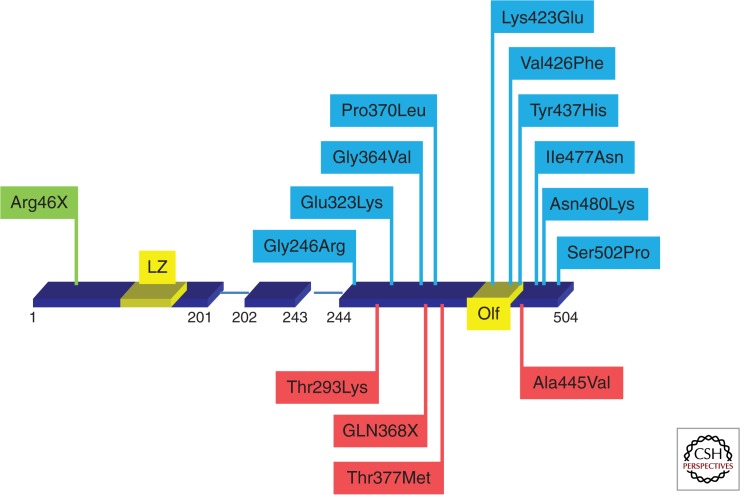
MYOC mutations causing glaucoma. The gene location of selected MYOC mutations known to cause glaucoma are shown. Exon 1 extends from codon 1–201, exon 2 from codon 202–243, and exon 3 from codon 244–504. Exon 1 contains a leucine zipper (LZ) and exon 3 contains the Olfactomedin domain (Olf). Mutations causing early-onset glaucoma are shown in blue, adult-onset glaucoma in red, and a nonsense mutation known to be a benign polymorphism in green.
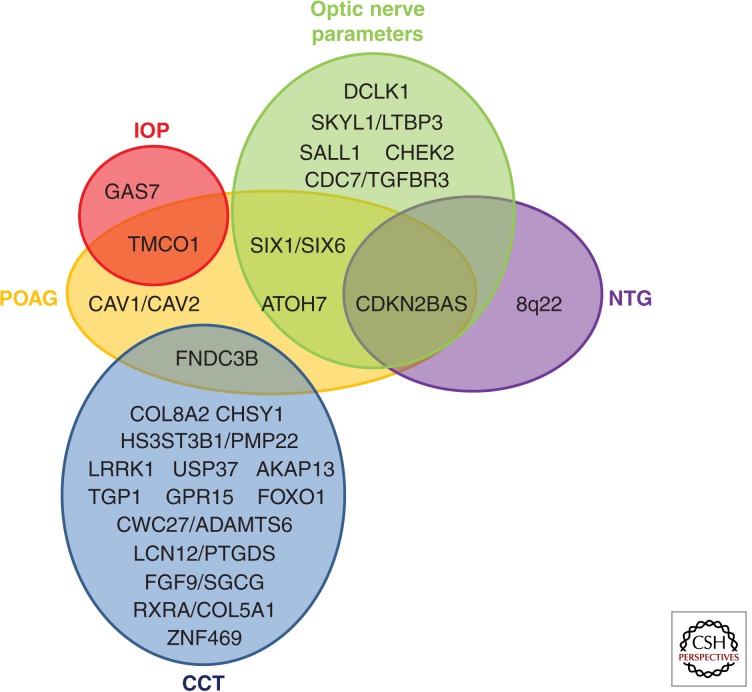
Gene and genomic regions with common variants that contribute to glaucoma and glaucoma-related ocular quantitative traits. Variants contributing to both primary open-angle glaucoma and normal tension glaucoma as well as selected ocular quantitative traits (CCT, IOP, and optic nerve parameters) are shown. Gene names are presented in dark font. Genes contributing to POAG are contained in the orange ellipse, NTG in the purple ellipse, CCT in the blue ellipse, IOP in the red ellipse, and optic nerve parameters in the green ellipse. Genes that contribute to more than one trait are indicated by their placement in the overlapping regions. For example, CDKN2BAS contributes to NTG, POAG, and to optic nerve parameters.
References
-
- Adam MF, Belmouden A, Binisti P, Brézin AP, Valtot F, Béchetoille A, Dascotte JC, Copin B, Gomez L, Chaventré A, et al. 1997. Recurrent mutations in a single exon encoding the evolutionarily conserved olfactomedin-homology domain of TIGR in familial open-angle glaucoma. Hum Mol Genet 6.12: 2091–2097. - PubMed
-
- Akarsu A, Nurten M, Erol Turacli S, Gulderen Aktan, Magda Barsoum-Homsy, Line Chevrette, B, Sitki Sayli, Mansoor Sarfarazi 1996. A second locus (GLC3B) for primary congenital glaucoma (Buphthalmos) maps to the 1p36 region. Hum Mol Genet 5: 1199–1203. - PubMed
Publication types
MeSH terms
LinkOut - more resources
Full Text Sources
Other Literature Sources
Medical