


Comment
doi: 10.7554/eLife.04565.
Mapping Ebola in wild animals for better disease control
Affiliations
- PMID: 25238569
- PMCID: PMC4166718
- DOI: 10.7554/eLife.04565
Item in Clipboard
Comment
Mapping Ebola in wild animals for better disease control
Elife.
.
Abstract
Identifying the regions where wild animal populations could transmit the Ebola virus should help with efforts to prepare at-risk areas for future outbreaks.
Keywords: Ebola; Ebolavirus; boosted regression trees; disease mapping; epidemiology; global health; human; infectious disease; microbiology; niche based modelling; species distribution modelling; viruses.
Conflict of interest statement
Figures
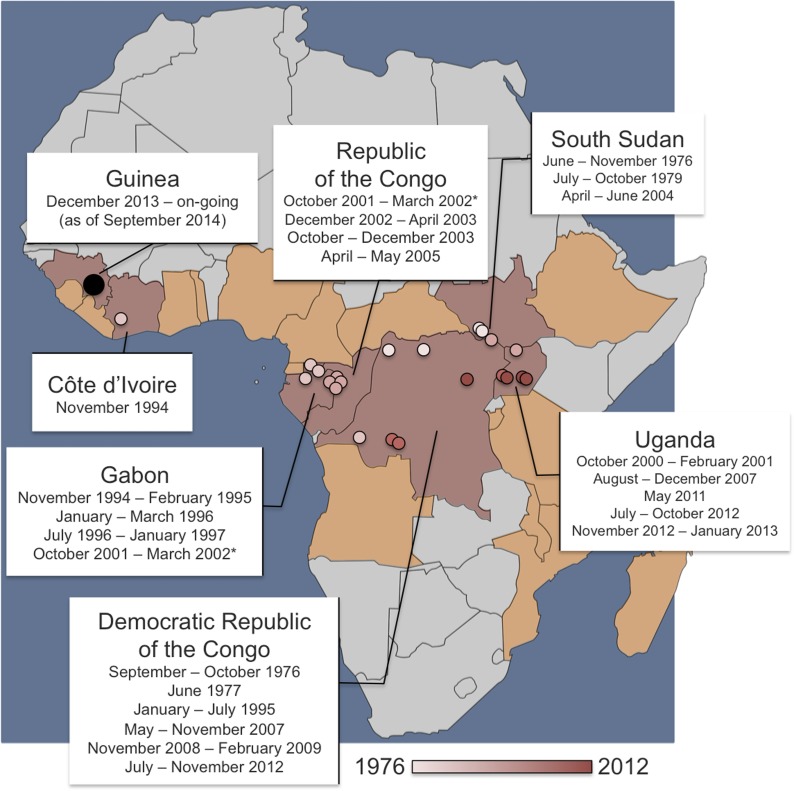
Over the last four decades, there have been 23 outbreaks of Ebola virus disease in humans across Africa. The locations of the primary infections from past outbreaks are shown on the map as small circles (coloured pink or red according to the date that the outbreak started). The on-going outbreak in West Africa—which started in December 2013 in Guinea—is shown as a larger black circle. The 2001–2002 outbreak (marked with an asterisk) had primary infections (or ‘index cases’) in both the Republic of the Congo and Gabon—and the 1994 ‘outbreak’ in Côte d’Ivoire infected one researcher who had handled a dead chimpanzee and who later recovered. Pigott, Golding et al. have used the data of previous primary infections, reports of infections in wild animals and data about climate and vegetation to predict regions where Ebola might be transmissible from non-human animals. The at-risk area spans 22 countries: the seven with previous index cases (shaded in red) and a further 15 countries where, to date, index cases have not been recorded (shaded in orange).
Comment on
-
Mapping the zoonotic niche of Ebola virus disease in Africa.Elife. 2014 Sep 8;3:e04395. doi: 10.7554/eLife.04395. Elife. 2014. PMID: 25201877 Free PMC article.
References
-
- Gire SK, Goba A, Andersen KG, Sealfon RSG, Park DJ, Kanneh L, Jalloh S, Momoh M, Fullah M, Dudas G, Wohl S, Moses LM, Yozwiak NL, Winnicki S, Matranga CB, Malboeuf CM, Qu J, Gladden AD, Schaffner SF, Yang X, Jiang P-P, Nekoui M, Colubri A, Coomber MR, Fonnie M, Moigboi A, Gbakie M, Kamara FK, Tucker V, Konuwa E, Saffa S, Sellu J, Jalloh AA, Kovoma A, Koninga J, Mustapha I, Kargbo K, Foday M, Yillah M, Kanneh F, Robert W, Massally JLB, Chapman SB, Bochicchio J, Murphy C, Nusbaum C, Young S, Birren BW, Grant DS, Scheiffelin JS, Lander ES, Happi C, Gevao SM, Gnirke A, Rambaut A, Garry RF, Khan SH, Sabeti PC. 2014. Genomic surveillance elucidates Ebola virus origin and transmission during the 2014 outbreak. Science 345:1369–1372. doi: 10.1126/science.1259657 - DOI - PMC - PubMed
Publication types
MeSH terms
LinkOut - more resources
Full Text Sources
Other Literature Sources
Medical
