Review
. 2014;14(11):549.
doi: 10.1007/s11892-014-0549-2.

Fine mapping of type 2 diabetes susceptibility loci

Affiliations
Review

Fine mapping of type 2 diabetes susceptibility loci

Andrew P Morris. Curr Diab Rep. 2014.

Erratum in

Abstract

Genome-wide association studies of type 2 diabetes have been extremely successful in discovering loci that contribute genetic effects to susceptibility to the disease. However, at the vast majority of these loci, the variants and transcripts through which these effects on type 2 diabetes are mediated are unknown, limiting progress in defining the pathophysiological basis of the disease. In this review, we will describe available approaches for assaying genetic variation across loci and discuss statistical methods to determine the most likely causal variants in the region. We will consider the utility of trans-ethnic meta-analysis for fine mapping by leveraging the differences in the structure of linkage disequilibrium between diverse populations. Finally, we will discuss progress in fine-mapping type 2 diabetes susceptibility loci to date and consider the prospects for future efforts to localise causal variants for the disease.


Conflict of interest statement

Andrew P. Morris declares that he has no conflict of interest.

Figures
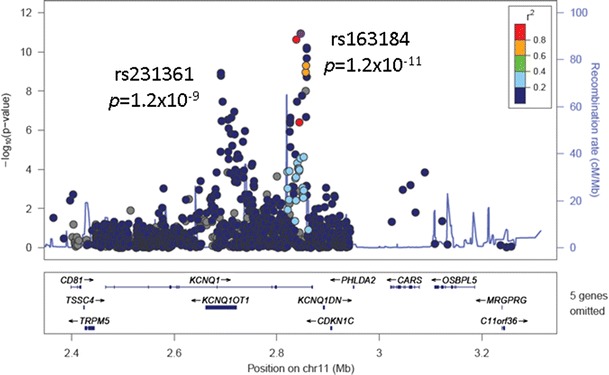
Fig. 1
Fig. 1
Fine-mapping of the KCNQ1 locus. Each point represents a Metabochip SNP passing quality control in a meta-analysis of 34,840 T2D cases and 114,981 controls, primarily of European descent. Each SNP is plotted with their p value (on a −log10 scale, y-axis) as a function of genomic position (NCBI Build 36, x-axis). The lead SNP (rs163184) is represented by the purple circle. The colour coding of all other SNPs indicates LD with the lead SNP (estimated by CEU r 2 from the 1000 Genomes Project, June 2010 release): red r 2 ≥ 0.8, gold 0.6 ≤ r 2 < 0.8, green 0.4 ≤ r 2 < 0.6, cyan 0.2 ≤ r 2 < 0.4, blue r 2 < 0.2, and grey r 2 unknown. Recombination rates are estimated from the International HapMap Project and gene annotations are taken from the University of California Santa Cruz genome browser

References

    1. Zeggini E, et al. Meta-analysis of genome-wide association data and large-scale replication identifies additional susceptibility loci for type 2 diabetes. Nat Genet. 2008;40:638–645. doi: 10.1038/ng.120. - DOI - PMC - PubMed
    1. Kong A, et al. Parental origin of sequence variants associated with complex diseases. Nature. 2009;462:868–874. doi: 10.1038/nature08625. - DOI - PMC - PubMed
    1. Dupuis J, et al. New genetic loci implicated in fasting glucose homeostasis and their impact on type 2 diabetes risk. Nat Genet. 2010;42:105–116. doi: 10.1038/ng.520. - DOI - PMC - PubMed
    1. Voight BF, et al. Twelve type 2 diabetes susceptibility loci identified through large-scale association analysis. Nat Genet. 2010;42:105–116. doi: 10.1038/ng.609. - DOI - PMC - PubMed
    1. Parra EJ, et al. Genome-wide association study of type 2 diabetes in a sample from Mexico City and a meta-analysis of a Mexican-American sample from Starr County, Texas. Diabetologia. 2011;54:2038–2046. doi: 10.1007/s00125-011-2172-y. - DOI - PMC - PubMed

Publication types

MeSH terms

Substances

LinkOut - more resources
