


Trends in hospital admissions at a Department for Infectious Diseases in Italy from 1995 to 2011 and implications for health policies
- PMID: 25239403
- PMCID: PMC4180147
- DOI: 10.1186/1471-2458-14-980
Trends in hospital admissions at a Department for Infectious Diseases in Italy from 1995 to 2011 and implications for health policies
Abstract
Background: Interactions among several environmental, behavioral, social, and biological variables contribute to the epidemiology of infectious diseases (IDs) and have an impact on the healthcare system and hospitalizations. We evaluated trends in ID hospitalizations at our Department for Infectious Diseases in the last two decades to aid decision-makers in defining appropriate healthcare strategies.
Methods: The discharge diagnoses of all patients admitted to the ID Department of L Sacco University Hospital between 1995 and 2011 were classified by the International Classification of Diseases (ICD-9) grouped in Major Diagnostic Categories (MDC). Linear regression was used to determine the trends in hospitalizations for each MDC. Estimates of the average annual change were based on the slope of the regression line.
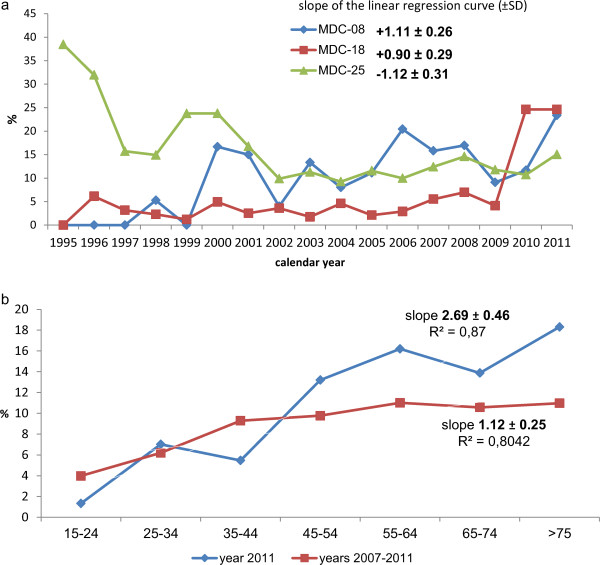
Results: A sharp decline in HIV/AIDS cases (-22.5 +/-6.0 cases per calendar year), and an increase in admissions for respiratory, cardiovascular, renal and musculoskeletal infections were recorded. The mean age of the patients increased by 1.2 years (+/-0.049) for each calendar year of observation (linear trend, p < 0.0001), increasing from 37.02 +/-11.91 years in 1995 to 56.02 +/-19.62 years in 2011 (p < 0.0001). The mean number of comorbidities per patient increased significantly over time (Mann-Whitney U test, p = 0.0153). From 1998/1999 to 2010/2011 the hospital length of stay (LOS) increased for cardiovascular, digestive system, musculoskeletal, and skin/subcutaneous infections, and infectious and parasitic diseases (p < 0.01). The rate of hospital stay over threshold (HSOT) increased in the last 5 years by 1.12% for every 10-year age group.
Conclusions: Older age, a higher number of comorbidities, a longer hospital LOS for certain conditions, and a higher rate of HSOT characterize the patients admitted to this ID department in recent years. Despite progress in treatment and management, infectious diseases continue to be a major threat to human health. The current challenge for ID departments is the treatment of complex cases, often associated with chronic diseases in elderly patients. Continuous monitoring at a local and national level will allow early identification of changes in the epidemiological patterns of IDs and provide information for healthcare system planning.
Figures



References
-
- The Global Burden of Disease: 2004 Update. World Health Organization; 2008. http://www.who.int/healthinfo/global_burden_disease/GBD_report_2004updat...
-
- OECD . Health at a Glance: Europe 2012. 2012.
-
- Eurosurveillance editorial team: Note from the editors: a new virus bringing back memories from the past.Euro Surveill 2012.,17(39): Available online: http://www.eurosurveillance.org/ViewArticle.aspx?ArticleId=20284
-
- Danielsson N, Team EIR, Catchpole M: Novel coronavirus associated with severe respiratory disease: case definition and public health measures.Euro Surveill 2012.,17(39): Availableonline: http://www.eurosurveillance.org/ViewArticle.aspx?ArticleId=20282 - PubMed
-
- Jain S, Kamimoto L, Bramley AM, Schmitz AM, Benoit SR, Louie J, Sugerman DE, Druckenmiller JK, Ritger KA, Chugh R, Jasuja S, Deutscher M, Chen S, Walker JD, Duchin JS, Lett S, Soliva S, Wells EV, Swerdlow D, Uyeki TM, Fiore AE, Olsen SJ, Fry AM, Bridges CB, Finelli L, for the 2009 Pandemic Influenza A (H1N1) Virus Hospitalizations Investigation Team Hospitalized patients with 2009 H1N1 influenza in the United States, April–June 2009. N Engl J Med. 2009;361:1935–1944. doi: 10.1056/NEJMoa0906695. - DOI - PubMed
Pre-publication history
-
- The pre-publication history for this paper can be accessed here:http://www.biomedcentral.com/1471-2458/14/980/prepub
MeSH terms
LinkOut - more resources
Full Text Sources
Other Literature Sources
Medical
