


Assessment of atherosclerosis in chronic granulomatous disease
- PMID: 25239440
- PMCID: PMC4258873
- DOI: 10.1161/CIRCULATIONAHA.113.006824
Assessment of atherosclerosis in chronic granulomatous disease
Abstract
Background: Patients with chronic granulomatous disease (CGD) experience immunodeficiency because of defects in the phagocyte NADPH oxidase and the concomitant reduction in reactive oxygen intermediates. This may result in a reduction in atherosclerotic injury.
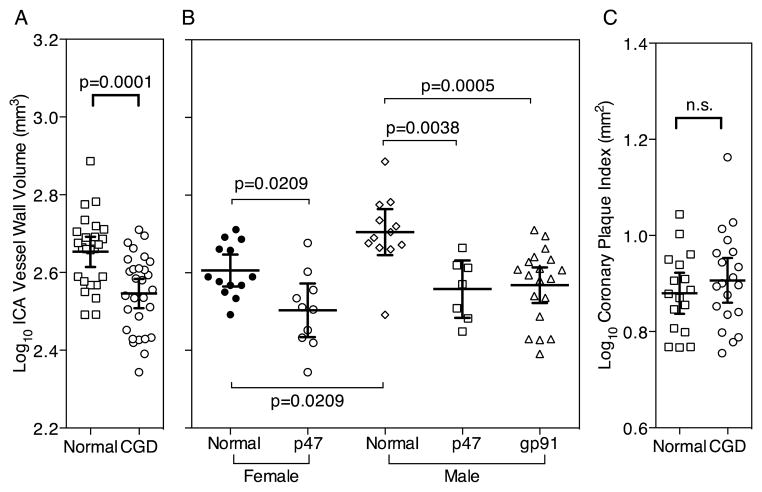
Methods and results: We prospectively assessed the prevalence of cardiovascular risk factors, biomarkers of inflammation and neutrophil activation, and the presence of magnetic resonance imaging and computed tomography quantified subclinical atherosclerosis in the carotid and coronary arteries of 41 patients with CGD and 25 healthy controls in the same age range. Univariable and multivariable associations among risk factors, inflammatory markers, and atherosclerosis burden were assessed. Patients with CGD had significant elevations in traditional risk factors and inflammatory markers compared with control subjects, including hypertension, high-sensitivity C-reactive protein, oxidized low-density lipoprotein, and low high-density lipoprotein. Despite this, patients with CGD had a 22% lower internal carotid artery wall volume compared with control subjects (361.3±76.4 mm(3) versus 463.5±104.7 mm(3); P<0.001). This difference was comparable in p47(phox)- and gp91(phox)-deficient subtypes of CGD and independent of risk factors in multivariate regression analysis. In contrast, the prevalence of coronary arterial calcification was similar between patients with CGD and control subjects (14.6%, CGD; 6.3%, controls; P=0.39).
Conclusions: The observation by magnetic resonance imaging and computerized tomography of reduced carotid but not coronary artery atherosclerosis in patients with CGD despite the high prevalence of traditional risk factors raises questions about the role of NADPH oxidase in the pathogenesis of clinically significant atherosclerosis. Additional high-resolution studies in multiple vascular beds are required to address the therapeutic potential of NADPH oxidase inhibition in cardiovascular diseases.
Clinical trial registration url: http://www.clinicaltrials.gov. Unique identifier: NCT01063309.
Keywords: atherosclerosis; carotid arteries; coronary vessels; immune system; inflammation.
© 2014 American Heart Association, Inc.
Conflict of interest statement
Figures
References
-
- Lekstrom-Himes JA, Gallin JI. Immunodeficiency diseases caused by defects in phagocytes. N Engl J Med. 2000;343:1703–1714. - PubMed
-
- Winkelstein JA, Marino MC, Johnston RB, Jr, Boyle J, Curnutte J, Gallin JI, Malech HL, Holland SM, Ochs H, Quie P, Buckley RH, Foster CB, Chanock SJ, Dickler H. Chronic granulomatous disease. Report on a national registry of 368 patients. Medicine (Baltimore) 2000;79:155–169. - PubMed
-
- Lekstrom-Himes JA, Kuhns DB, Alvord WG, Gallin JI. Inhibition of human neutrophil il-8 production by hydrogen peroxide and dysregulation in chronic granulomatous disease. J Immunol. 2005;174:411–417. - PubMed
-
- Henderson WR, Klebanoff SJ. Leukotriene production and inactivation by normal, chronic granulomatous disease and myeloperoxidase-deficient neutrophils. J Biol Chem. 1983;258:13522–13527. - PubMed
Publication types
MeSH terms
Substances
Supplementary concepts
Associated data
Grants and funding
LinkOut - more resources
Full Text Sources
Other Literature Sources
Medical
Research Materials
Miscellaneous
