. 2015 Jan;148(1):203-214.e16.
doi: 10.1053/j.gastro.2014.09.014. Epub 2014 Sep 16.

Supplementation of saturated long-chain fatty acids maintains intestinal eubiosis and reduces ethanol-induced liver injury in mice

Affiliations

Supplementation of saturated long-chain fatty acids maintains intestinal eubiosis and reduces ethanol-induced liver injury in mice

Peng Chen et al. Gastroenterology. 2015 Jan.

Abstract

Background & aims: Alcoholic liver disease is a leading cause of mortality. Chronic alcohol consumption is accompanied by intestinal dysbiosis, and development of alcoholic liver disease requires gut-derived bacterial products. However, little is known about how alterations to the microbiome contribute to pathogenesis of alcoholic liver disease.

Methods: We used the Tsukamoto-French mouse model, which involves continuous intragastric feeding of isocaloric diet or alcohol for 3 weeks. Bacterial DNA from the cecum was extracted for deep metagenomic sequencing. Targeted metabolomics assessed concentrations of saturated fatty acids in cecal contents. To maintain intestinal metabolic homeostasis, diets of ethanol-fed and control mice were supplemented with saturated long-chain fatty acids (LCFA). Bacterial genes involved in fatty acid biosynthesis, amounts of lactobacilli, and saturated LCFA were measured in fecal samples of nonalcoholic individuals and patients with active alcohol abuse.

Results: Analyses of intestinal contents from mice revealed alcohol-associated changes to the intestinal metagenome and metabolome, characterized by reduced synthesis of saturated LCFA. Maintaining intestinal levels of saturated fatty acids in mice resulted in eubiosis, stabilized the intestinal gut barrier, and reduced ethanol-induced liver injury. Saturated LCFA are metabolized by commensal Lactobacillus and promote their growth. Proportions of bacterial genes involved in fatty acid biosynthesis were lower in feces from patients with active alcohol abuse than controls. Total levels of LCFA correlated with those of lactobacilli in fecal samples from patients with active alcohol abuse but not in controls.

Conclusions: In humans and mice, alcohol causes intestinal dysbiosis, reducing the capacity of the microbiome to synthesize saturated LCFA and the proportion of Lactobacillus species. Dietary approaches to restore levels of saturated fatty acids in the intestine might reduce ethanol-induced liver injury in patients with alcoholic liver disease.

Keywords: Metabolomics; Metagenomics; Microbiome; Microbiota.


Conflict of interest statement

None of the authors has a financial, personal or professional conflict of interest to disclose.

Figures
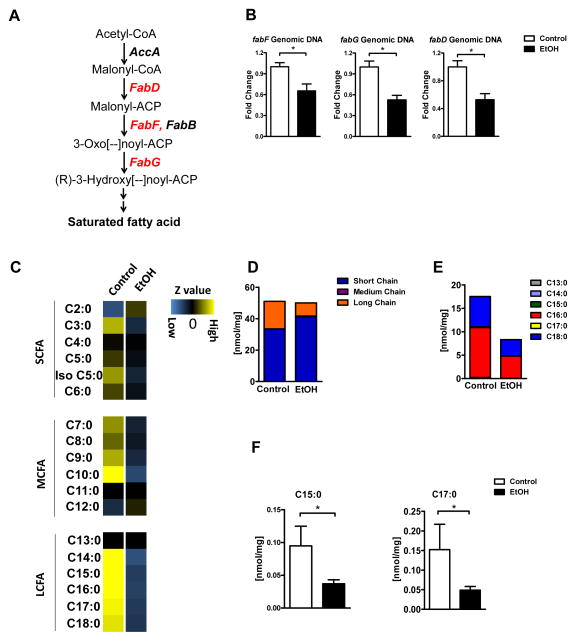
Figure 1
Figure 1. Chronic ethanol administration reduces bacterial biosynthesis of saturated LCFA
C57BL/6 mice were fed intragastric isocaloric (control) or alcohol diets for 3 weeks. (A) Fatty acid synthesis pathway: Metagenomic sequencing revealed a reduced proportion of bacterial genomic DNA (shown in red) containing genes involved in biosynthesis of saturated fatty acids. (B) Fold changes in genomic DNA containing malonyl CoA:ACP acyltransferase (fabD), 3-oxoacyl-[acyl-carrier-protein] synthase II (fabF) and 3-oxoacyl-[acyl-carrier protein] reductase (fabG), based on real-time PCR (n = 5). (C) Z value of each single fatty acid in the cecum of control (n = 3) and ethanol fed mice (n = 7). (D) Levels of saturated short-, medium-, and long-chain fatty acids in the cecum of control (n = 3) and ethanol-fed mice (n = 7). (E and F) Total levels of saturated LCFA, C15:0 and C17:0, in the cecum of control and ethanol-fed mice (n = 3 for control; n = 7 for ethanol). *p<0.05.
Figure 2
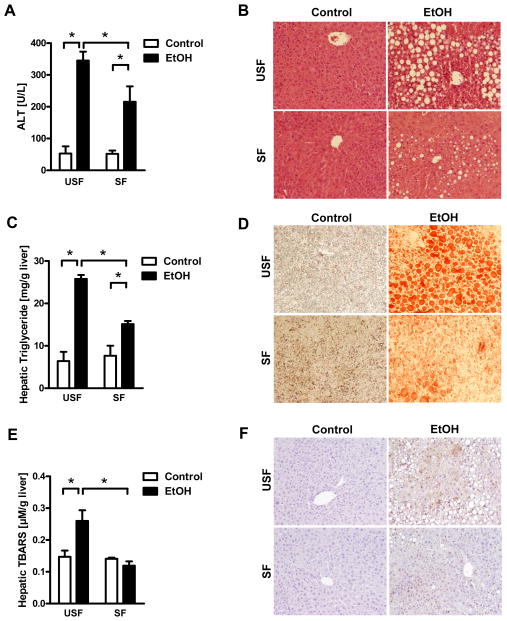
Figure 2. Supplementation of saturated fatty acids reduces ethanol-induced liver disease
C57BL/6 mice were fed saturated fatty acids (SF) or unsaturated fatty acids (USF) and received an intragastric isocaloric (n=3) or ethanol-containing (n=6–7) diet for 3 weeks. (A) Plasma levels of ALT. (B) Representative H&E stained liver sections. (C) Hepatic levels of triglyceride. (D) Representative Oil Red O-stained liver sections. (E) Hepatic levels of TBARS. (F) Representative liver sections stained for 4-HNE. *p<0.05.
Figure 3
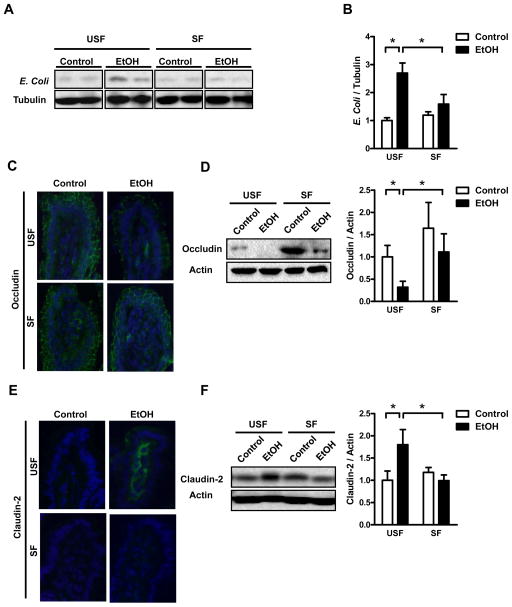
Figure 3. Saturated fatty acid supplementation suppresses alcohol-induced intestinal leakiness
C57BL/6 mice were fed saturated fatty acids (SF) or unsaturated fatty acids (USF) and received an intragastric isocaloric (n=3) or ethanol-containing (n=5–7) diet for 3 weeks. (A) Immunoblot analyses of hepatic tissues for E. coli. (B) Quantification of E. coli proteins normalized to α-tubulin. (C) Representative images of immunofluorescence analysis of occludin (green) in distal small intestine. Nuclei were stained with Hoechst (blue). (D) Immunoblot of occludin in the distal small intestine and quantification of occludin protein, normalized to β-actin. (E) Representative images of immunofluorescence analysis of claudin-2 (green) in distal small intestine. Nuclei were stained with Hoechst (blue). (F) Immunoblot of claudin-2 in the distal small intestine and quantification of claudin-2 protein, normalized to β-actin. *p<0.05.
Figure 4
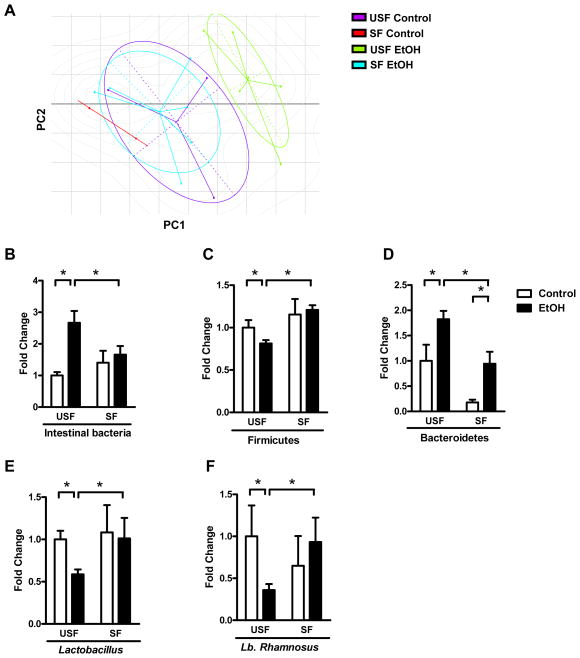
Figure 4. Supplementation of diet with saturated fatty acid reverses alcohol-induced dysbiosis
C57BL/6 mice were fed saturated fatty acids (SF) or unsaturated fatty acids (USF) and received intragastric isocaloric (n=2–3) or ethanol-containing (n=5–7) diets for 3 weeks. (A) Clusters of groups, based on 16S rRNA gene sequence analysis. Principal component analysis was performed on weighted and normalized P1 vs P2 UniFrac distances. PC: principal component. (B–F) Fold-differences between groups in proportions of the intestinal bacteria Firmicutes, Bacteroidetes, total Lactobacillus species and Lactobacillus (Lb.) rhamnosus in cecum of mice. *p<0.05.
Figure 5
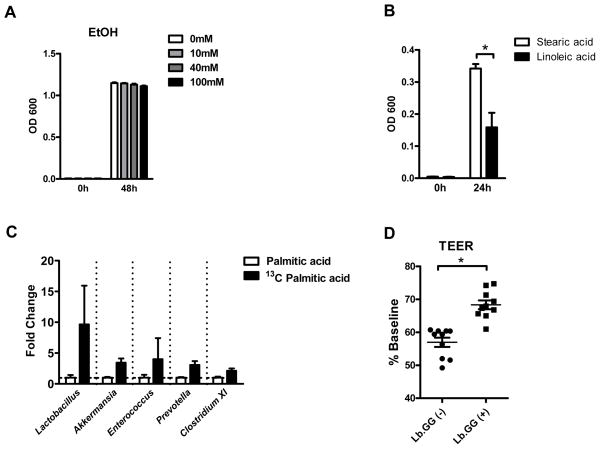
Figure 5. Lactobacillus rhamnosus metabolizes saturated fatty acids in vivo and prevents disruption of monolayers of Caco-2 cells by acetaldehyde
(A) Effect of ethanol on Lactobacillus rhamnosus growth in vitro (n = 3). (B) Effect of fatty acids on Lactobacillus rhamnosus growth in vitro (n = 4). (C) qPCR amplification of extracted C-labeled DNA following gavage with unlabeled palmitic acid or [1-13C] palmitic acid in vivo (n = 5–6). (D) TEER of monolayers of polarized Caco-2 cells incubated with acetaldehyde in the absence or presence of supernatants from cultures of Lactobacillus rhamnosus (n = 10). *p<0.05.
Figure 6
Figure 6. Alcohol abuse decreases bacterial genes that regulate fatty acid synthesis in humans
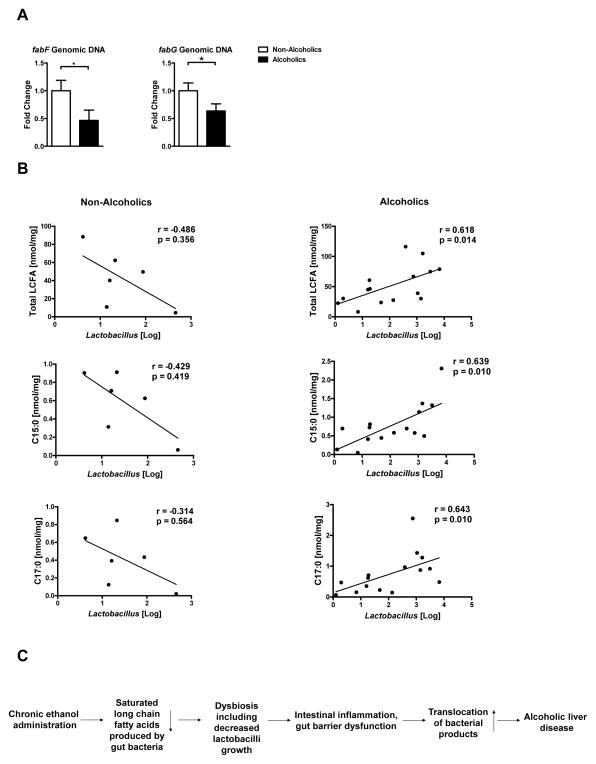
(A) Real-time PCR of genomic DNA for 3-oxoacyl-[acyl-carrier-protein] synthase II (fabF) and 3-oxoacyl-[acyl-carrier protein] reductase (fabG) in stool samples of healthy individuals (n = 6) and patients with alcohol abuse (n = 7–8). (B) Total fecal levels of LCFA, C15:0 and C17:0 were correlated with fecal amounts of Lactobacillus species in non-alcoholic individuals (left column; n= 6) and patients with active alcohol abuse (right column; n= 15). One patient sample was excluded from the analysis due to the very high amount of fecal lactobacilli and it was considered as true outlier. (C) Schematic representation of the proposed model: Chronic ethanol feeding reduced the capacity of intestinal bacteria to synthesize saturated LCFA in mice and humans. Dietary supplementation with saturated LCFA maintains eubiosis by preventing ethanol-induced overgrowth of intestinal bacterial and by increasing intestinal levels of probiotic lactobacilli. These bacteria appear to produce factors that promote intestinal barrier integrity. Reduced translocation of bacterial products decreases ethanol-induced liver damage in mice. *p<0.05.

Comment in

References

    1. Kim WR, Brown RS, Jr, Terrault NA, El-Serag H. Burden of liver disease in the United States: summary of a workshop. Hepatology. 2002;36:227–42. - PubMed
    1. Tilg H, Day CP. Management strategies in alcoholic liver disease. Nat Clin Pract Gastroenterol Hepatol. 2007;4:24–34. - PubMed
    1. Yan AW, Fouts DE, Brandl J, Starkel P, Torralba M, Schott E, et al. Enteric dysbiosis associated with a mouse model of alcoholic liver disease. Hepatology. 2011;53:96–105. - PMC - PubMed
    1. Hartmann P, Chen P, Wang HJ, Wang L, McCole DF, Brandl K, et al. Deficiency of intestinal mucin-2 ameliorates experimental alcoholic liver disease in mice. Hepatology. 2013;58:108–19. - PMC - PubMed
    1. Fouts DE, Torralba M, Nelson KE, Brenner DA, Schnabl B. Bacterial translocation and changes in the intestinal microbiome in mouse models of liver disease. J Hepatol. 2012;56:1283–92. - PMC - PubMed

MeSH terms