. 2014 Nov;64(6):433-43.
doi: 10.1007/s12576-014-0338-3. Epub 2014 Sep 20.

Insulin is involved in transcriptional regulation of NKCC and the CFTR Cl(-) channel through PI3K activation and ERK inactivation in renal epithelial cells

Affiliations

Insulin is involved in transcriptional regulation of NKCC and the CFTR Cl(-) channel through PI3K activation and ERK inactivation in renal epithelial cells

Hongxin Sun et al. J Physiol Sci. 2014 Nov.

Abstract

It is is well known that insulin stimulates glucose transport and epithelial Na(+) channel (ENaC)-mediated Na(+) reabsorption; however, the action of insulin on Cl(-) secretion is not fully understood. In this study, we investigated the action of insulin on Na(+)-K(+)-2Cl(-) cotransporter (NKCC)-mediated Cl(-) secretion in epithelial A6 cells. Interestingly, insulin treatment remarkably enhanced the forskolin-stimulated Cl(-) secretion associated with an increase in apical Cl(-) conductance by upregulating mRNA expression of both CFTR and NKCC, although insulin treatment alone had no effect on the basal Cl(-) secretion or apical Cl(-) conductance without forskolin application. We next elucidated a role of phosphoinositide 3-kinase (PI3K) in the insulin-induced enhancement of the Cl(-) secretion, since insulin actually activated PI3K, resulting in activation of Akt, a downstream molecule of PI3K. LY294002 (a PI3K inhibitor) reduced the Cl(-) secretion by suppressing mRNA expression of NKCC, whereas insulin still had a stimulatory action on mRNA expression of CFTR even in the presence of LY294002. On the other hand, we found that a MEK inhibitor (PD98059) further enhanced the insulin-stimulated CFTR mRNA expression and the Cl(-) secretion in forskolin-stimulated A6 cells and that insulin induced slight, transient activation of ERK followed by significant inactivation of ERK. These observations suggest that: (1) insulin respectively upregulates mRNA expression of NKCC and CFTR through activation of PI3K and inactivation of ERK; (2) insulin signals on mRNA expression of NKCC and CFTR are not enough to stimulate transepithelial Cl(-) secretion, but enhance the stimulatory action of cAMP on transepithelial Cl(-) secretion.


Figures
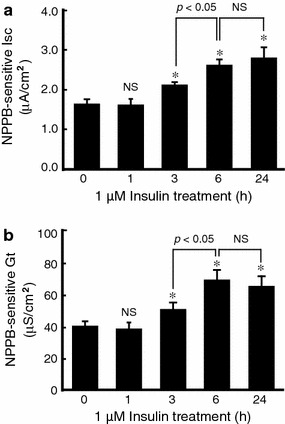
Fig. 1
Fig. 1
Time-dependent effect of insulin on forskolin-stimulated NPPB-sensitive Isc (a) and Gt (b) in A6 cells. After pretreating monolayer A6 cells with 1 μM insulin for 0, 1, 3, 6 and 24 h, 10 μM forskolin was applied to the apical and basolateral sites, and then NPPB-sensitive Isc and Gt were detected by the addition of 100 μM NPPB to the apical solution 60 min after application of forskolin. Data are presented as mean ± SEM. n = 5–7. *p < 0.05 vs. control (0 h; without insulin)
Fig. 2
Fig. 2
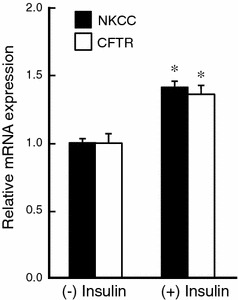
Effects of insulin on mRNA expression of NKCC and the CFTR Cl channel. A6 monolayers were treated with 1 μM insulin for 24 h, and then mRNA expression of NKCC and the CFTR Cl channel was detected by quantitative real-time PCR. Data are presented as mean ± SEM. n = 5–8. *p < 0.05 vs. insulin (−)
Fig. 3
Fig. 3
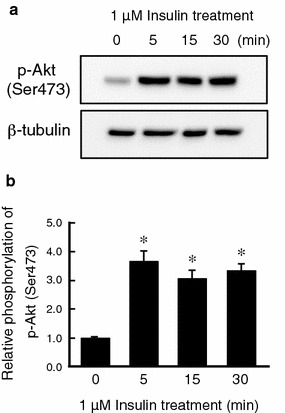
Effects of insulin on phosphorylation of Akt as an indicator of PI3K activity in A6 monolayered cells. a A6 monolayers were treated with 1 μM insulin for the indicated time, and then phosphorylation of Akt (p-Akt) at Ser473 was detected by immunoblotting with an anti-phospho Akt (Ser473)-specific antibody. b Relative amounts of phosphorylated Akt (p-Akt) at Ser473 are shown. Equal loading of cell lysate to each well was confirmed by measuring β-tubulin as an internal control. Data are presented as mean ± SEM. n = 3. *p < 0.05 vs. insulin (−)
Fig. 4
Fig. 4
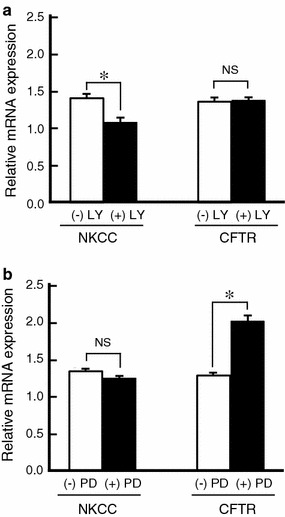
Effects of LY294002 (LY, a PI3K inhibitor, 30 μM) (a) and PD98059 (PD, a MEK inhibitor, 50 μM) (b) on insulin-induced mRNA expression of the NKCC and the CFTR Cl channel. After pretreatment with or without LY294002 or PD98059 for 1 h in the culture medium, A6 monolayers were incubated in the culture medium with or without 1 μM insulin in the presence or absence of LY294002 or PD98059 for 6 h. The mRNA expression of NKCC and CFTR was detected by real-time PCR. Relative amounts of mRNA expression of NKCC and the CFTR Cl channel were normalized to β-actin as an internal control. Amounts of mRNA expression of NKCC and the CFTR Cl channel in the absence of insulin are shown as 1.0; therefore, the relative amounts of mRNA expression of NKCC and the CFTR Cl channel shown here mean the insulin action on amounts of mRNA expression of NKCC and the CFTR Cl channel compared with those without insulin pretreatment. Data are presented as mean ± SEM. n = 5–8. NS, no significance; *p < 0.05
Fig. 5
Fig. 5
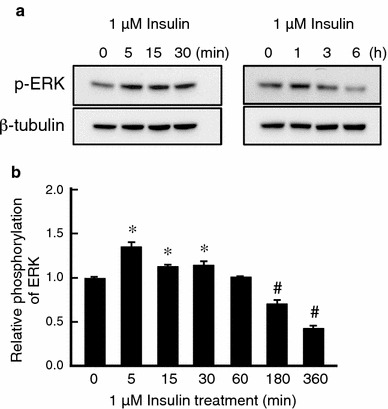
Effects of insulin on phosphorylation of ERK in A6 monolayered cells. a A6 monolayers were treated with 1 μM insulin for the indicated time, and then phosphorylation of ERK was detected by immunoblotting with an anti-phospho-ERK specific antibody. b Relative amounts of phosphorylated ERK are shown. Equal loading of cell lysate to each well was confirmed by measuring β-tubulin as an internal control. Data are presented as mean ± SEM. n = 3. * Significantly larger than that at 0 min (without insulin treatment) with p < 0.05. # Significantly smaller than that at 0 min (without insulin treatment) with p < 0.05
Fig. 6
Fig. 6
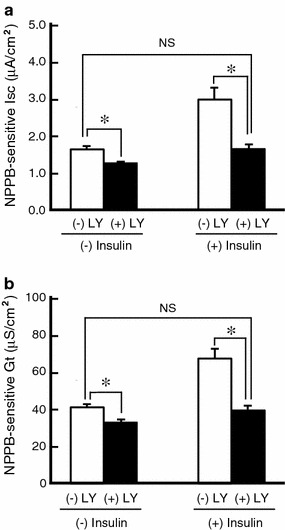
Effects of LY294002 (LY, a PI3K inhibitor, 30 μM) on forskolin-stimulated NPPB-sensitive Isc (a) and Gt (b) in A6 cells treated with or without insulin. After pretreatment with or without LY294002 for 1 h in the culture medium, A6 monolayers were incubated in the medium with or without 1 μM insulin in the presence or absence of LY294002 for 6 h. After each treatment, 10 μM forskolin was applied, and then NPPB-sensitive Isc and Gt were measured by adding NPPB 60 min after the application of forskolin. Data are presented as mean ± SEM. n = 5–8. *p < 0.05
Fig. 7
Fig. 7
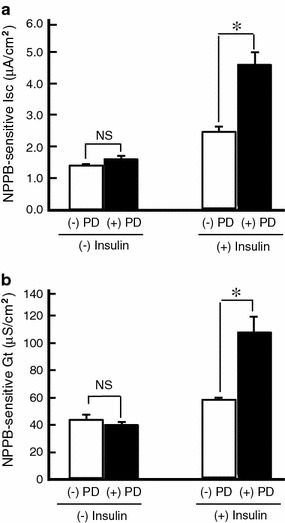
Effects of PD98059 (PD, a MEK inhibitor, 50 μM) on forskolin-stimulated NPPB-sensitive Isc (a) and Gt (b) in A6 cells treated with or without insulin. After pretreatment with or without 50 μM PD98059 for 1 h in the culture medium, A6 monolayers were incubated in the medium with or without 1 μM insulin for 6 h in the presence or absence of PD98059. After each treatment, 10 μM forskolin was applied, and then NPPB-sensitive Isc and Gt were measured by adding NPPB 60 min after application of forskolin. Data are presented as mean ± SEM. n = 5–8. *p < 0.05
Fig. 8
Fig. 8
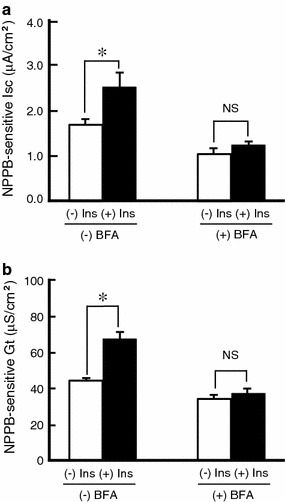
Effects of brefeldin A (BFA) on forskolin-stimulated Cl secretion (a) and conductance (b) in A6 cells treated with or without insulin. After pretreatment with or without 1 μM insulin for 5 h in the culture medium, A6 monolayers were incubated in the medium with or without 5 μg/ml BFA in the presence or absence of insulin for 1 h. After each treatment, A6 monolayers were incubated with 10 μM forskolin under each condition without insulin, and then NPPB-sensitive Isc and Gt were measured by adding NPPB 60 min after application of forskolin. Data are presented as mean ± SEM. n = 4. Ins insulin, NS no significance; *p < 0.05
Fig. 9
Fig. 9
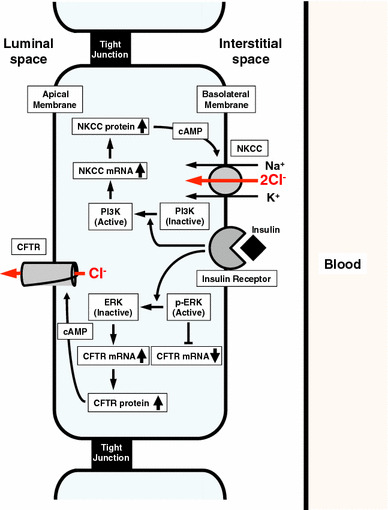
Summary of insulin action on NKCC and CFTR participating in epithelial Cl secretion in epithelial A6 cells. (1) Insulin activates PI3K, resulting in stimulation of NKCC mRNA expression. (2) Insulin inactivates ERK, which suppresses CFTR mRNA expression. Insulin-induced inactivation of ERK releases suppression of CFTR mRNA expression, leading to elevation of CFTR mRNA expression. Both elevation of mRNA expression of NKCC and CFTR induced by insulin stimulates expression of NKCC and CFTR proteins, which stay in cytosolic store sites. cAMP stimulates translocation of insulin-induced NKCC and CFTR proteins staying in cytosolic store sites, leading to much larger epithelial Cl secretion associated with much larger elevation of CFTR activity than that under the insulin-untreated condition

References

    1. Bachmann O, Juric M, Seidler U, Manns MP, Yu H. Basolateral ion transporters involved in colonic epithelial electrolyte absorption, anion secretion and cellular homeostasis. Acta Physiol (Oxf) 2011;201:33–46. doi: 10.1111/j.1748-1716.2010.02153.x. - DOI - PubMed
    1. Hong JH, Park S, Shcheynikov N, Muallem S. Mechanism and synergism in epithelial fluid and electrolyte secretion. Pflugers Arch. 2014;466:1487–1499. doi: 10.1007/s00424-013-1390-1. - DOI - PMC - PubMed
    1. Marunaka Y. Importance of expression and function of angiotensin II receptor type 1 in pulmonary epithelial cells. Respir Physiol Neurobiol. 2014;196:39–42. doi: 10.1016/j.resp.2014.02.013. - DOI - PubMed
    1. Marunaka Y (2014) Characteristics and pharmacological regulation of epithelial Na+ channel (ENaC) and epithelial Na+ transport. J Pharmacol Sci. (in press). - PubMed
    1. Ikehara O, Hayashi H, Waguri T, Kaji I, Karaki S, Kuwahara A, Suzuki Y. Subepithelial trypsin induces enteric nerve-mediated anion secretion by activating proteinase-activated receptor 1 in the mouse cecum. J Physiol Sci. 2012;62:211–219. doi: 10.1007/s12576-012-0198-7. - DOI - PMC - PubMed

Publication types

MeSH terms