. 2014 Dec;35(12):2698-705.
doi: 10.1093/carcin/bgu203. Epub 2014 Sep 19.

Genetic polymorphisms in the 9p21 region associated with risk of multiple cancers

Affiliations

Genetic polymorphisms in the 9p21 region associated with risk of multiple cancers

Wen-Qing Li et al. Carcinogenesis. 2014 Dec.

Abstract

The chromosome 9p21 region has been implicated in the pathogenesis of multiple cancers. We analyzed 9p21 single nucleotide polymorphisms (SNPs) from eight genome-wide association studies (GWAS) with data deposited in dbGaP, including studies of esophageal squamous cell carcinoma (ESCC), gastric cancer (GC), pancreatic cancer, renal cell carcinoma (RCC), lung cancer (LC), breast cancer (BrC), bladder cancer (BC) and prostate cancer (PrC). The number of subjects ranged from 2252 (PrC) to 7619 (LC). SNP-level analyses for each cancer were conducted by logistic regression or random-effects meta-analysis. A subset-based statistical approach (ASSET) was performed to combine SNP-level P values across multiple cancers. We calculated gene-level P values using the adaptive rank truncated product method. We identified that rs1063192 and rs2157719 in the CDKN2A/2B region were significantly associated with ESCC and rs2764736 (3' of TUSC1) was associated with BC (P ≤ 2.59 × 10(-6)). ASSET analyses identified four SNPs significantly associated with multiple cancers: rs3731239 (CDKN2A intronic) with ESCC, GC and BC (P = 3.96 × 10(-) (4)); rs10811474 (3' of IFNW1) with RCC and BrC (P = 0.001); rs12683422 (LINGO2 intronic) with RCC and BC (P = 5.93 × 10(-) (4)) and rs10511729 (3' of ELAVL2) with LC and BrC (P = 8.63 × 10(-) (4)). At gene level, CDKN2B, CDKN2A and CDKN2B-AS1 were significantly associated with ESCC (P ≤ 4.70 × 10(-) (5)). Rs10511729 and rs10811474 were associated with cis-expression of 9p21 genes in corresponding cancer tissues in the expression quantitative trait loci analysis. In conclusion, we identified several genetic variants in the 9p21 region associated with the risk of multiple cancers, suggesting that this region may contribute to a shared susceptibility across different cancer types.


Figures

Fig. 1.
Fig. 1.
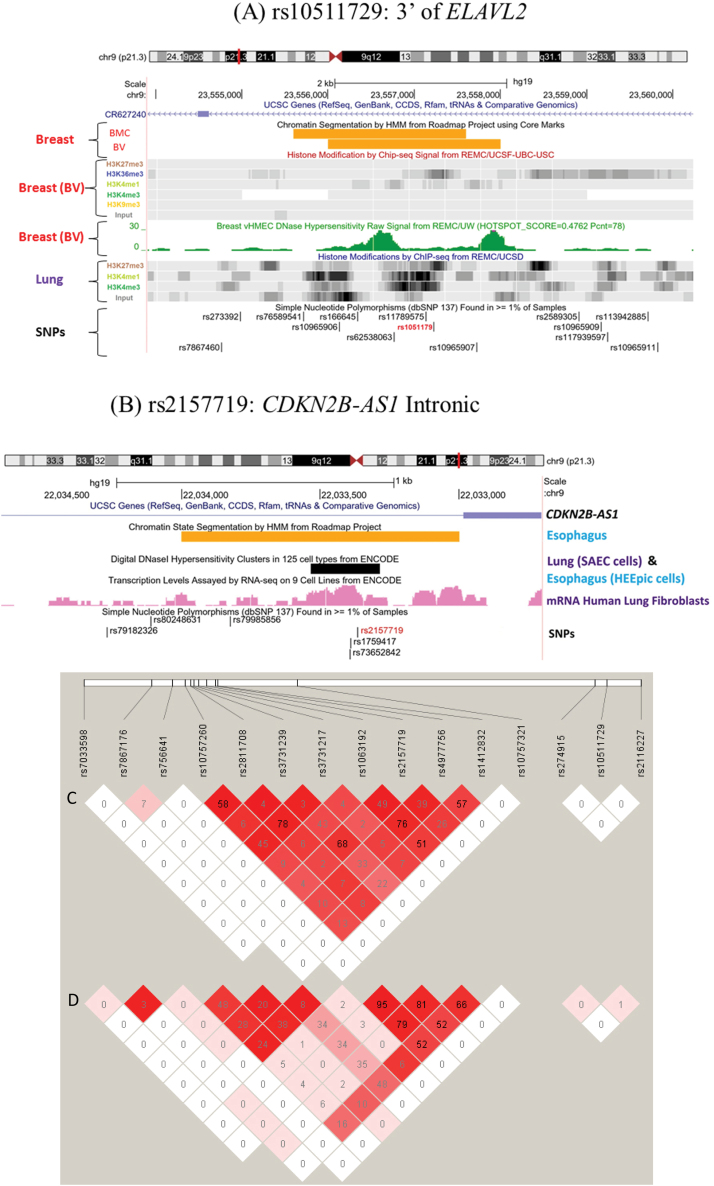
SNP function annotation using UCSC Genome Browser and LD structure of rs10511729 and rs2157719. (A) UCSC Genome Browser image of 3′ region of ELAVL2 on human assembly hg19 showing 9p21 region, UCSC Genes, Roadmap Chromatin State Segmentation by a Hidden Markov Model (HMM) and core marks for Roadmap breast myoepithelial cells and breast variant human mammary epithelial cells, histone marks H3K27me3, H3K36me3, H3K4me1, H3K4me3 and H3K9me3 in Bv cells, DNaseI sites in Bv cells, histone marks H3K27ac, H3K4me1, H3K4me3 and H3K9me3 in Roadmap lung cells and dbSNP 137 track on the left hand scale. The SNP rs10511729 is colored red. The HMM utilizes computationally integrated ChIP-seq data for 5/6 core marks (H3K27me3, H3K36me3, H3K4me1, H3K4me3, H3K9ac, H3K9me3) + H3K27ac with the associated yellow segment color indicating a weak enhancer annotation for the overlapping SNP region in normal breast cells. The overlapping SNP region is also bordered by two separate DNaseI peaks in normal breast epithelial cells. In normal lung cells, histone marks (H3K27ac, H3K4me1 and H3K4me3) which are associated with active enhancers were also observed for the overlapping region, suggesting rs10511729 is contained within a potential regulatory region in breast and lung tissues. (B) UCSC genome Browser image of intronic region of CDKN2B-AS1 on human assembly hg19 showing 9p21 region, ENCODE/GENCODE V17 gene annotation, UCSC Genes, Roadmap Chromatin State Segmentation by a HMM for Roadmap normal esophageal cells, DNaseI sites/cluster for 8/125 ENCODE cell lines, RNA-seq in ENCODE normal Human Lung Fibroblasts and dbSNP 137 on the right hand scale. The SNP rs2157719 is colored red. The associated yellow segment color for HMM indicates a weak enhancer annotation for the overlapping SNP region in Roadmap normal esophageal cells. The rs2157719 containing region also overlaps with a strong DNaseI cluster in a number of ENCODE cells lines including small airway epithelial cells (SAEC) and esophageal epithelial cells (HEEpic) cells suggesting rs2157719 is contained within a potential regulatory region in esophageal and lung (bronchiole) tissues. (C) The LD structures of rs10511729 and rs2157719 among controls of Chinese in the ESCC study. Only SNPs with P value <0.001 for at least one cancer or P value <0.01 for at least two cancers, that locate <500kb apart from rs10511729 and rs2157719, were analyzed. (D) The LD structures of rs10511729 and rs2157719 among controls of Caucasian in the LC study. Only SNPs with P value <0.001 for at least one cancer or P value <0.01 for at least two cancers, that locate less than 500kb apart from rs10511729 and rs2157719, were analyzed. The LD structures of these two SNPs among controls of Caucasians in the BrC study are very similar. BMC, breast human mammary epithelial cells; BV, breast myoepithelial cells.

References

    1. Chung C.C., et al. (2011). Current status of genome-wide association studies in cancer. Hum. Genet., 130, 59–78. - PubMed
    1. Gu F., et al. (2013). Common genetic variants in the 9p21 region and their associations with multiple tumours. Br. J. Cancer, 108, 1378–1386. - PMC - PubMed
    1. Jin G., et al. (2012). Genetic variants at 6p21.1 and 7p15.3 are associated with risk of multiple cancers in Han Chinese. Am. J. Hum. Genet., 91, 928–934. - PMC - PubMed
    1. Garcia-Closas M., et al. ; Australian Ovarian Cancer Management Group; Kathleen Cuningham Foundation Consortium for Research into Familial Breast Cancer. (2008). Heterogeneity of breast cancer associations with five susceptibility loci by clinical and pathological characteristics. PLoS Genet., 4, e1000054. - PMC - PubMed
    1. Hu N., et al. (2004). High frequency of CDKN2A alterations in esophageal squamous cell carcinoma from a high-risk Chinese population. Genes. Chromosomes Cancer, 39, 205–216. - PubMed

Publication types

Substances