. 2014 Sep 21:12:266.
doi: 10.1186/s12967-014-0266-2.

Curcumin inhibits EMMPRIN and MMP-9 expression through AMPK-MAPK and PKC signaling in PMA induced macrophages

Curcumin inhibits EMMPRIN and MMP-9 expression through AMPK-MAPK and PKC signaling in PMA induced macrophages

Jiatian Cao et al. J Transl Med. .

Abstract

In coronary arteries, plaque disruption, the major acute clinical manifestations of atherosclerosis, leads to a subsequent cardiac event, such as acute myocardial infarction (AMI) and unstable angina pectoris (UA). Numerous reports have shown that high expression of MMP-9 (matrix metalloproteinase-9), MMP-13 (matrix metalloproteinase-13) and EMMPRIN (extracellular matrix metalloproteinase induce) in monocyte/macrophage results in the plaque progression and destabilization. Curcumin exerts well-known anti-inflammatory and antioxidant effects and probably has a protective role in the atherosclerosis. The purpose of our study was to investigate the molecular mechanisms by which curcumin affects MMP-9, MMP13 and EMMPRIN in PMA (phorbol 12-myristate 13-acetate) induced macrophages. Human monocytic cells (THP-1 cells) were pretreated with curcumin or compound C for 1 h, and then induced by PMA for 48 h. Total RNA and proteins were collected for real-time PCR and Western blot analysis, respectively. In the present study, the exposure to curcumin resulted in attenuated JNK, p38, and ERK activation and decreased expression of MMP-9, MMP-13 and EMMPRIN in PMA induced macrophages. Moreover, we demonstrated that AMPK (AMP-activated protein kinase) and PKC (Protein Kinase C) was activated by PMA during monocyte/macrophage differentiation. Furthermore, curcumin reversed PMA stimulated PKC activation and suppressed the chronic activation of AMPK, which in turn reduced the expression of MMP-9, MMP-13 and EMMPRIN. Therefore, it is suggested that curcumin by inhibiting AMPK-MAPK (mitogen activated protein kinase) and PKC pathway may led to down-regulated EMMPRIN, MMP-9 and MMP-13 expression in PMA-induced THP-1 cells.


Figures
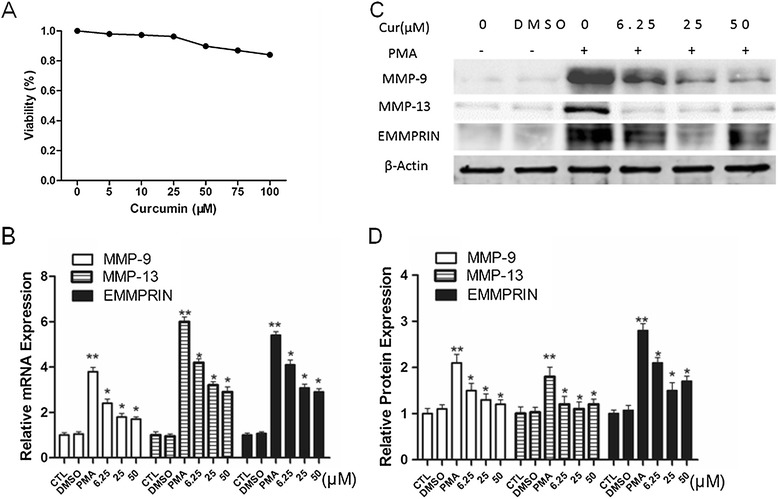
Figure 1
Figure 1
Curcumin suppresses MMP-9, MMP13 and EMMPRIN expression in PMA induced macrophages. A. Effect of curcumin on cell viability. PMA-induced macrophages were treated with indicated concentrations of curcumin (5–100 μM) for 48 h, and cell viability was assessed using the CCK-8 assay. Cells incubated in a medium without curcumin were defined as a control and were considered 100% viable. B-D. Curcumin suppresses EMMPRIN, MMP-9 and MMP13 expression in PMA-induced macrophages. The mRNA level and protein level were measured by Real-time PCR and Western blot, respectively. *P < 0.05 vs PMA group, **P < 0.05 vs CTL group. CTL indicates that cells incubated in a medium without curcumin. 6.25 μM, 25 μM, 50 μM indicates that THP-1 cells were pretreated with indicated concentrations of curcumin before stimulating with 100 nM PMA for another 48 h. Cur: curcumin.
Figure 2
Figure 2
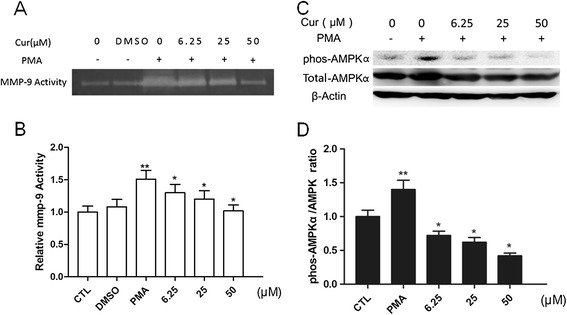
Curcumin suppresses the activation of MMP-9 and chronic AMPK activation. A-B. Effect of curcumin on the activity of MMP-9 from cultured supernatant. THP-1 cells were pretreated with curcumin before stimulating with PMA (100 nM) for another 48 h. MMP-9 activities were detected by gelatin zymography assay (A), and the corresponding densitometric measurement was shown in B. Cur: curcumin. C-D. Effect of curcumin on total AMPK and phospho-AMPKα (Thr172). Differentiated THP-1 cells were treated with indicated agents and assayed by Western blot using indicated antibodies (C), and the corresponding densitometric measurement was shown in D. *P < 0.05 vs PMA group, **P < 0.05 vs CTL group.
Figure 3
Figure 3
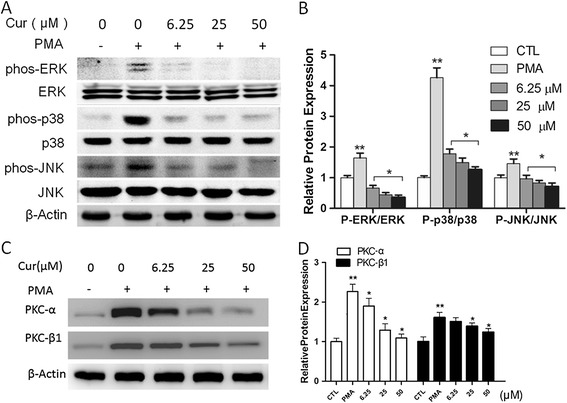
Curcumin inhibits JNK, ERK, and p38 phosphorylation and PKC pathway. A. Differentiated THP-1 cells were treated with indicated agents, and assayed by Western blot using indicated antibodies. Cells were pretreated with vehicle or curcumin at the indicated concentration (5–50 μM) for 1 h, followed by PMA for 48 h. B. Protein quantification was carried out by densitometric analysis. Normalized proteins of JNK, p-JNK, ERK, p-ERK, p38 and p-p38 were normalized based on the internal control β-actin. C. Expression of PKC-α and PKC-β1,cells were pretreated with vehicle or curcumin at the indicated concentration (5–50 μM) for 1 h, followed by PMA for 48 h. D. Densitometry measurements of protein analysis. The mean density values of PKC-αand PKC-β1 are expressed as ratios relative to that of β-actin. *P < 0.05 vs PMA group, **P < 0.05 vs CTL group.
Figure 4
Figure 4
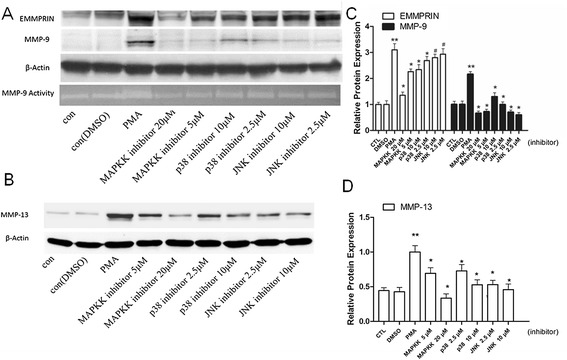
PMA induced EMMPRIN, MMP-9 and MMP13 expression by macrophages is blocked by a specific ERK, p38 and/or JNK inhibitors. A-B. The addition of a specific ERK inhibitor (PD98059, 5 and 20 μM), p38 inhibitor (SB203580, 2.5 and 10 μM) completely blocks PMA-induced MMP-9 protein expression and activation, and p38-specific inhibitor showed weaker function. ERK1/2 and p38-specific inhibitor inhibitor significantly decreased EMMPRIN expression, whereas JNK specific inhibitor showed no inhibitory effect. C-D. ERK1/2, p38 and JNK-specific inhibitor at high dose showed remarkable inhibitory effect on MMP-13 expression. *P < 0.05 vs PMA group, #P >0.05 vs PMA group.
Figure 5
Figure 5
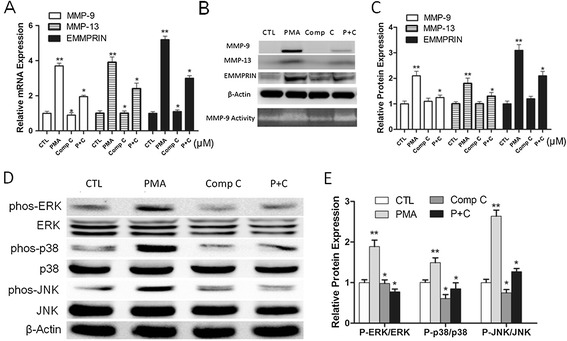
AMPK inhibitor mediated EMMPRIN, MMP-9 and MMP13 expression inhibition depends on the activation of MAPK pathway. A-C. Compound C, AMPK inhibitor, significantly inhibits EMMPRIN, MMP-9 and MMP13 expression in PMA induced THP-1 cells. Cells were pretreated with vehicle or Compound C (10 μM) for 1 h, followed by PMA for 48 h. The mRNA level of EMMPRIN, MMP-9 and MMP13 was determined by qPCR (A), and protein level was determined by Western blot (B) and quantified by densitometric analysis (C). Comp C indicates group treated with compound C; P + C indicates group treated with both PMA and compound C. D-E. Compound C inhibited the activation of MAPK pathway. Differentiated THP-1 cells were treated with indicated agents, and assayed by Western blot using indicated antibodies (D) and quantified by densitometric analysis (E). *P < 0.05 vs PMA group, **P < 0.05 vs CTL group.
Figure 6
Figure 6
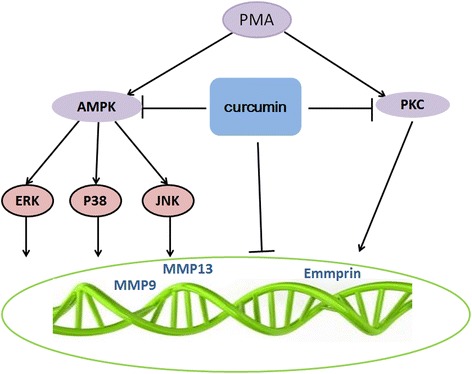
Model for regulation of MMP-9, MMP-13 and EMMPRIN by curcumin. PMA induced EMMPRIN, MMP-9 and MMP13 expression by macrophages through AMPK and PKC pathway.Curcumin attenuates expression of MMP-9, MMP-13 and EMMPRIN by inhibiting the activation of AMPK and PKC pathway.

References

    1. Joghetaei N, Stein A, Byrne RA, Schulz C, King L, May AE, Schmidt R. The Extracellular Matrix Metalloproteinase Inducer (EMMPRIN, CD147) - a potential novel target in atherothrombosis prevention? Thromb Res. 2013;131:474–480. doi: 10.1016/j.thromres.2013.04.017. - DOI - PubMed
    1. Zhu X, Song Z, Zhang S, Nanda A, Li G. CD147: a novel modulator of inflammatory and immune disorders. Curr Med Chem. 2014;21:2138–2145. doi: 10.2174/0929867321666131227163352. - DOI - PubMed
    1. Kim JY, Kim WJ, Kim H, Suk K, Lee WH. The Stimulation of CD147 Induces MMP-9 Expression through ERK and NF-kappaB in Macrophages: Implication for Atherosclerosis. IImmune Netw. 2009;9:90–97. doi: 10.4110/in.2009.9.3.90. - DOI - PMC - PubMed
    1. Yang D, Wang J, Ni J, Shang S, Liu L, Xiang J, Li C. Temporal expression of metalloproteinase-8 and −13 and their relationships with extracellular matrix metalloproteinase inducer in the development of ligature-induced periodontitis in rats. J Periodontal Res. 2013;48:411–419. doi: 10.1111/jre.12019. - DOI - PubMed
    1. Lizarbe TR, Tarin C, Gomez M, Lavin B, Aracil E, Orte LM, Zaragoza C. Nitric oxide induces the progression of abdominal aortic aneurysms through the matrix metalloproteinase inducer EMMPRIN. Am J Pathol. 2009;175:1421–1430. doi: 10.2353/ajpath.2009.080845. - DOI - PMC - PubMed

Publication types

MeSH terms