


Paternal Autonomy Restriction, Neighborhood Safety, and Child Anxiety Trajectory in Community Youth
- PMID: 25242837
- PMCID: PMC4165086
- DOI: 10.1016/j.appdev.2014.04.006
Paternal Autonomy Restriction, Neighborhood Safety, and Child Anxiety Trajectory in Community Youth
Abstract
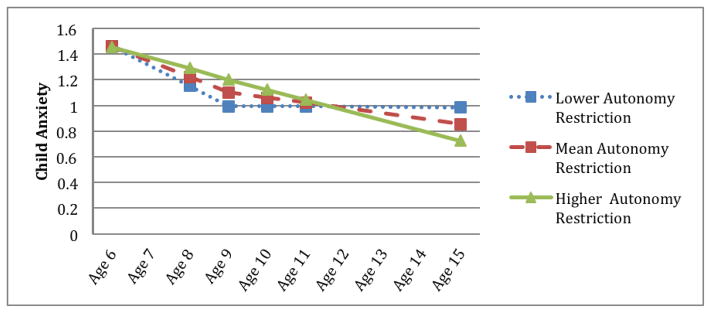
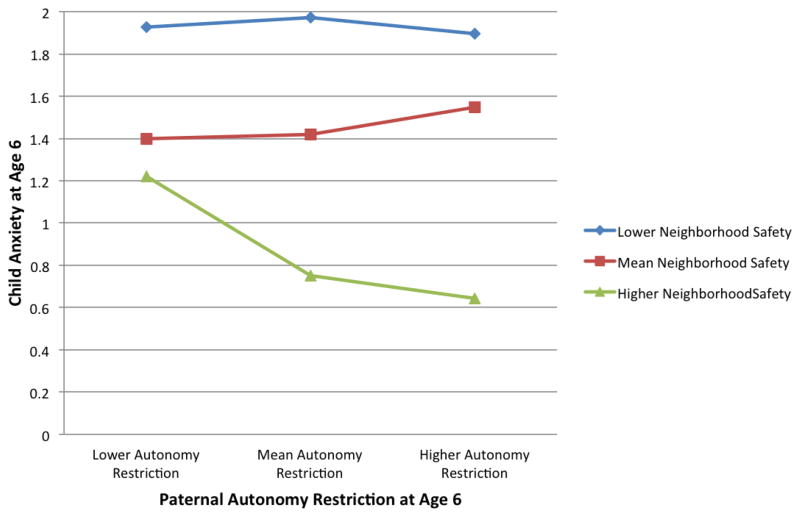
Intrusive parenting, primarily examined among middle to upper-middle class mothers, has been positively associated with the presence and severity of anxiety in children. This study employed cross-sectional linear regression and longitudinal latent growth curve analyses to evaluate the main and interactive effects of early childhood paternal autonomy restriction (AR) and neighborhood safety (NS) on the trajectory of child anxiety in a sample of 596 community children and fathers from the NICHD SECYD. Longitudinal analyses revealed that greater paternal AR at age 6 was actually associated with greater decreases in child anxiety in later childhood. Cross-sectional analyses revealed main effects for NS across childhood, and interactive effects of paternal AR and NS that were present only in early childhood, whereby children living in safer neighborhoods demonstrated increased anxiety when experiencing lower levels of paternal AR. Findings further clarify for whom and when paternal AR impacts child anxiety in community youth.
Keywords: autonomy; child anxiety; father; latent growth modeling; neighborhood safety.
Figures

References
-
- Achenbach TM. Manual for the Child Behavior Checklist/4–18 and profile. Burlington, VT: University of Vermont, Department of Psychiatry; 1991.
-
- Allhusen V, Appelbaum M, Belsky J, Booth CL, Bradley R, Brownell C, Weinraub M. Nonmaternal care and family factors in early development: An overview of the NICHD Study of Early Child Care. Journal of Applied Developmental Psychology. 2001;22:457–492. doi: 10.1016/s0193-3973(01)00092-2. - DOI
Publication types
Grants and funding
LinkOut - more resources
Full Text Sources
Other Literature Sources
Research Materials
Miscellaneous