


doi: 10.1002/adma.200900018.
Light-Induced Content Release from Plasmon Resonant Liposomes
Affiliations
- PMID: 25242864
- PMCID: PMC4166531
- DOI: 10.1002/adma.200900018
Item in Clipboard
Light-Induced Content Release from Plasmon Resonant Liposomes
Adv Mater.
.
No abstract available
Keywords: Biomedical Materials; Core/Shell Materials; Hybrid Materials; Nanostructures; Optically Active Materials.
Figures
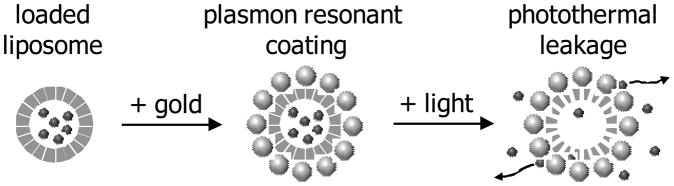
Schematic representation of the formation of plasmon resonant shell and subsequent content release. A water-soluble agent is encapsulated in thermosensitive liposomes. Gold coating is introduced by reduction of ionic gold in the presence of liposomes. The density with which gold clusters are produced on the liposome surface controls the spectral position of resulting plasmon resonance. When illuminated at the wavelength matching plasmon resonance, the energy of absorbed light is converted into heat so the thermosenstive liposomes release their content.
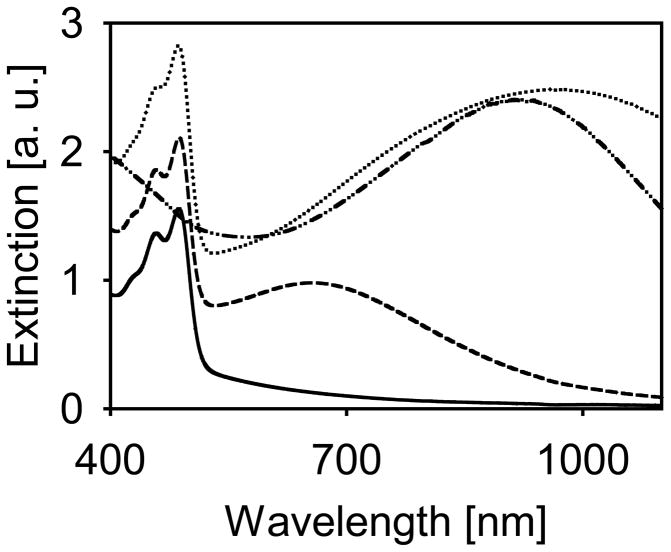
Extinction spectra of liposome preparations. Bare liposome suspension loaded with fluorescein (solid), gold-coated liposome suspension resonant at 655 nm loaded with fluorescein (dashed), gold-coated liposome suspension resonant at 971 nm loaded with fluorescein (dotted), gold-coated liposome suspension without fluorescein (dash-dot).
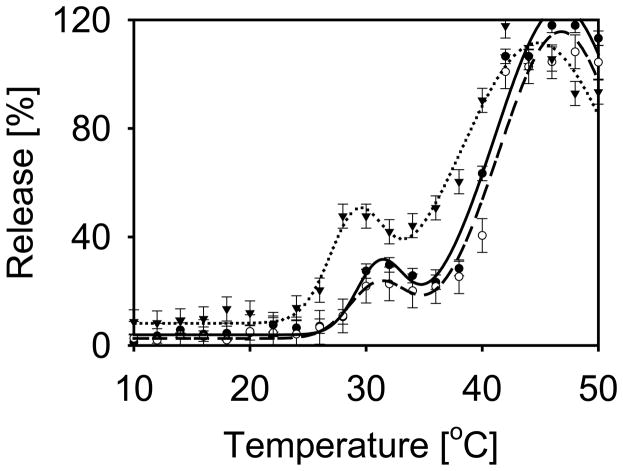
Liposome content release induced by temperature. Data and fitted curves are shown for bare liposomes (inverted triangle, dotted), gold-coated liposomes resonant at 655 nm (open circle, dashed), and gold-coated liposomes resonant at 971 nm (closed circle, solid line). The data were modeled with a sum of two Gaussian functions yielding initial release at 29 and 31 °C for bare liposomes and coated liposomes, respectively. The level of initial release was 35, 24, and 19 % from uncoated, on-resonant, and off-resonant liposome suspensions respectively. Complete release was observed at 45 and 47 °C for bare liposomes and coated liposomes, respectively. Error bars represent average of the three standard deviations acquired at 6, 24 and 46 °C.
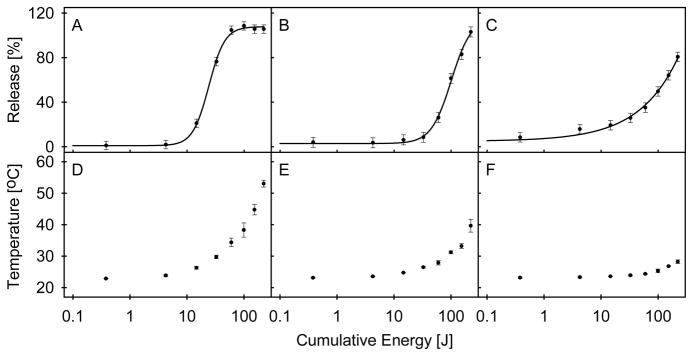
(A–C) Light-induced release of liposome contents. Data and fitted curves are shown for gold-coated liposomes resonant at 971 nm (A), 655 nm (B), and bare liposomes (C). The response of each liposome type to light was modeled with a four-parameter logistic function, with 50 % release observed at 12, 84, and 100 J of cumulative energy for on-resonant, off-resonant and non-coated liposome suspensions respectively. Error bars represent the average of the three standard deviations acquired at cumulative energy levels of 0.38, 14.65, and 221.9 J. (D–F) Peak temperatures recorded during light induced release, for gold-coated liposomes resonant at 971 nm (D), 655 nm (E), and bare liposomes (F) is shown. Error bars represent the standard deviations at cumulative energy levels of three trials.
References
Grants and funding
LinkOut - more resources
Full Text Sources
Other Literature Sources
