


The DOMUS study protocol: a randomized clinical trial of accelerated transition from oncological treatment to specialized palliative care at home
- PMID: 25242890
- PMCID: PMC4169691
- DOI: 10.1186/1472-684X-13-44
The DOMUS study protocol: a randomized clinical trial of accelerated transition from oncological treatment to specialized palliative care at home
Abstract
Background: The focus of Specialized Palliative Care (SPC) is to improve care for patients with incurable diseases and their families, which includes the opportunity to make their own choice of place of care and ultimately place of death. The Danish Palliative Care Trial (DOMUS) aims to investigate whether an accelerated transition process from oncological treatment to continuing SPC at home for patients with incurable cancer results in more patients reaching their preferred place of care and death. The SPC in this trial is enriched with a manualized psychological intervention.
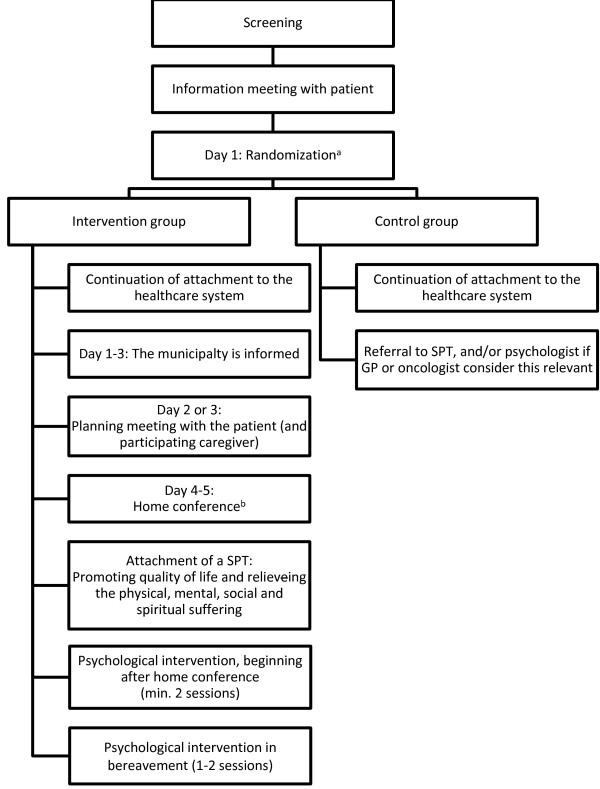
Methods/design: DOMUS is a controlled randomized clinical trial with a balanced parallel-group randomization (1:1). The planned sample size is 340 in- and outpatients treated at the Department of Oncology at Copenhagen University Hospital. Patients are randomly assigned either to: a) standard care plus SPC enriched with a standardized psychological intervention for patients and caregivers at home or b) standard care alone. Inclusion criteria are incurable cancer with no or limited antineoplastic treatment options.
Discussion: Programs that facilitate transition from hospital treatment to SPC at home for patients with incurable cancer can be a powerful tool to improve patients' quality of life and support family/caregivers during the disease trajectory. The present study offers a model for achieving optimal delivery of palliative care in the patient's preferred place of care and attempt to clarify challenges.
Trial registration: Clinicaltrials.gov Identifier: NCT01885637.
Keywords: Cancer; Home care services; Palliative treatment; Patient care; Randomized controlled trial; Specialized palliative care.
Figures
References
-
- OECD/European Union. Health at a Glance. Europe: OECD Publishing; 2010.
Associated data
LinkOut - more resources
Full Text Sources
Other Literature Sources
Medical
