. 2014 Sep 19;6(9):3487-99.
doi: 10.3390/v6093487.

Fitness impaired drug resistant HIV-1 is not compromised in cell-to-cell transmission or establishment of and reactivation from latency

Affiliations

Fitness impaired drug resistant HIV-1 is not compromised in cell-to-cell transmission or establishment of and reactivation from latency

Sophie M Bastarache et al. Viruses. .

Abstract

Both the presence of latently infected cells and cell-to-cell viral transmission are means whereby HIV can partially evade the inhibitory activities of antiretroviral drugs. The clinical use of a novel integrase inhibitor, dolutegravir (DTG), has established hope that this compound may limit HIV persistence, since no treatment-naïve patient treated with DTG has yet developed resistance against this drug, even though a R263K substitution in integrase confers low-level resistance to this drug in tissue culture. Here, we have studied the impact of R263K on HIV replication capacity and the ability of HIV to establish or be reactivated from latency and/or spread through cell-to-cell transmission. We affirm that DTG-resistant viruses have diminished capacity to replicate and establish infection. However, DTG-resistant viruses were efficiently transmitted via cell-to-cell contacts, and were as likely to establish and be reactivated from latent infection as wildtype viruses. Both cell-to-cell transmission of HIV and the establishment of and reemergence from latency are important for the establishment and maintenance of viral reservoirs. Since the DTG and other drug-resistant viruses studied here do not seem to have been impaired in regard to these activities, studies should be undertaken to characterize HIV reservoirs in patients who have been treated with DTG.


Figures
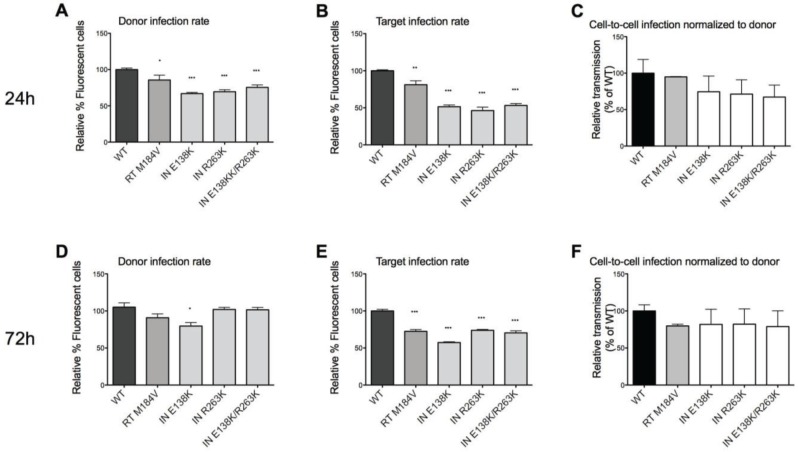
Figure 1
Figure 1
Cell-to-cell transmission by WT and drug-resistant viruses. (A,D) Relative reporter virus GFP expression of infected donor cells prior to co-culture for 24 h or 72 h respectively, compared to WT. Mutant viruses were less infectious than WT. (B,E) Relative reporter virus GFP expression of infected target cells after co-culture for 24 h or 72 h, respectively, compared to WT. Fewer target cells were infected with the mutant viruses than with WT. (C,F) Relative proportion of cells infected via cell-to-cell transmission by measurement of GFP expression by reporter virus after 24- or 72-h co-culture, respectively. No statistical differences in the rates of cell-to-cell transmission were observed between the different viruses. Relative expression of GFP in target cells compared to WT after the co-culture was assessed on the basis of relative expression of GFP in donor cells compared to WT prior to co-culture. Statistically significant differences between drug-resistant mutated viruses and WT viruses are indicated. The absence of an asterix indicates no statistical difference from WT. Error bars represent standard error of the mean (SEM, four independent experiments were performed for 24 h co-culture, two independent experiments were performed for 72 h co-culture. All experiments were performed in triplicate).
Figure 2
Figure 2
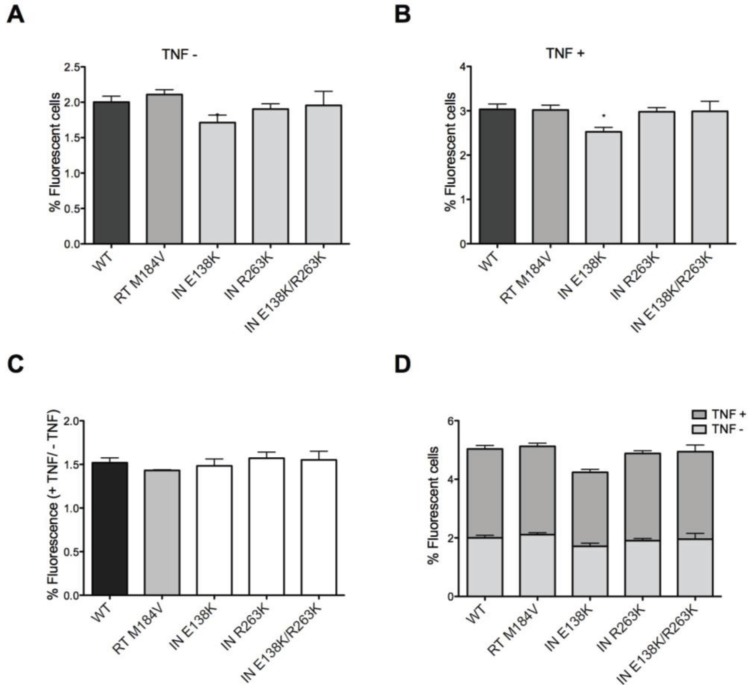
Establishment of and reactivation from latency by WT and drug-resistant viruses. (A) Expression of GFP reporter virus in Jurkat cells cultured in the presence of DRV after 7-days of infection. GFP expression in this experiment represents the background of actively replicating viruses that have not achieved latency. No statistically significant differences were observed between the various viruses; (B) Expression of GFP reporter virus in Jurkat cells grown in the presence of DRV for 7-days after infection, following overnight TNFα treatment to reactivate latent proviruses. DRV was used for the purpose of ensuring that only a single round of infection would occur. Only E138K resulted in a decrease in the proportion of infected cells (*); (C) Relative proportion of GFP-expressing reporter proviruses that became reactivated following TNFα treatment. The results show the relative GFP expression of reporter virus after TNFα treatment divided by relative GFP expression of reporter virus before TNFα treatment. No statistically significant differences were observed between the various viruses; (D) Comparison of TNFα-treated samples and untreated samples for each virus tested. No statistically significant differences were observed between the various viruses. Statistically significant results for drug-resistant mutated viruses compared with the WT control are indicated. Error bars represent standard error of the mean (SEM, two independent experiments, performed in triplicate).
Figure 3
Figure 3
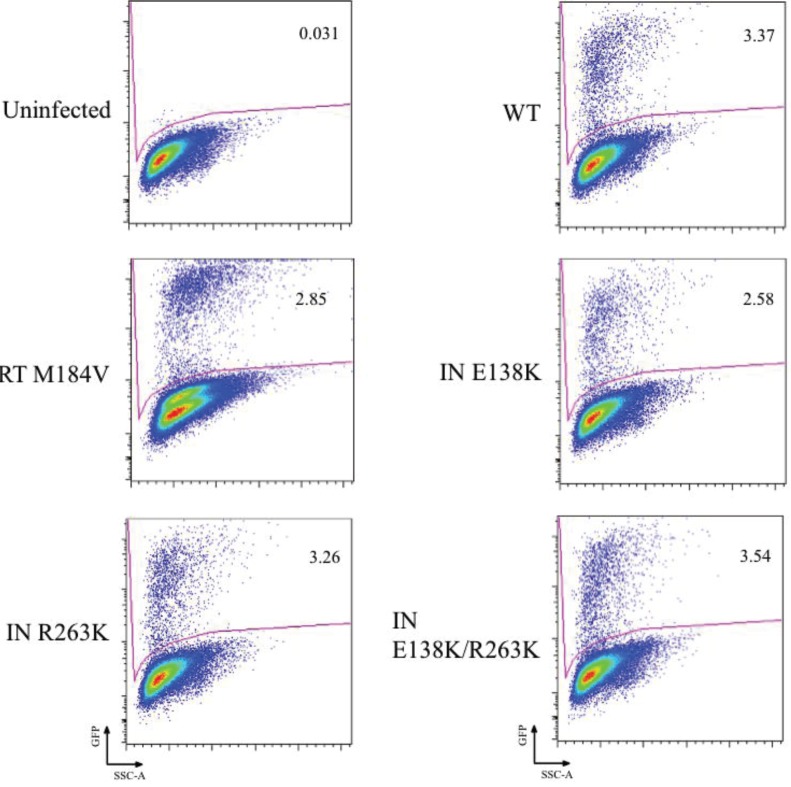
Reactivation of latently infected Jurkat cells. Jurkat cells that were either infected or uninfected with WT or INSTI-resistant viruses were cultured for 7 days in 1 μM DRV to inhibit new infections before reactivation with 20 ng/mL TNF-α. Representative results are shown here. As shown in Figure 2, there were no statistical differences between the mutants and WT viruses. Gating strategy is shown, and the percent of reactivated virus is denoted within the gate. SSC-A, side scatter area. GFP represents activated virus.

References

    1. Zhong P., Agosto L.M., Munro J.B., Mothes W. Cell-to-cell transmission of viruses. Curr. Opin. Virol. 2013;3:44–50. doi: 10.1016/j.coviro.2012.11.004. - DOI - PMC - PubMed
    1. Richman D.D., Margolis D.M., Delaney M., Greene W.C., Hazuda D., Pomerantz R.J. The challenge of finding a cure for HIV infection. Science. 2009;323:1304–1307. doi: 10.1126/science.1165706. - DOI - PubMed
    1. Shan L., Siliciano R.F. From reactivation of latent HIV-1 to elimination of the latent reservoir: The presence of multiple barriers to viral eradication. BioEssays. 2013;35:544–552. doi: 10.1002/bies.201200170. - DOI - PMC - PubMed
    1. Michaud V., Bar-Magen T., Turgeon J., Flockhart D., Desta Z., Wainberg M.A. The dual role of pharmacogenetics in HIV treatment: Mutations and polymorphisms regulating antiretroviral drug resistance and disposition. Pharm. Rev. 2012;64:803–833. doi: 10.1124/pr.111.005553. - DOI - PubMed
    1. Pennings P.S. HIV Drug Resistance: Problems and Perspectives. Infect. Dis. Rep. 2013;5(Suppl. S1):e5. doi: 10.4081/idr.2013.s1.e5. - DOI - PMC - PubMed

Publication types

Substances

LinkOut - more resources