


Rapid losses of surface elevation following tree girdling and cutting in tropical mangroves
- PMID: 25244646
- PMCID: PMC4171491
- DOI: 10.1371/journal.pone.0107868
Rapid losses of surface elevation following tree girdling and cutting in tropical mangroves
Erratum in
-
Correction: Rapid losses of surface elevation following tree girdling and cutting in tropical mangroves.PLoS One. 2015 Mar 18;10(3):e0118334. doi: 10.1371/journal.pone.0118334. eCollection 2015. PLoS One. 2015. PMID: 25785864 Free PMC article. No abstract available.
Abstract
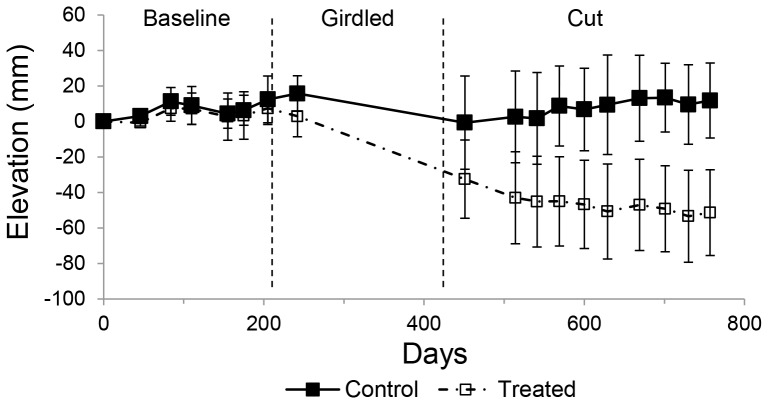
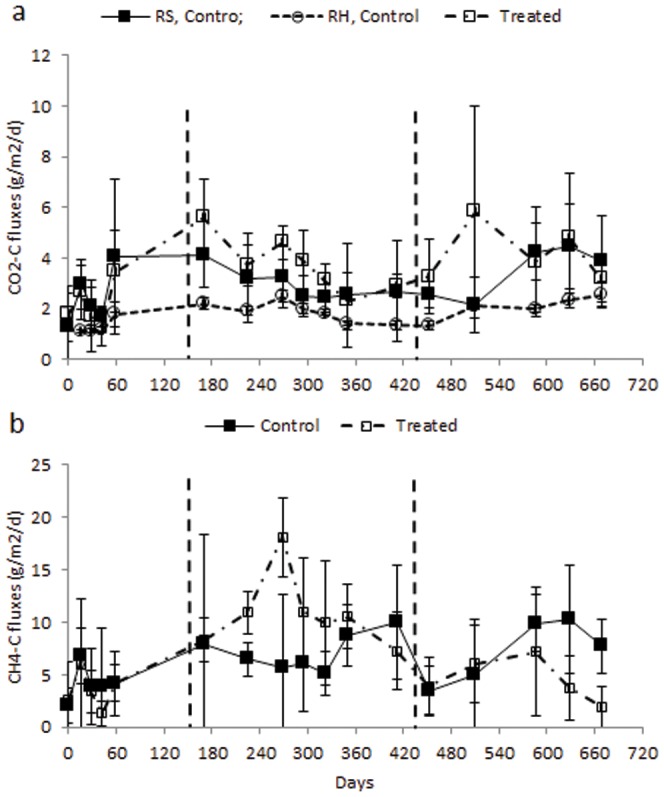
The importance of mangrove forests in carbon sequestration and coastal protection has been widely acknowledged. Large-scale damage of these forests, caused by hurricanes or clear felling, can enhance vulnerability to erosion, subsidence and rapid carbon losses. However, it is unclear how small-scale logging might impact on mangrove functions and services. We experimentally investigated the impact of small-scale tree removal on surface elevation and carbon dynamics in a mangrove forest at Gazi bay, Kenya. The trees in five plots of a Rhizophora mucronata (Lam.) forest were first girdled and then cut. Another set of five plots at the same site served as controls. Treatment induced significant, rapid subsidence (-32.1±8.4 mm yr-1 compared with surface elevation changes of +4.2±1.4 mm yr-1 in controls). Subsidence in treated plots was likely due to collapse and decomposition of dying roots and sediment compaction as evidenced from increased sediment bulk density. Sediment effluxes of CO₂ and CH₄ increased significantly, especially their heterotrophic component, suggesting enhanced organic matter decomposition. Estimates of total excess fluxes from treated compared with control plots were 25.3±7.4 tCO₂ ha-1 yr-1 (using surface carbon efflux) and 35.6±76.9 tCO₂ ha-1 yr-1 (using surface elevation losses and sediment properties). Whilst such losses might not be permanent (provided cut areas recover), observed rapid subsidence and enhanced decomposition of soil sediment organic matter caused by small-scale harvesting offers important lessons for mangrove management. In particular mangrove managers need to carefully consider the trade-offs between extracting mangrove wood and losing other mangrove services, particularly shoreline stabilization, coastal protection and carbon storage.
Conflict of interest statement
Figures
References
-
- Twilley RR, Chen RH, Hargis T (1992) Carbon sinks in mangroves and their implications to carbon budget of tropical coastal ecosystems. Water Air Soil Poll 64: 265–288.
-
- Bouillon S, Borges A, Castañeda-Moya E, Diele K, Dittmar T, et al. (2008) Mangrove production and carbon sinks: A revision of global budget estimates. Global Biogeochem Cycles 22: GB2013 doi:2010.1029/2007GB003052
-
- Kristensen E, Bouillon S, Dittmar T, Marchand C (2008) Organic carbon dynamics in mangrove ecosystems: A review. Aquat Bot 89: 201–219.
-
- Breithaupt JL, Smoak JM, Smith TJ III, Sanders CJ, Hoare A (2012) Organic carbon burial rates in mangrove sediments: Strengthening the global budget. Global Biogeochem Cycles: doi:10.1029/2012GB004375, in press.
-
- McKee KL, Cahoon DR, Feller I (2007) Caribbean mangroves adjust to rising sea level through biotic controls on change in soil elevation. Glob Ecol Biogeogr 16: 545–556.
Publication types
MeSH terms
Substances
LinkOut - more resources
Full Text Sources
Other Literature Sources
Research Materials
