


Patterns of food consumption among vegetarians and non-vegetarians
- PMID: 25247790
- PMCID: PMC4232985
- DOI: 10.1017/S000711451400261X
Patterns of food consumption among vegetarians and non-vegetarians
Abstract
Vegetarian dietary patterns have been reported to be associated with a number of favourable health outcomes in epidemiological studies, including the Adventist Health Study 2 (AHS-2). Such dietary patterns may vary and need further characterisation regarding foods consumed. The aims of the present study were to characterise and compare the food consumption patterns of several vegetarian and non-vegetarian diets. Dietary intake was measured using an FFQ among more than 89 000 members of the AHS-2 cohort. Vegetarian dietary patterns were defined a priori, based on the absence of certain animal foods in the diet. Foods were categorised into fifty-eight minor food groups comprising seventeen major food groups. The adjusted mean consumption of each food group for the vegetarian dietary patterns was compared with that for the non-vegetarian dietary pattern. Mean consumption was found to differ significantly across the dietary patterns for all food groups. Increased consumption of many plant foods including fruits, vegetables, avocados, non-fried potatoes, whole grains, legumes, soya foods, nuts and seeds was observed among vegetarians. Conversely, reduced consumption of meats, dairy products, eggs, refined grains, added fats, sweets, snack foods and non-water beverages was observed among vegetarians. Thus, although vegetarian dietary patterns in the AHS-2 have been defined based on the absence of animal foods in the diet, they differ greatly with respect to the consumption of many other food groups. These differences in food consumption patterns may be important in helping to explain the association of vegetarian diets with several important health outcomes.
Conflict of interest statement
The authors report the following potential conflicts of interest: K. J.-S. has received research grants from the Almond Board of California and from Unilever. J. S. is an unpaid member of the Scientific Advisory Board for the California Walnut Commission and has received grants from the nut, soya and avocado growers.
The authors M. J. O., J. F., P. N. S. and G. E. F. have no conflicts of interest to declare.
Figures
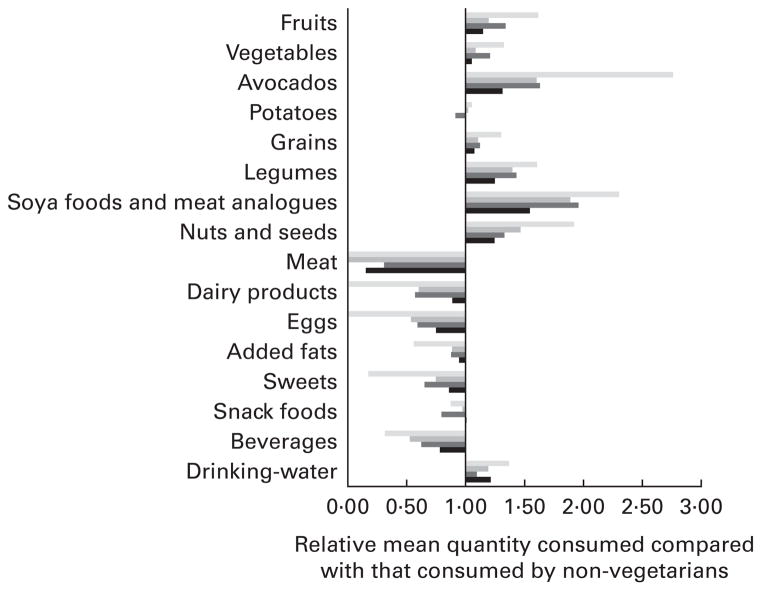
 , Vegan v. non-vegetarian;
 , lacto-ovo-vegetarian v. non-vegetarian;
 , pesco-vegetarian v. non-vegetarian; ■, semi-vegetarian v. non-vegetarian.
References
Publication types
MeSH terms
Grants and funding
LinkOut - more resources
Full Text Sources
Other Literature Sources
Medical
