


Thio-urethanes improve properties of dual-cured composite cements
- PMID: 25248610
- PMCID: PMC4237638
- DOI: 10.1177/0022034514551768
Thio-urethanes improve properties of dual-cured composite cements
Abstract
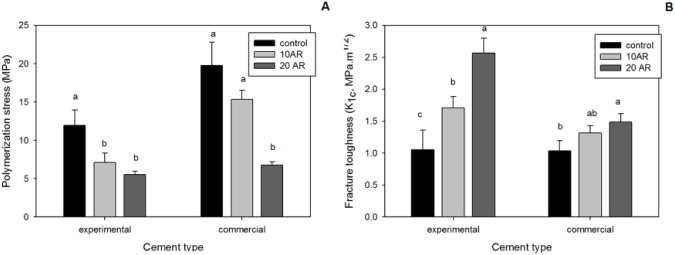
This study aims at modifying dual-cure composite cements by adding thio-urethane oligomers to improve mechanical properties, especially fracture toughness, and reduce polymerization stress. Thiol-functionalized oligomers were synthesized by combining 1,3-bis(1-isocyanato-1-methylethyl)benzene with trimethylol-tris-3-mercaptopropionate, at 1:2 isocyanate:thiol. Oligomer was added at 0, 10 or 20 wt% to BisGMA-UDMA-TEGDMA (5:3:2, with 25 wt% silanated inorganic fillers) or to one commercial composite cement (Relyx Ultimate, 3M Espe). Near-IR was used to measure methacrylate conversion after photoactivation (700 mW/cm(2) × 60s) and after 72 h. Flexural strength and modulus, toughness, and fracture toughness were evaluated in three-point bending. Polymerization stress was measured with the Bioman. The microtensile bond strength of an indirect composite and a glass ceramic to dentin was also evaluated. Results were analyzed with analysis of variance and Tukey's test (α = 0.05). For BisGMA-UDMA-TEGDMA cements, conversion values were not affected by the addition of thio-urethanes. Flexural strength/modulus increased significantly for both oligomer concentrations, with a 3-fold increase in toughness at 20 wt%. Fracture toughness increased over 2-fold for the thio-urethane modified groups. Contraction stress was reduced by 40% to 50% with the addition of thio-urethanes. The addition of thio-urethane to the commercial cement led to similar flexural strength, toughness, and conversion at 72h compared to the control. Flexural modulus decreased for the 20 wt% group, due to the dilution of the overall filler volume, which also led to decreased stress. However, fracture toughness increased by up to 50%. The microtensile bond strength increased for the experimental composite cement with 20 wt% thio-urethane bonding for both an indirect composite and a glass ceramic. Novel dual-cured composite cements containing thio-urethanes showed increased toughness, fracture toughness and bond strength to dentin while demonstrating reduced contraction stress. All of these benefits are derived without compromising the methacrylate conversion of the resin component. The modification does not require changing the operatory technique.
Keywords: delayed gelation; fracture toughness; kinetics of conversion; polymerization stress; prepolymerized additives; volumetric shrinkage.
© International & American Associations for Dental Research.
Conflict of interest statement
The authors declare no potential conflicts of interest with respect to the authorship and/or publication of this article.
Figures
References
-
- American Society for Testing Materials (1997). E399-90: Standard Test Method for Plane-Strain Fracture Toughness of Metallic Materials. Philadelphia, PA.
-
- Berchtold KA, Lovestead TM, Bowman CN. (2002). Coupling chain length dependent and reaction diffusion controlled termination in the free radical polymerization of multivinyl (meth)acrylates. Macromolecules 35:7968-7975.
-
- Cramer NB, Bowman CN. (2001). Kinetics of thiol-ene and thiol-acrylate photopolymerization with real-time Fourier transform infrared. J Polym Sci Part A: Polym Chem 39:3311-3319.
Publication types
MeSH terms
Substances
Grants and funding
LinkOut - more resources
Full Text Sources
Other Literature Sources
Miscellaneous
