


Additive effects of two quantitative trait loci that confer Rhopalosiphum maidis (corn leaf aphid) resistance in maize inbred line Mo17
- PMID: 25249072
- PMCID: PMC4286405
- DOI: 10.1093/jxb/eru379
Additive effects of two quantitative trait loci that confer Rhopalosiphum maidis (corn leaf aphid) resistance in maize inbred line Mo17
Abstract
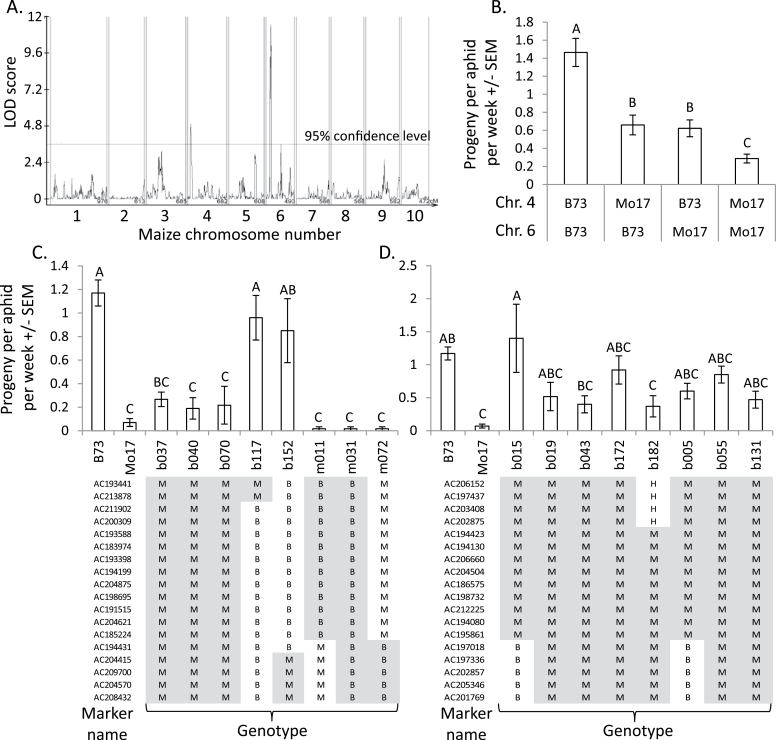
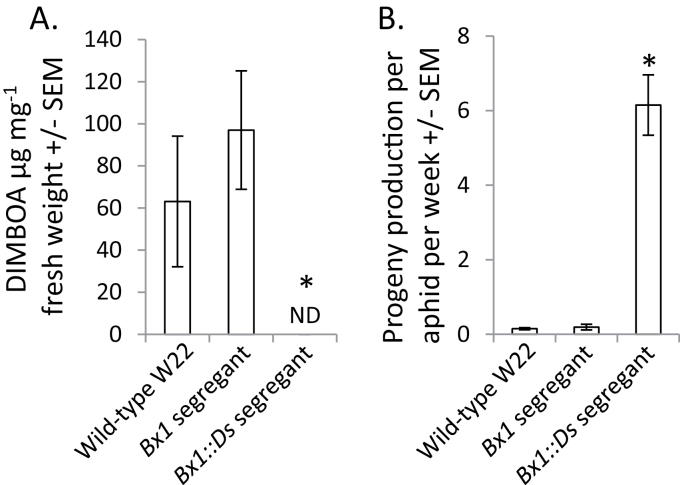
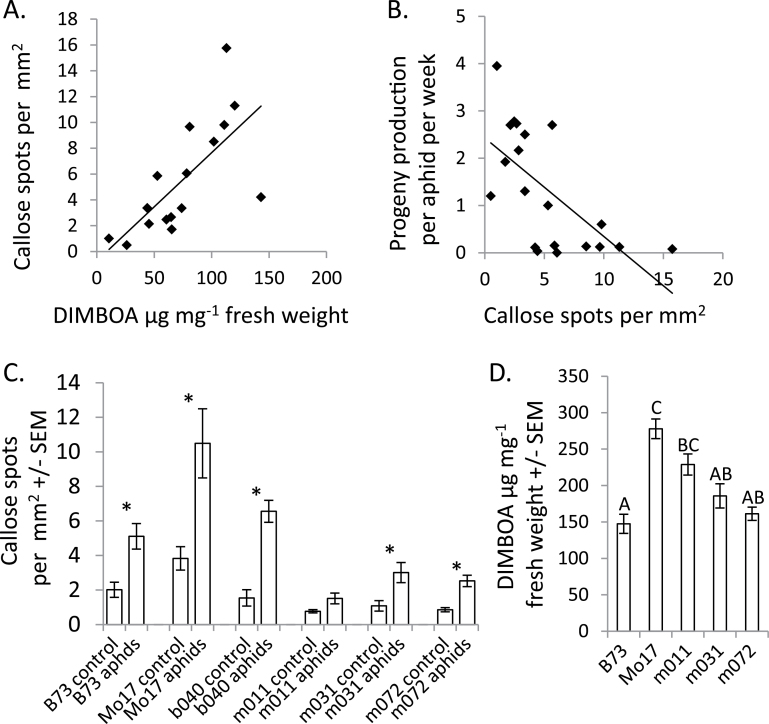
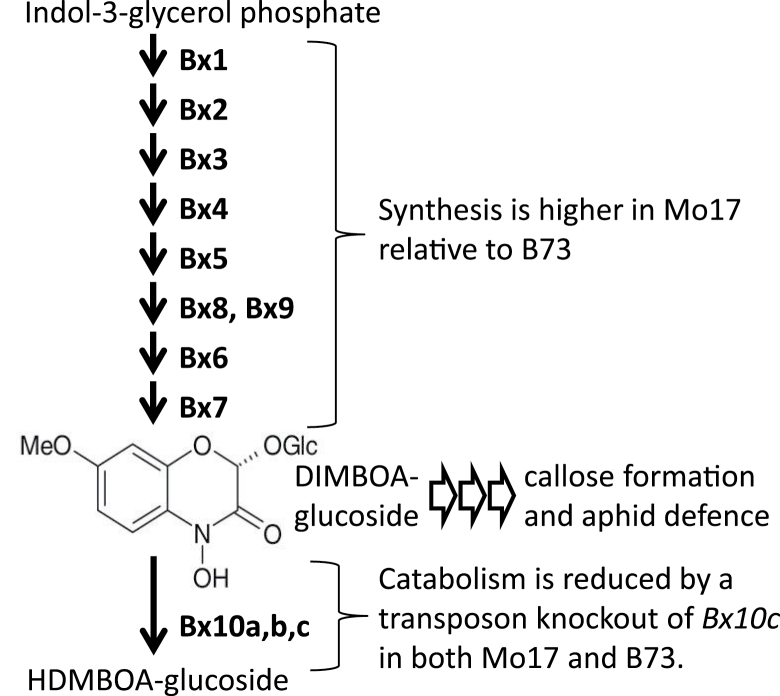
Plants show considerable within-species variation in their resistance to insect herbivores. In the case of Zea mays (cultivated maize), Rhopalosiphum maidis (corn leaf aphids) produce approximately twenty times more progeny on inbred line B73 than on inbred line Mo17. Genetic mapping of this difference in maize aphid resistance identified quantitative trait loci (QTL) on chromosomes 4 and 6, with the Mo17 allele reducing aphid reproduction in each case. The chromosome 4 QTL mapping interval includes several genes involved in the biosynthesis of DIMBOA (2,4-dihydroxy-7-methoxy-1,4-benzoxazin-3-one), a maize defensive metabolite that also is required for callose accumulation in response to aphid feeding. Consistent with the known association of callose with plant defence against aphids, R. maidis reproduction on B73×Mo17 recombinant inbred lines was negatively correlated with both DIMBOA content and callose formation. Further genetic mapping, as well as experiments with near-isogenic lines, confirmed that the Mo17 allele causes increased DIMBOA accumulation relative to the B73 allele. The chromosome 6 aphid resistance QTL functions independently of DIMBOA accumulation and has an effect that is additive to that of the chromosome 4 QTL. Thus, at least two separate defence mechanisms account for the higher level of R. maidis resistance in Mo17 compared with B73.
Keywords: DIMBOA; Rhopalosiphum maidis; aphid; benzoxazinoid; callose; maize; quantitative trait..
© The Author 2014. Published by Oxford University Press on behalf of the Society for Experimental Biology.
Figures

References
-
- Awadallah WH, Hanna LI. 1985. Evaluation of certain U.S. corn inbred lines for their resistance to infestation with the corn leaf aphid, Rhopalosiphum maidis (Fitch) in Egypt. Annals Of Agricultural Science, Moshtohor Journal 23, 327–333.
-
- Balint-Kurti PJ, Zwonitzer JC, Wisser RJ, Carson ML, Oropeza-Rosas MA, Holland JB, Szalma SJ. 2007. Precise mapping of quantitative trait loci for resistance to southern leaf blight, caused by Cochliobolus heterostrophus race O, and flowering time using advanced intercross maize lines. Genetics 176, 645–57. - PMC - PubMed
-
- Bing JW, Guthrie WD. 1991. Generation mean analysis for resistance in maize to the corn leaf aphid (Homoptera, Aphididae). Journal of Economic Entomology 84, 1080–1082.
-
- Bing JW, Guthrie WD, Dicke FF. 1992. Genetics of resistance in maize to the corn leaf aphid (Homoptera, Aphididae). Journal of Economic Entomology 85, 1476–1479.
Publication types
MeSH terms
Substances
LinkOut - more resources
Full Text Sources
Other Literature Sources
