


Hypoalbuminemia in critically sick children
- PMID: 25249740
- PMCID: PMC4166871
- DOI: 10.4103/0972-5229.140143
Hypoalbuminemia in critically sick children
Abstract
Context: There is a paucity of data evaluating serum albumin levels and outcome of critically ill-children admitted to intensive care unit (ICU).
Aims: The aim was to study frequency of hypoalbuminemia and examine association between hypoalbuminemia and outcome in critically ill-children.
Settings and design: Retrospective review of medical records of 435 patients admitted to 12 bedded pediatric ICU (PICU).
Materials and methods: Patients with hypoalbuminemia on admission or any time during PICU stay were compared with normoalbuminemic patients for demographic and clinical profile. Effect of albumin infusion was also examined. Odds ratio and 95% confidence interval were calculated using SPSS 16.
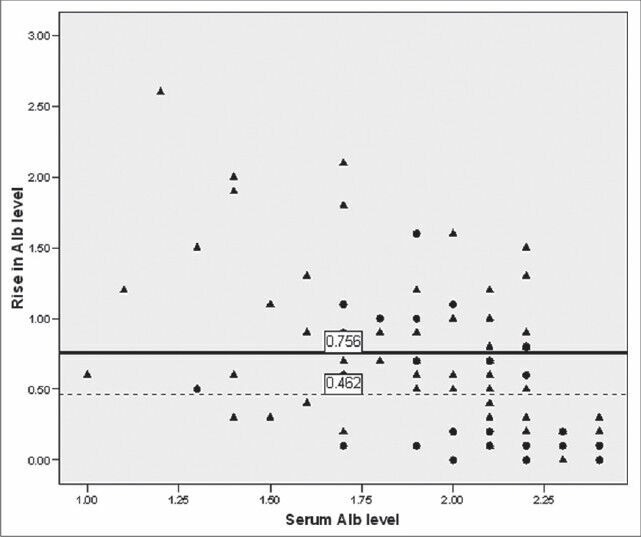
Results: Hypoalbuminemia was present on admission in 21% (92 of 435) patients that increased to 34% at the end of 1(st) week and to 37% (164 of 435) during rest of the stay in PICU. Hypoalbuminemic patients had higher Pediatric Risk of Mortality scores (12.9 vs. 7.5, P < 0.001) and prolonged PICU stay (13.8 vs. 6.7 days, P < 0.001); higher likelihood of respiratory failure requiring mechanical ventilaton (84.8% vs. 28.8%, P < 0.001), prolonged ventilatory support, progression to multiorgan dysfunction syndrome (87.8% vs. 16.2%) and risk of mortality (25.6% vs. 17.7%). Though, the survivors among recipients of albumin infusion had significantly higher increase in serum albumin level (0.76 g/dL, standard deviation [SD] 0.54) compared with nonsurvivors (0.46 g/dL, SD 0.44; P = 0.016), albumin infusion did not reduce the risk of mortality.
Conclusions: Hypoalbuminemia is a significant indicator of mortality and morbidity in critically sick children. More studies are needed to define role of albumin infusion in treatment of such patients.
Keywords: Critically sick children; hypoalbuminemia; pediatric intensive care unit.
Conflict of interest statement
Figures
References
-
- McPherson RA, Pincus MR. Specific protiens. In: McPherson RA, Pincus MR, editors. Henry's Clinical Diagnosis and Management by Laboratory Methods. 21st ed. Philadelphia: Saunders Elsevier; 2007. pp. 511–9.
-
- Sung J, Bochicchio GV, Joshi M, Bochicchio K, Costas A, Tracy K, et al. Admission serum albumin is predicitve of outcome in critically ill trauma patients. Am Surg. 2004;70:1099–102. - PubMed
-
- Nicholson JP, Wolmarans MR, Park GR. The role of albumin in critical illness. Br J Anaesth. 2000;85:599–610. - PubMed
-
- Horowitz IN, Tai K. Hypoalbuminemia in critically ill children. Arch Pediatr Adolesc Med. 2007;161:1048–52. - PubMed
-
- Fleck A, Raines G, Hawker F, Trotter J, Wallace PI, Ledingham IM, et al. Increased vascular permeability: A major cause of hypoalbuminaemia in disease and injury. Lancet. 1985;1:781–4. - PubMed
LinkOut - more resources
Full Text Sources
Other Literature Sources