


Large-scale analysis of NBS domain-encoding resistance gene analogs in Triticeae
- PMID: 25249784
- PMCID: PMC4171767
- DOI: 10.1590/s1415-47572014000400017
Large-scale analysis of NBS domain-encoding resistance gene analogs in Triticeae
Abstract
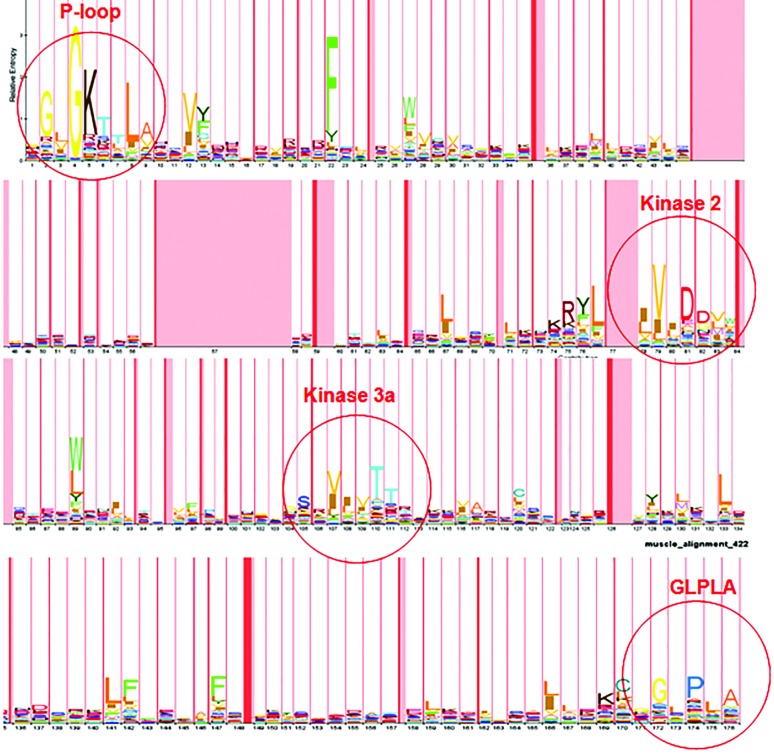
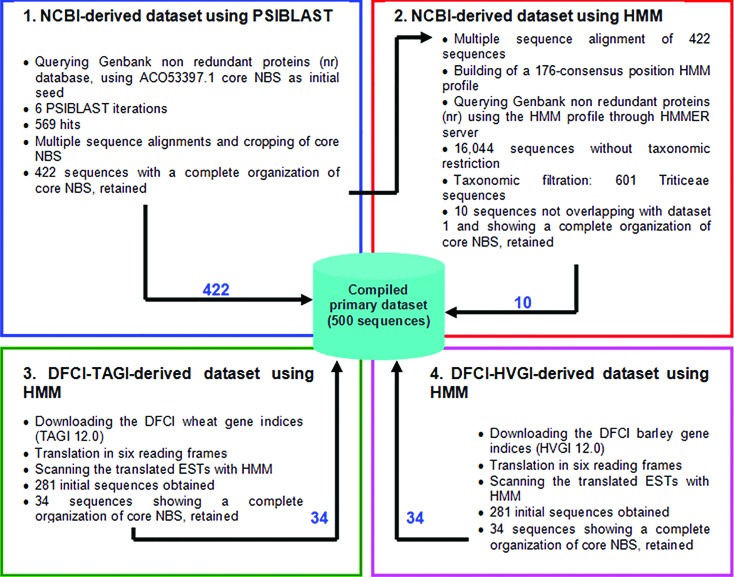
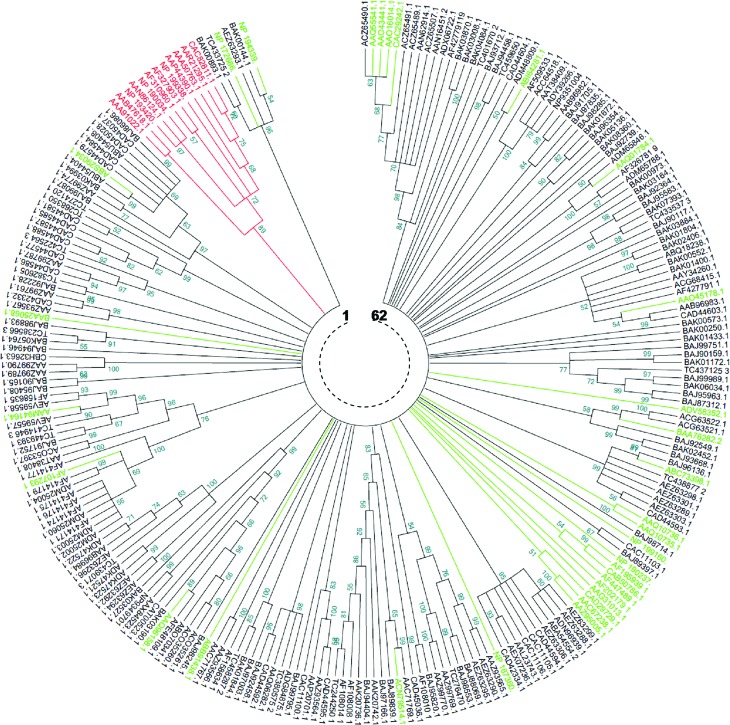
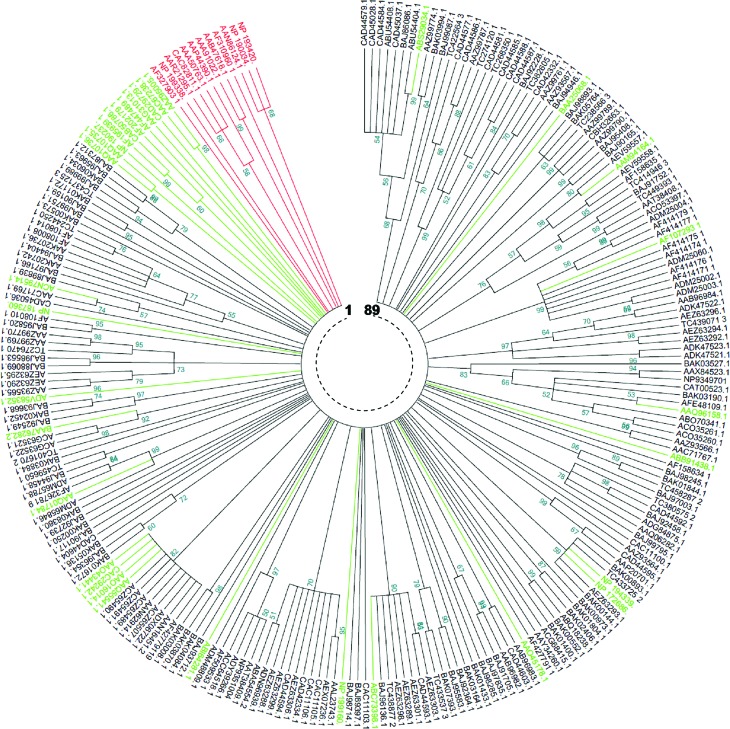
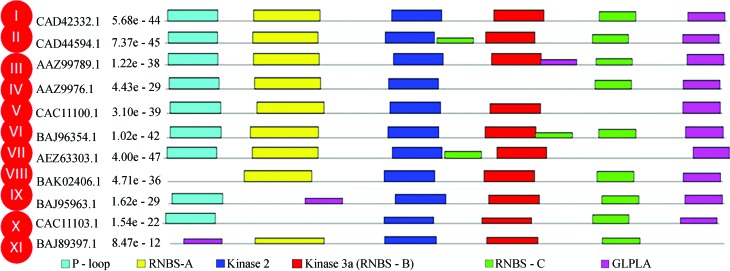
Proteins containing nucleotide binding sites (NBS) encoded by plant resistance genes play an important role in the response of plants to a wide array of pathogens. In this paper, an in silico search was conducted in order to identify and characterize members of NBS-encoding gene family in the tribe of Triticeae. A final dataset of 199 sequences was obtained by four search methods. Motif analysis confirmed the general structural organization of the NBS domain in cereals, characterized by the presence of the six commonly conserved motifs: P-loop, RNBS-A, Kinase-2, Kinase-3a, RNBS-C and GLPL. We revealed the existence of 11 distinct distribution patterns of these motifs along the NBS domain. Four additional conserved motifs were shown to be significantly present in all 199 sequences. Phylogenetic analyses, based on genetic distance and parsimony, revealed a significant overlap between Triticeae sequences and Coiled coil-Nucleotide binding site-Leucine rich repeat (CNL)-type functional genes from monocotyledons. Furthermore, several Triticeae sequences belonged to clades containing functional homologs from non Triticeae species, which has allowed for these sequences to be functionally assigned. The findings reported, in this study, will provide a strong groundwork for the isolation of candidate R-genes in Triticeae crops and the understanding of their evolution.
Keywords: NBS domain; Triticeae; data mining; phylogeny; plant resistance genes.
Figures
References
-
- Bailey TL, Elkan C. Fitting a mixture model by expectation maximization to discover motifs in biopolymers. Proceedings of the Second International Conference on Intelligent Systems for Molecular Biology; AAAI Press, Menlo Park. 1994. pp. 28–36. - PubMed
-
- Buschges R, Hollricher K, Panstruga R, Simons G, Wolter M, Frijters A, van Daelen R, van der Lee T, Diergaarde P, Groenendijk J, et al. The barley Mlo gene: A novel control element of plant pathogen resistance. Cell. 1997;88:695–705. - PubMed
-
- Cameron M, Bernstein Y, Hugh E. Clustered sequence representation for fast homology search. J Comput Biol. 2007;4:594–614. - PubMed
Internet Resources
-
- National Center of Biotechnology Information (NCBI) Taxonomy database. http://www.ncbi.nlm.nih.gov/taxonomy (July 20, 2013)
-
- National Center of Biotechnology Information (NCBI) GenBank. ( http://www.ncbi.nlm.nih.gov/genbank/) (February 02, 2013)
-
- Plant Resistance Gene database (PRGdb) www.prgdb.org (December 02, 2013)
-
- The Dana-Farber Cancer Institute (DFCI) Expressed Sequence Tag (EST)-based Gene Indices (GIs) http://compbio.dfci.harvard.edu/tgi/ (February 18, 2013)
-
- Multiple Sequence Comparison by Log- Expectation (MUSCLE) http://www.ebi.ac.uk/Tools/msa/muscle/ (March 17, 2013)
LinkOut - more resources
Full Text Sources
Other Literature Sources
Research Materials
Miscellaneous