


The relationship between nature connectedness and happiness: a meta-analysis
- PMID: 25249992
- PMCID: PMC4157607
- DOI: 10.3389/fpsyg.2014.00976
The relationship between nature connectedness and happiness: a meta-analysis
Abstract
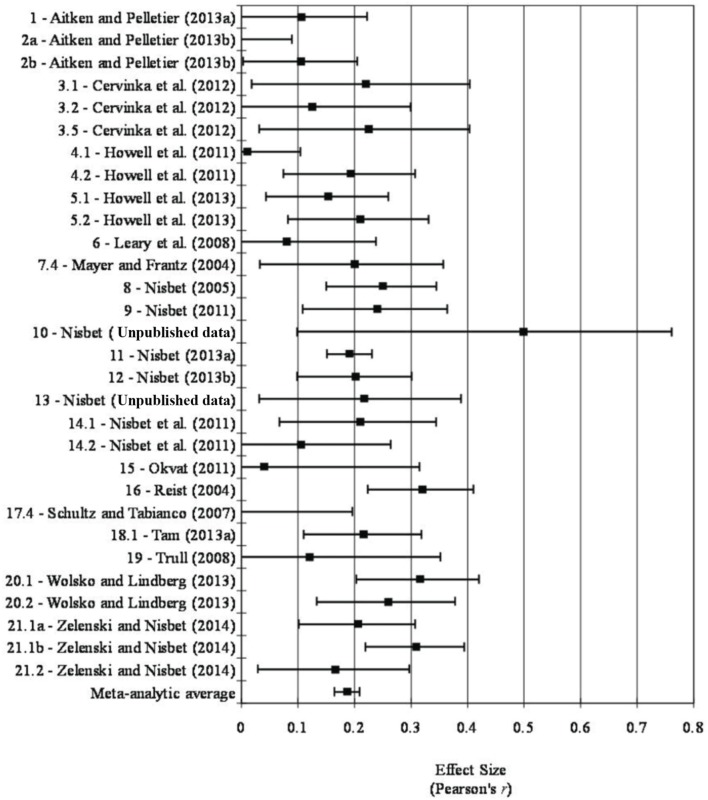
Research suggests that contact with nature can be beneficial, for example leading to improvements in mood, cognition, and health. A distinct but related idea is the personality construct of subjective nature connectedness, a stable individual difference in cognitive, affective, and experiential connection with the natural environment. Subjective nature connectedness is a strong predictor of pro-environmental attitudes and behaviors that may also be positively associated with subjective well-being. This meta-analysis was conducted to examine the relationship between nature connectedness and happiness. Based on 30 samples (n = 8523), a fixed-effect meta-analysis found a small but significant effect size (r = 0.19). Those who are more connected to nature tended to experience more positive affect, vitality, and life satisfaction compared to those less connected to nature. Publication status, year, average age, and percentage of females in the sample were not significant moderators. Vitality had the strongest relationship with nature connectedness (r = 0.24), followed by positive affect (r = 0.22) and life satisfaction (r = 0.17). In terms of specific nature connectedness measures, associations were the strongest between happiness and inclusion of nature in self (r = 0.27), compared to nature relatedness (r = 0.18) and connectedness to nature (r = 0.18). This research highlights the importance of considering personality when examining the psychological benefits of nature. The results suggest that closer human-nature relationships do not have to come at the expense of happiness. Rather, this meta-analysis shows that being connected to nature and feeling happy are, in fact, connected.
Keywords: biophilia; connectedness to nature; happiness; hedonic well-being; human-nature relationship; meta-analysis; nature relatedness; subjective well-being.
References
-
- *. Aitken N., Pelletier L. G. (2013a). The benefits of being connected to nature and motivated toward the environment on subjective well-being, in Presented at the 74th Annual Canadian Psychological Association Convention, Quebec City, QC
-
- *. Aitken N., Pelletier L. G. (2013b). Differentiating Habits for pro-environmental transportation behaviour, in Presented at the 10th Biennial Conference on Environmental Psychology, Magdeburg, Germany
-
- Ajzen I., Driver B. L. (1992). Application of the theory of planned behavior to leisure choice. J. Leisure Res. 24, 207–224
-
- Aron A., Aron E. N., Smollan D. (1992). Inclusion of other in the self scale and the structure of interpersonal closeness. J. Pers. Soc. Psychol. 63, 596–612 10.1037/0022-3514.63.4.596 - DOI
LinkOut - more resources
Full Text Sources
Other Literature Sources
