


Comparison of percutaneous versus open surgical techniques for placement of peritoneal dialysis catheter in children: A randomized clinical trial
- PMID: 25250279
- PMCID: PMC4154274
Comparison of percutaneous versus open surgical techniques for placement of peritoneal dialysis catheter in children: A randomized clinical trial
Abstract
Background This research compares the outcomes of percutaneous technique and open surgical peritoneal dialysis catheter placement in children.
Methods: In this randomized controlled trial, between 2010 and 2011,a total of 35 pediatric uremic patients were enrolled and randomized into two study groups. Follow up data included duration of operation (minute), duration of hospitalization (days) and onset time of peritoneal dialysis. Complications were considered as mechanical and infectious.
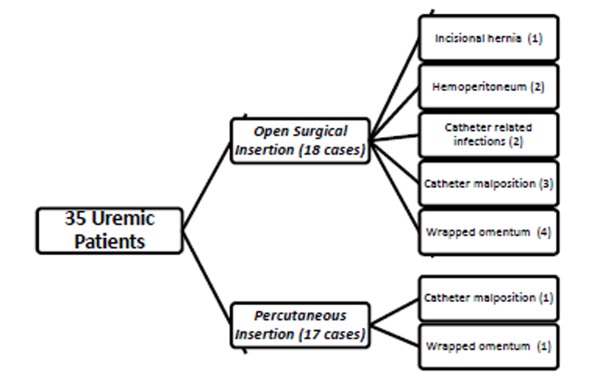
Results: The percutaneous procedure was significantly faster than the open surgical technique (9.5 ± 1.81 versus 27.00 ± 2.61 minutes, p= 0.0001). The onset of dialysis was earlier in percutaneous insertion. There were no cases of hollow viscous perforation, early peritonitis and exit site infection at the 3rd, 7th, and 14th day in both groups. Complications in open surgical group were include wrapped omentum in 4 (23.5%), catheter malposition in 3 (17.6%),delayed exit site infection in 2 (11.7%), Incisional hernia in 1 (5.8%)and hemoperitoneum in 2 (11.7%)cases. Complications in percutaneous insertion group were include catheter malposition and wrapped omentum each in one case.
Conclusion: Percutaneous method with secure insertion of the catheter reduced the rate of some complications. Although they were not statistically significant, this technique reduces the time of hospitalization and operation without need to general anesthesia. The onset of dialysis was earlier significantly. Trial registry code: IRCT2013091514670N1.
Keywords: Catheters; Complications; Peritoneal dialysis; Surgical Procedures.
References
-
- Jwo SC, Chen KS, Lin YY. Video –assisted laparoscopic procedures in peritoneal dialysis. Surg Endos. 2003;17(10):1666–70. - PubMed
-
- Bullmaster JR, Miller SF, Finley RK, Jones LM. Surgical aspects of the Tenckhoff peritoneal dialysis catheter A 7 year experience. Am J surg. 1985;149(3):339–42. - PubMed
-
- Cronen PW, Moss JP, Simpson T, Rao M, Cowles L. Tenckhoff catheter placement: surgical aspects. Am surg. 1985;51(11):627–9. - PubMed
-
- Fleisher AG, Kimmelstiel FM, Lattes CG, Miller RE. Surgical complications of peritoneal dialysis catheters. Am J surg. 1985;149(6):726–9. - PubMed
LinkOut - more resources
Full Text Sources