Review
. 2015 Jan 3:66:349-79.
doi: 10.1146/annurev-psych-010213-115108. Epub 2014 Sep 22.

Hemodynamic correlates of cognition in human infants

Affiliations
Review

Hemodynamic correlates of cognition in human infants

Richard N Aslin et al. Annu Rev Psychol. .

Abstract

Over the past 20 years, the field of cognitive neuroscience has relied heavily on hemodynamic measures of blood oxygenation in local regions of the brain to make inferences about underlying cognitive processes. These same functional magnetic resonance imaging (fMRI) and functional near-infrared spectroscopy (fNIRS) techniques have recently been adapted for use with human infants. We review the advantages and disadvantages of these two neuroimaging methods for studies of infant cognition, with a particular emphasis on their technical limitations and the linking hypotheses that are used to draw conclusions from correlational data. In addition to summarizing key findings in several domains of infant cognition, we highlight the prospects of improving the quality of fNIRS data from infants to address in a more sophisticated way how cognitive development is mediated by changes in underlying neural mechanisms.

Keywords: brain; cognitive neuroscience; development; human infant; neuroimaging.


Figures
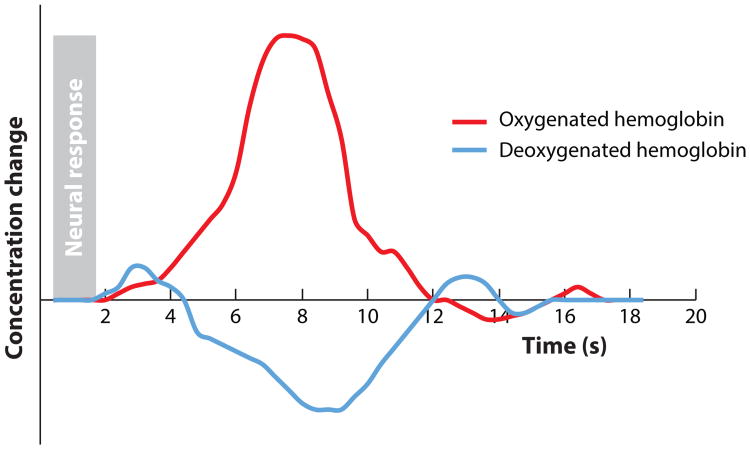
Figure 1
Figure 1
Depiction of the canonical hemodynamic response, with decreases in deoxygenated hemoglobin and increases in oxygenated hemoglobin that are delayed by several seconds after a brief stimulus and its elicited neural activity (shaded region). Adapted from Gervain et al. (2011) with permission.
Figure 2
Figure 2
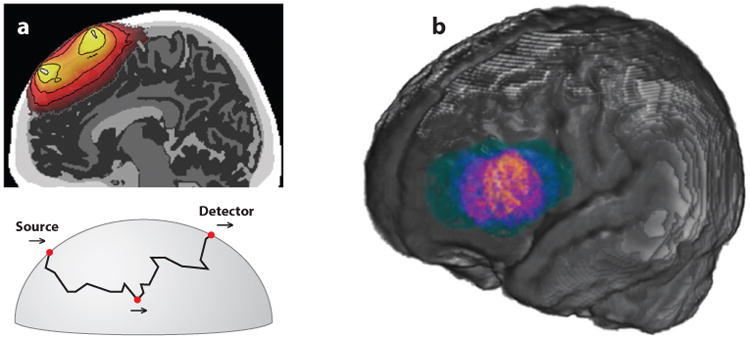
Illustration of the spatial locations sampled by a single NIRS channel (source-detector pair). (a) Top: Cross-section of the brain with a color-coded probability map of how photons move through a banana-shaped pathway from a source (emitter) to a detector location. Brighter colors indicate a higher relative probability of sampling that spatial location for this NIRS channel. Bottom: A possible path of a single photon going from the emitter to the detector as it dips to a specific point in the brain and returns to the surface. (b) Given the relatively large spatial extent of a single channel and variability in head size and probe placement across a population, this panel illustrates the spatial extent of recordings from a single NIRS channel in a sample of 6-month-old infants when coregistered to a standard brain template. Colors indicate the likelihood of sampling different brain regions. Brighter colors indicate greater representation of this region for the population. Panel a from Strangman et al. (2013), adapted with permission; panel b courtesy of Lauren Emberson, John Richards, and Richard Aslin.
Figure 3
Figure 3
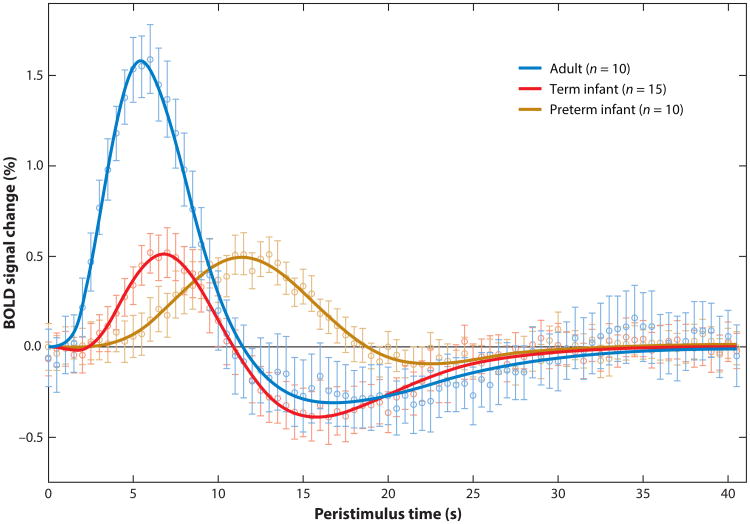
Variations in the time course and amplitude of the hemodynamic response function (HRF) between adults, infants, and preterm infants as derived from functional magnetic resonance imaging (fMRI) in the somatosensory cortex. Redrawn from Arichi et al. (2012), with permission. Abbreviation: BOLD, blood oxygen level–dependent.
Figure 4
Figure 4
Spatial coregistration of functional near-infrared spectroscopy (fNIRS) channels with age- and headsize-appropriate magnetic resonance (MR) templates courtesy of John Richards and Sarah Lloyd-Fox, with permission (to appear in Lloyd-Fox et al. 2014).

References

    1. Aguiar A, Baillargeon R. 2.5-month-old infants' reasoning about when objects should and should not be occluded. Cogn Psychol. 1999;39:116–57. - PubMed
    1. Akiyama L, Richards T, Imada T, Dager S, Wroblewski L, Kuhl P. Age-specific average head template for typically developing 6-month-old infants. PLoS ONE. 2013;8:e73821. - PMC - PubMed
    1. Altman NR, Bernal B. Brain activation in sedated children: auditory and visual functional MR imaging. Radiology. 2001;221(1):56–63. - PubMed
    1. Anderson AW, Marois R, Colson ER, Peterson BS, Duncan CC, et al. Neonatal auditory activation detected by functional magnetic resonance imaging. Magn Reson Imaging. 2001;19(1):1–5. - PubMed
    1. Arichi T, Fagiolo G, Varela M, Melendez-Calderon A, Allievi A, et al. Development of BOLD signal hemodynamic responses in the human brain. NeuroImage. 2012;63:663–673. - PMC - PubMed

Publication types

MeSH terms