


Rhodiola crenulata- and Cordyceps sinensis-based supplement boosts aerobic exercise performance after short-term high altitude training
- PMID: 25251930
- PMCID: PMC4174424
- DOI: 10.1089/ham.2013.1114
Rhodiola crenulata- and Cordyceps sinensis-based supplement boosts aerobic exercise performance after short-term high altitude training
Abstract
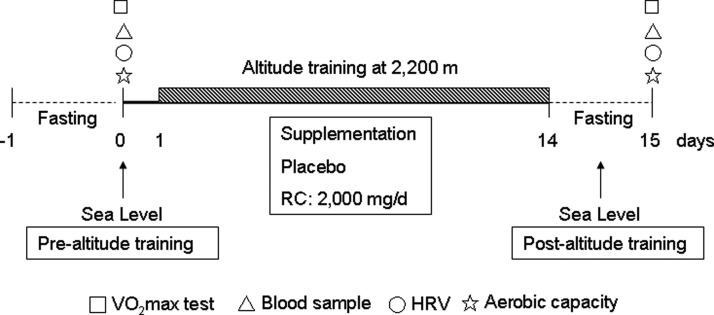
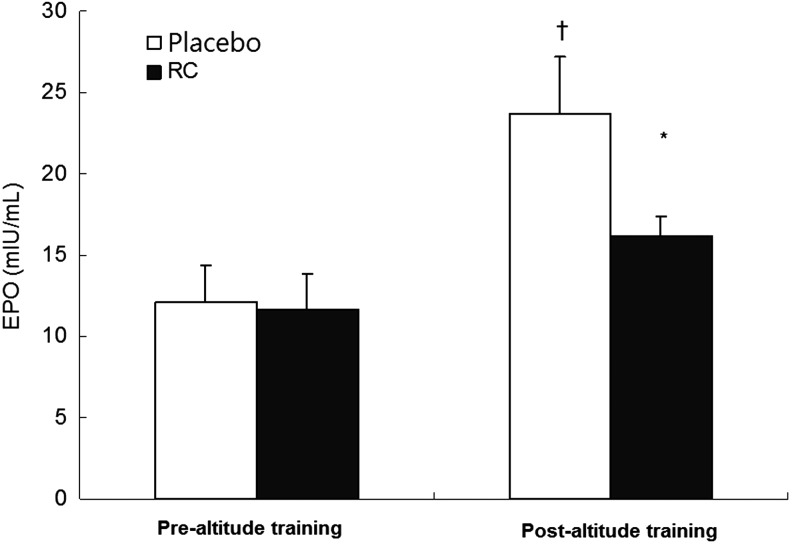
High altitude training is a widely used strategy for improving aerobic exercise performance. Both Rhodiola crenulata (R) and Cordyceps sinensis (C) supplements have been reported to improve exercise performance. However, it is not clear whether the provision of R and C during high altitude training could further enhance aerobic endurance capacity. In this study, we examined the effect of R and C based supplementation on aerobic exercise capacity following 2-week high altitude training. Alterations to autonomic nervous system activity, circulatory hormonal, and hematological profiles were investigated. Eighteen male subjects were divided into two groups: Placebo (n=9) and R/C supplementation (RC, n=9). Both groups received either RC (R: 1400 mg+C: 600 mg per day) or the placebo during a 2-week training period at an altitude of 2200 m. After 2 weeks of altitude training, compared with Placebo group, the exhaustive run time was markedly longer (Placebo: +2.2% vs. RC: +5.7%; p<0.05) and the decline of parasympathetic (PNS) activity was significantly prevented in RC group (Placebo: -51% vs. RC: -41%; p<0.05). Red blood cell, hematocrit, and hemoglobin levels were elevated in both groups to a comparable extent after high altitude training (p<0.05), whereas the erythropoietin (EPO) level remained higher in the Placebo group (∼48% above RC values; p<0.05). The provision of an RC supplement during altitude training provides greater training benefits in improving aerobic performance. This beneficial effect of RC treatment may result from better maintenance of PNS activity and accelerated physiological adaptations during high altitude training.
Keywords: athletes at altitude; erythropoietin; exercise; hypobaric hypoxia; parasympathetic nervous system.
Figures
References
-
- Abidov M, Crendal F, Grachev S, Seifulla R, and Ziegenfuss T. (2003). Effect of extracts from Rhodiola rosea and Rhodiola crenulata (Crassulaceae) roots on ATP content in mitochondria of skeletal muscles. Bull Exp Biol Med 136:585–587 - PubMed
-
- Bailey DM, Davies B, Romer L, Castell L, Newsholme E, and Gandy G. (1998). Implications of moderate altitude training for sea-level endurance in elite distance runners. Eur J Appl Physiol Occup Physiol 78:360–368 - PubMed
-
- Basset FA, Joanisse DR, Boivin F, St-Onge J, Billaut F, Dore J, Chouinard R, Falgairette G, Richard D, and Boulay MR. (2006). Effects of short-term normobaric hypoxia on haematology, muscle phenotypes and physical performance in highly trained athletes. Exp Physiol 91:391–402 - PubMed
-
- Bernardi L, Passino C, Serebrovskaya Z, Serebrovskaya T, and Appenzeller O. (2001). Respiratory and cardiovascular adaptations to progressive hypoxia. Eur Heart J 22:879–886 - PubMed
-
- Bonetti DL, and Hopkins WG. (2009). Sea-level exercise performance following adaptation to hypoxia: A meta-analysis. Sports Med 39:107–127 - PubMed
Publication types
MeSH terms
Substances
LinkOut - more resources
Full Text Sources
Other Literature Sources
Medical
Research Materials
