


Female sexual function improved with ospemifene in postmenopausal women with vulvar and vaginal atrophy: results of a randomized, placebo-controlled trial
- PMID: 25252699
- PMCID: PMC4389697
- DOI: 10.3109/13697137.2014.954996
Female sexual function improved with ospemifene in postmenopausal women with vulvar and vaginal atrophy: results of a randomized, placebo-controlled trial
Abstract
Background: Ospemifene is a non-estrogen, tissue selective estrogen receptor agonist/antagonist, or selective estrogen receptor modulator, recently approved for the treatment of dyspareunia, a symptom of vulvar and vaginal atrophy (VVA), due to menopause. Postmenopausal dyspareunia is often associated with female sexual dysfunction (FSD). In this report, we present data that demonstrate the effect of ospemifene 60 mg/day on FSD assessed by the Female Sexual Function Index (FSFI), a widely used tool with six domains (Arousal, Desire, Orgasm, Lubrication, Satisfaction, and Pain).
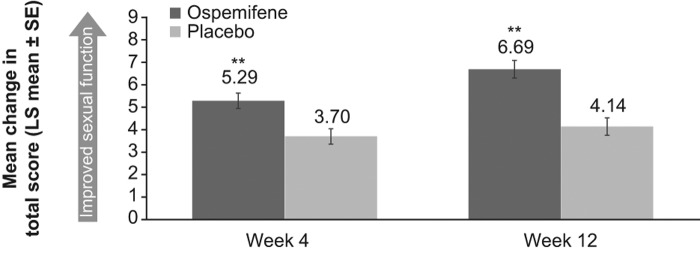
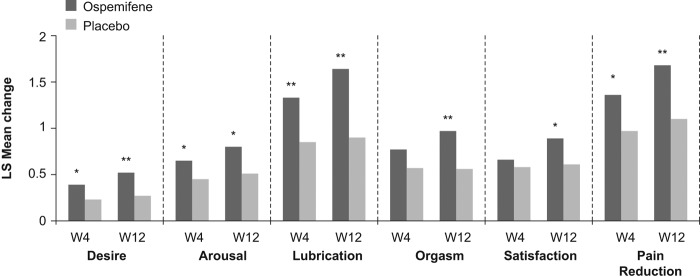
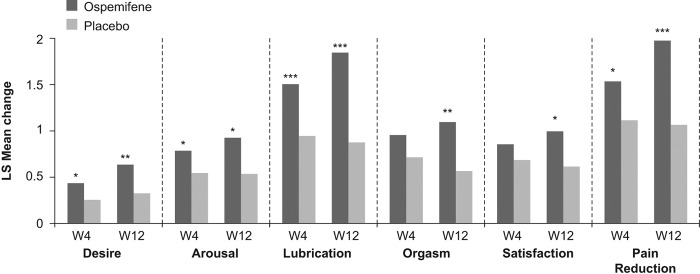
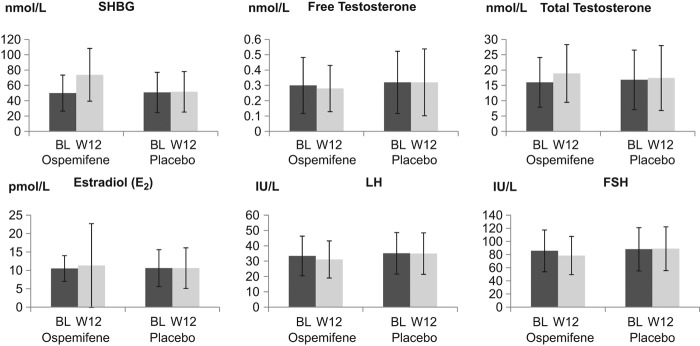
Methods: A phase-3, randomized, double-blind, 12-week trial (n = 919) compared the efficacy and safety of oral ospemifene 60 mg/day vs. placebo in postmenopausal women with VVA in two strata based on self-reported, most bothersome symptom of either dyspareunia or dryness. Primary data were published previously. We report herein pre-specified secondary efficacy endpoints analyses, including changes from baseline to Weeks 4 and 12 for FSFI total and domain scores as well as serum hormone levels.
Results: Ospemifene 60 mg/day demonstrated a significantly greater FSFI total score improvement vs. placebo at Week 4 (p < 0.001). Improvement in FSFI scores continued to Week 12 (p < 0.001). At Week 4, the FSFI domains of Sexual Pain, Arousal, and Desire were significantly improved with ospemifene vs. placebo; at Week 12, improvements in all domains were significant (p < 0.05). Changes in serum hormones were minor and uncorrelated with changes in sexual functioning.
Conclusion: In a large, randomized, double-blind, placebo-controlled trial, ospemifene 60 mg/day significantly improved FSD in women with VVA. Consistent effects across FSFI domains were observed.
Keywords: DYSPAREUNIA; FEMALE SEXUAL DYSFUNCTION; MENOPAUSE; OSPEMIFENE; TISSUE-SELECTIVE ESTROGEN AGONIST/ANTAGONIST; VULVAR AND VAGINAL ATROPHY.
Figures

References
-
- Santoro N, Komi J. Prevalence and impact of vaginal symptoms among postmenopausal women. J Sex Med. 2009;6:2133–42. - PubMed
-
- Soules MR, Bremner WJ. The menopause and climacteric: endocrinologic basis and associated symptomatology. J Am Geriatr Soc. 1982;30:547–61. - PubMed
-
- US Census Bureau. Statisitical Abstract of the United States: 2012. Available at: http://www.census.gov/compendia/statab/2012/tables/12s0104.pdf Accessed April 21, 2014.
-
- Goldstein I. Recognizing and treating urogenital atrophy in postmenopausal women. J Womens Health (Larchmt) 2010;19:425–32. - PubMed
Publication types
MeSH terms
Substances
LinkOut - more resources
Full Text Sources
Other Literature Sources
Medical
