. 2014 Nov 6;11(100):20140845.
doi: 10.1098/rsif.2014.0845.

Self-preservation strategies during bacterial biomineralization with reference to hydrozincite and implications for fossilization of bacteria

Affiliations

Self-preservation strategies during bacterial biomineralization with reference to hydrozincite and implications for fossilization of bacteria

Bryne T Ngwenya et al. J R Soc Interface. .

Abstract

The induction of mineralization by microbes has been widely demonstrated but whether induced biomineralization leads to distinct morphologies indicative of microbial involvement remains an open question. For calcium carbonate, evidence suggests that microbial induction enhances sphere formation, but the mechanisms involved and the role of microbial surfaces are unknown. Here, we describe hydrozincite biominerals from Sardinia, Italy, which apparently start life as smooth globules on cyanobacterial filaments, and evolve to spheroidal aggregates consisting of nanoplates. Complementary laboratory experiments suggest that organic compounds are critical to produce this morphology, possibly by inducing aggregation of nanoscopic crystals or nucleation within organic globules produced by metabolizing cells. These observations suggest that production of extracellular polymeric substances by microbes may constitute an effective mechanism to enhance formation of porous spheroids that minimize cell entombment while also maintaining metabolite exchange. However, the high porosity arising from aggregation-based crystal growth probably facilitates rapid oxidation of entombed cells, reducing their potential to be fossilized.

Keywords: biomineralization; fossilization; nucleation.


Figures

Figure 1.
Figure 1.
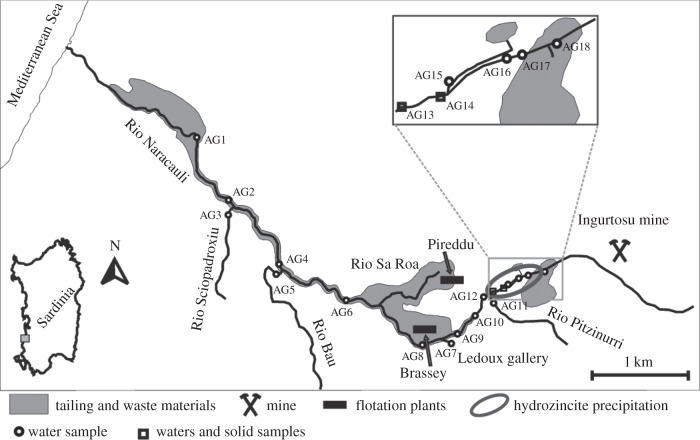
Map showing location of the Rio Naracauli in southwest Sardinia and sampling locations for hydrozincite bio-precipitates shown in figure 2.
Figure 2.
Figure 2.
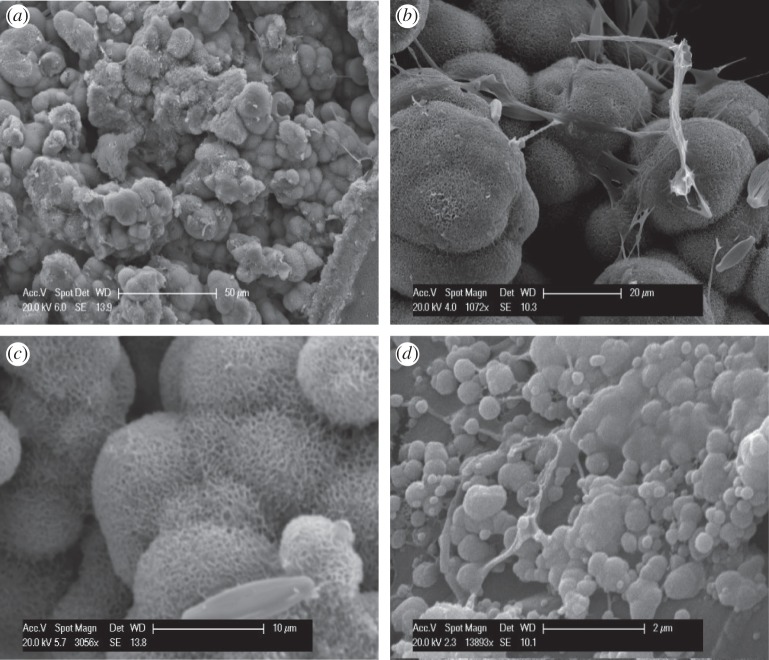
SEM photographs illustrating dominant morphologies and textures in hydrozincite bio-precipitates from Rio Naracauli. (a) General appearance of the bio-precipitates displaying botryoidal structure, (b) higher magnification of spheroids showing close association with organic strands thought to be EPS, (c) close-up view of the spheroids consisting of platy/needle-like aggregates and (d) even higher magnification image showing globular nature of early formed hydrozincite in association with EPS.
Figure 3.
Figure 3.
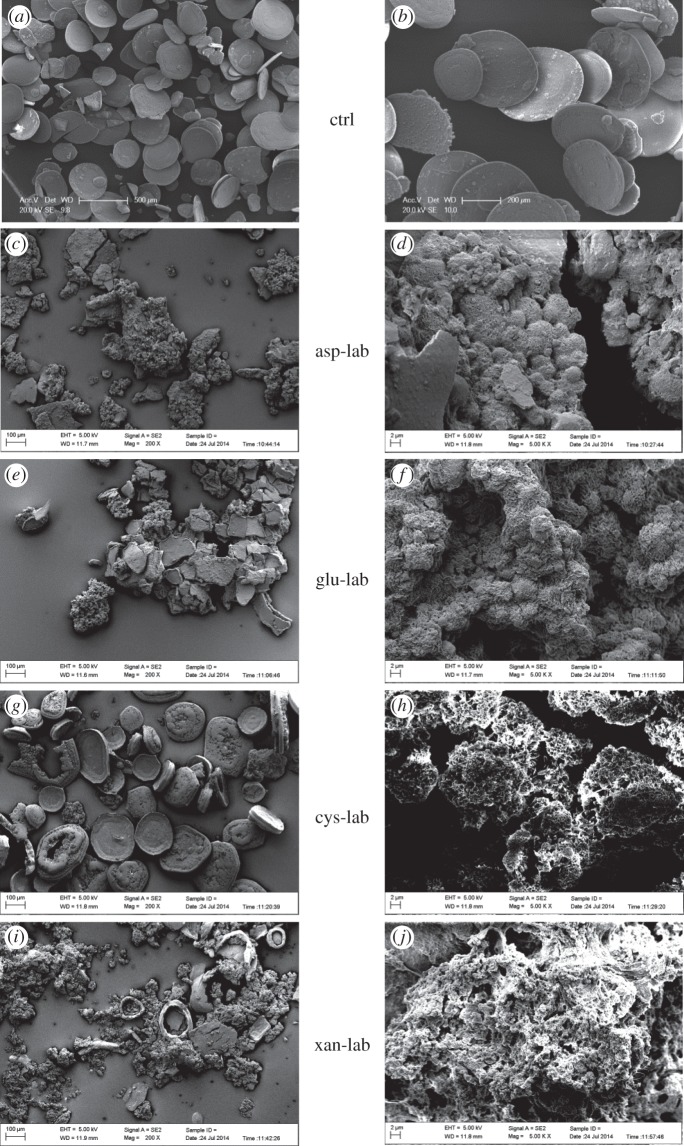
SEM photographs of hydrozincite precipitated under sterile conditions in the laboratory in (a,b) the absence of organic additives (ctrl) and (c–j) the presence of different organic additives (as labelled), simulating the presence of bacterial extracellular polymers. l-Aspartic acid (asp-lab), l-glutamic acid (glu-lab) and l-cysteine (cys-lab) were added to a concentration of 1 mg ml−1, whereas xanthan (xan-lab) was added at 0.25 mg ml−1 to reduce suspension viscosity and facilitate precipitate recovery by filtration. Note the botryoidal structure similar to natural hydrozincite in the presence of l-aspartic and l-glutamic acids; this structure is poorly developed in precipitates with l-cysteine and xanthan.
Figure 4.
Figure 4.
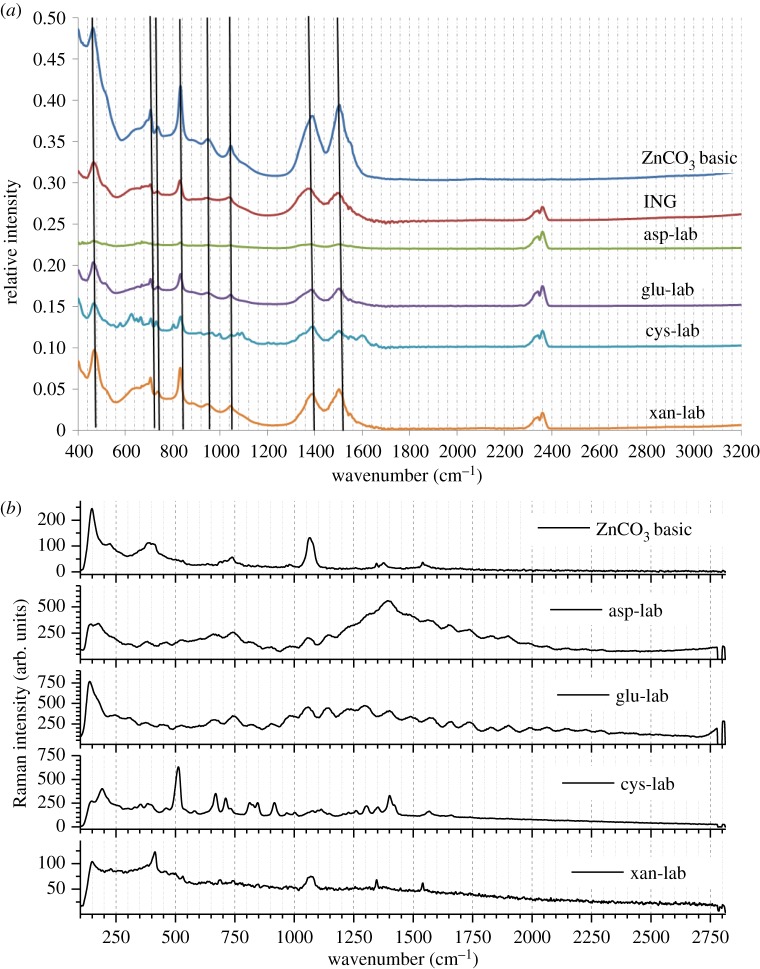
Infrared (a) and Raman (b) spectroscopic comparison of natural bio-precipitates (ING) and laboratory synthesized hydrozincites (asp-lab, glu-lab, cys-lab, xan-lab) with a commercial hydrozincite standard (ZnCO3 basic). Note the slight red shift in the peaks at 1504 and 837 cm−1 in the presence of organic additives and for the natural sample in FTIR data, while both FTIR and Raman suggest possible incorporation of l-cysteine in the precipitate. The laboratory control without additives showed an identical spectrum to the commercial standard and is not shown. (Online version in colour.)
Figure 5.
Figure 5.
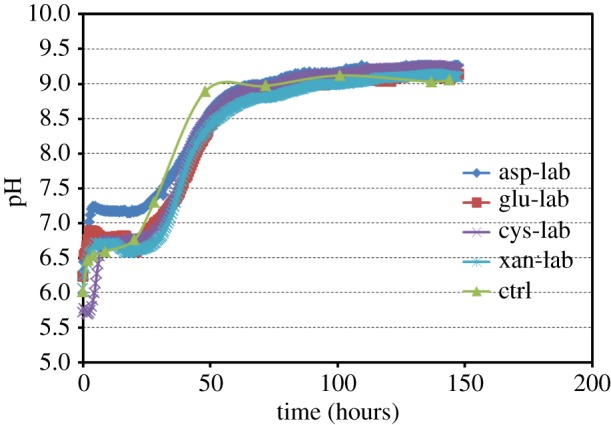
Graph showing changes in solution pH during laboratory experiments. The curves display similar trends consisting of a rapid increase in pH in the first 5 h, a nearly constant (buffered) region up to 25 h during which nucleation is thought to occur, and a third phase of rapid increase towards an asymptotic value around 9. Lines represent experiments containing l-aspartic acid (asp-lab), l-glutamic acid (glu-lab), l-cysteine (cys-lab), xanthan (xan-lab) and control without additives (ctrl). (Online version in colour.)
Figure 6.
Figure 6.
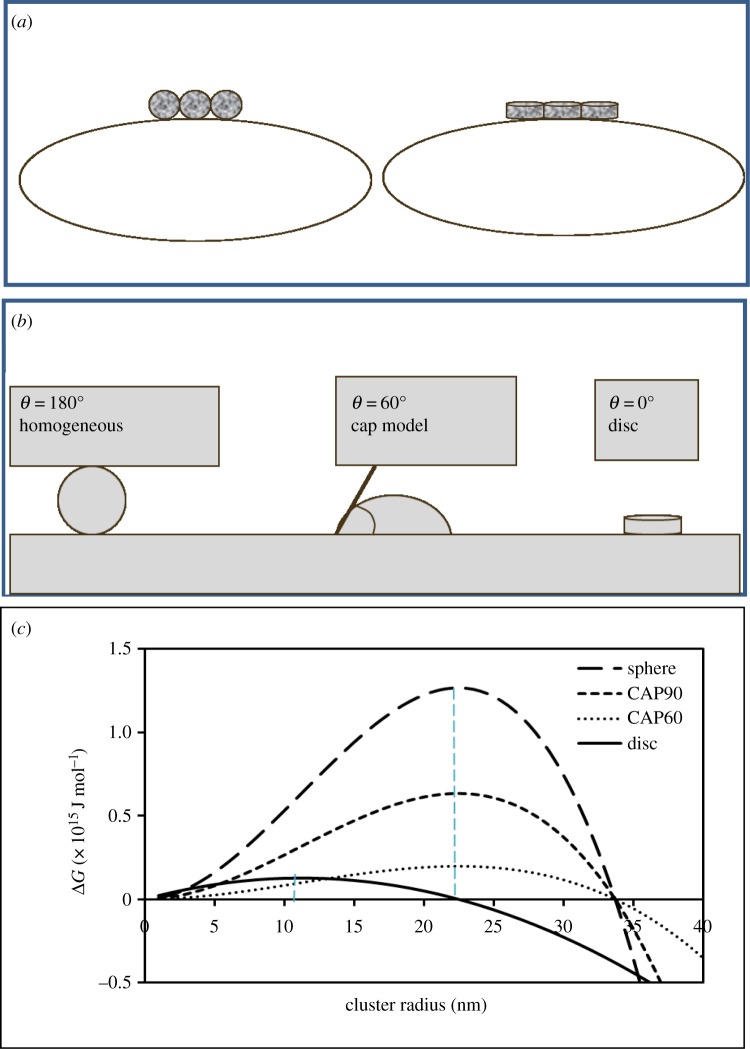
(a) Conceptual view of the relative likely potency to entomb a bacterial cell by spheres and discs and comparison of the thermodynamic drive for the nucleation of each shape (b,c), showing a lower energy cost of forming a disc-shaped nucleus. Note that equation (3.1) is multiplied by (1 − cosθ)2(2 + cosθ)/4 for heterogeneous nucleation [18], where θ is the contact angle as shown in (a). Dotted vertical lines in (c) mark the maximum ΔG for the sphere and the disc and represent the radius of the critical cluster for each shape. (Online version in colour.)

References

    1. Podda F, Zuddas P, Minacci A, Pepi A, Baldi F. 2000. Heavy metal co-precipitation with hydrozincite [Zn5(CO3)2(OH)6] from mine waters caused by photosynthetic microorganisms. Appl. Environ. Microbiol. 66, 5092–5098. ( 10.1128/AEM.66.11.5092-5098.2000) - DOI - PMC - PubMed
    1. De Giudici G, Podda F, Sanna R, Musu E, Tombolini R, Cannas C, Musinu A, Casu M. 2009. Structural properties of biologically controlled hydrozincite: an HRTEM and NMR spectroscopic study. Am. Mineral. 94, 1698–1706. ( 10.2138/am.2009.3181) - DOI
    1. Aloisi G, Gloter A, Krüger M, Wallmann K, Guyot F, Zuddas P. 2006. Nucleation of calcium carbonate on bacterial nanoglobules. Geology 34, 1017–1020. ( 10.1130/G22986A.1) - DOI
    1. Sánchez-Román M, Vasconcelos C, Schmid T, Dittrich M, McKenzie JA, Zenobi R, Rivadeneyra MA. 2008. Aerobic microbial dolomite at the nanometer scale: implications for the geologic record. Geology 36, 879–882. ( 10.1130/G25013A.1) - DOI
    1. Frolund B, Palmgren R, Keiding K, Nielsen PH. 1996. Extraction of extracellular polymers from activated sludge using a cation exchange resin. Water Res. 30, 1749–1758. ( 10.1016/0043-1354(95)00323-1) - DOI

Publication types

LinkOut - more resources