


Effects of a guided web-based smoking cessation program with telephone counseling: a cluster randomized controlled trial
- PMID: 25253539
- PMCID: PMC4211026
- DOI: 10.2196/jmir.3536
Effects of a guided web-based smoking cessation program with telephone counseling: a cluster randomized controlled trial
Abstract
Background: Preliminary findings suggest that Web-based interventions may be effective in achieving significant smoking cessation. To date, very few findings are available for primary care patients, and especially for the involvement of general practitioners.
Objective: Our goal was to examine the short-term effectiveness of a fully automated Web-based coaching program in combination with accompanied telephone counseling in smoking cessation in a primary care setting.
Methods: The study was an unblinded cluster-randomized trial with an observation period of 12 weeks. Individuals recruited by general practitioners randomized to the intervention group participated in a Web-based coaching program based on education, motivation, exercise guidance, daily short message service (SMS) reminding, weekly feedback through Internet, and active monitoring by general practitioners. All components of the program are fully automated. Participants in the control group received usual care and advice from their practitioner without the Web-based coaching program. The main outcome was the biochemically confirmed smoking status after 12 weeks.
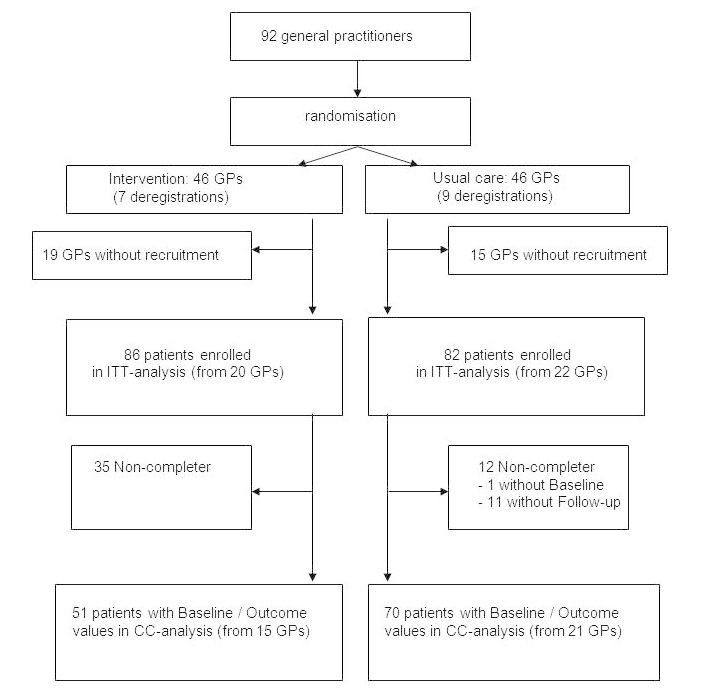
Results: We recruited 168 participants (86 intervention group, 82 control group) into the study. For 51 participants from the intervention group and 70 participants from the control group, follow-up data were available both at baseline and 12 weeks. Very few patients (9.8%, 5/51) from the intervention group and from the control group (8.6%, 6/70) successfully managed smoking cessation (OR 0.86, 95% CI 0.25-3.0; P=.816). Similar results were found within the intent-to-treat analysis: 5.8% (5/86) of the intervention group and 7.3% (6/82) of the control group (OR 1.28, 95% CI 0.38-4.36; P=.694). The number of smoked cigarettes per day decreased on average by 9.3 in the intervention group and by 6.6 in the control group (2.7 mean difference; 95% CI -5.33 to -0.58; P=.045). After adjustment for the baseline value, age, gender, and height, this significance decreases (mean difference 2.2; 95% CI -4.7 to 0.3; P=.080).
Conclusions: This trial did not show that the tested Web-based intervention was effective for achieving smoking cessation compared to usual care. The limited statistical power and the high drop-out rate may have reduced the study's ability to detect significant differences between the groups. Further randomized controlled trials are needed in larger populations and to investigate the long-term outcome.
Trial registration: German Register for Clinical Trials, registration number DRKS00003067; http://drks-neu.uniklinik-freiburg.de/drks_web/navigate.do?navigationId=trial.HTML&TRIAL_ ID=DRKS00003067 (Archived by WebCite at http://www.webcitation.org/6Sff1YZpx).
Keywords: Web-based; primary care; randomized controlled trial; smoking cessation.
Conflict of interest statement
Conflicts of Interest: This study was completely funded by HausMed eHealth Services GmbH (Berlin, Germany). The sponsor did not have access to study data and did not influence the development of this manuscript. AS, KL, and MM are employed at University Hospital Klinikum rechts der Isar, Technische Universität München. MH is a medical student. SW is employed at the Institute for Medical Biometry, Epidemiology und Medical Informatics (IMBEI), Universitätsklinikum des Saarlandes, Homburg/Saar.
Figures


References
-
- World Health Organization Fact sheet N° 339. 2013. [2014-05-12]. http://www.who.int/mediacentre/factsheets/fs339/en/
-
- World Health Organization Building blocks for Tobacco Control - A Handbook. 2004. [2014-05-12]. http://whqlibdoc.who.int/publications/2004/9241546581_eng.pdf?ua=1.
-
- Lader D. Smoking-related Behaviour and Attitudes. 2008. [2014-05-12]. Opinions Survey Report No 40 http://www.ons.gov.uk/ons/rel/lifestyles/smoking-related-behaviour-and-a....
-
- Centers for Disease Control . MMWR. Morbidity and Mortality Weekley Report 2011; 60: 2011. [2014-09-17]. Quitting smoking among adults - United States - 2001-2010 http://www.cdc.gov/mmwr/preview/mmwrhtml/mm6044a2.htm.
Publication types
MeSH terms
LinkOut - more resources
Full Text Sources
Other Literature Sources
Medical
Research Materials
Miscellaneous
