. 2014 Nov;21(11):1581-8.
doi: 10.1128/CVI.00489-14. Epub 2014 Sep 24.

Inter- and intralaboratory comparison of JC polyomavirus antibody testing using two different virus-like particle-based assays

Affiliations

Inter- and intralaboratory comparison of JC polyomavirus antibody testing using two different virus-like particle-based assays

Piotr Kardas et al. Clin Vaccine Immunol. 2014 Nov.

Abstract

JC polyomavirus (JCPyV) can cause progressive multifocal leukoencephalopathy (PML), a debilitating, often fatal brain disease in immunocompromised patients. JCPyV-seropositive multiple sclerosis (MS) patients treated with natalizumab have a 2- to 10-fold increased risk of developing PML. Therefore, JCPyV serology has been recommended for PML risk stratification. However, different antibody tests may not be equivalent. To study intra- and interlaboratory variability, sera from 398 healthy blood donors were compared in 4 independent enzyme-linked immunoassay (ELISA) measurements generating >1,592 data points. Three data sets (Basel1, Basel2, and Basel3) used the same basic protocol but different JCPyV virus-like particle (VLP) preparations and introduced normalization to a reference serum. The data sets were also compared with an independent method using biotinylated VLPs (Helsinki1). VLP preadsorption reducing ≥35% activity was used to identify seropositive sera. The results indicated that Basel1, Basel2, Basel3, and Helsinki1 were similar regarding overall data distribution (P = 0.79) and seroprevalence (58.0, 54.5, 54.8, and 53.5%, respectively; P = 0.95). However, intra-assay intralaboratory comparison yielded 3.7% to 12% discordant results, most of which were close to the cutoff (0.080 < optical density [OD] < 0.250) according to Bland-Altman analysis. Introduction of normalization improved overall performance and reduced discordance. The interlaboratory interassay comparison between Basel3 and Helsinki1 revealed only 15 discordant results, 14 (93%) of which were close to the cutoff. Preadsorption identified specificities of 99.44% and 97.78% and sensitivities of 99.54% and 95.87% for Basel3 and Helsinki1, respectively. Thus, normalization to a preferably WHO-approved reference serum, duplicate testing, and preadsorption for samples around the cutoff may be necessary for reliable JCPyV serology and PML risk stratification.


Figures

FIG 1
FIG 1
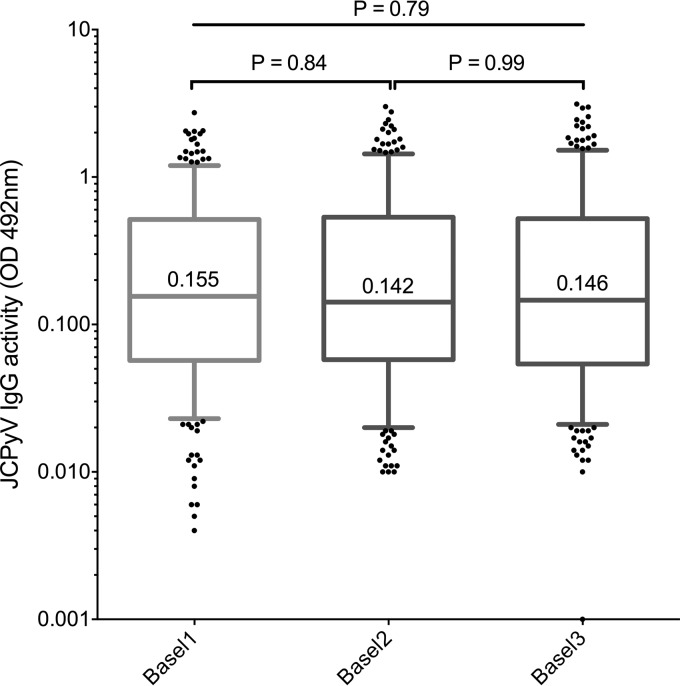
Intralaboratory comparison of JCPyV VLP IgG activity (OD492) by ELISA in 398 health blood donors. Basel1 shows the IgG activity results as reported previously; Basel2 shows results of retesting using a newly prepared VLP batch; Basel3 shows results of retesting together with the internal normalization control using reference serum (Basel3). IgG activity corresponds to an optical density at 492 nm without or with normalization (OD492/nOD492) as described in Materials and Methods. Boxes span the interquartile range (IQR) with the 25th and the 75th percentiles. The number in the box indicates the median, the whiskers indicate the 5th and 95th percentile range, and dots indicate outliers below and above the range. P values were calculated by the Kruskal-Wallis test and Mann-Whitney U test.
FIG 2
FIG 2
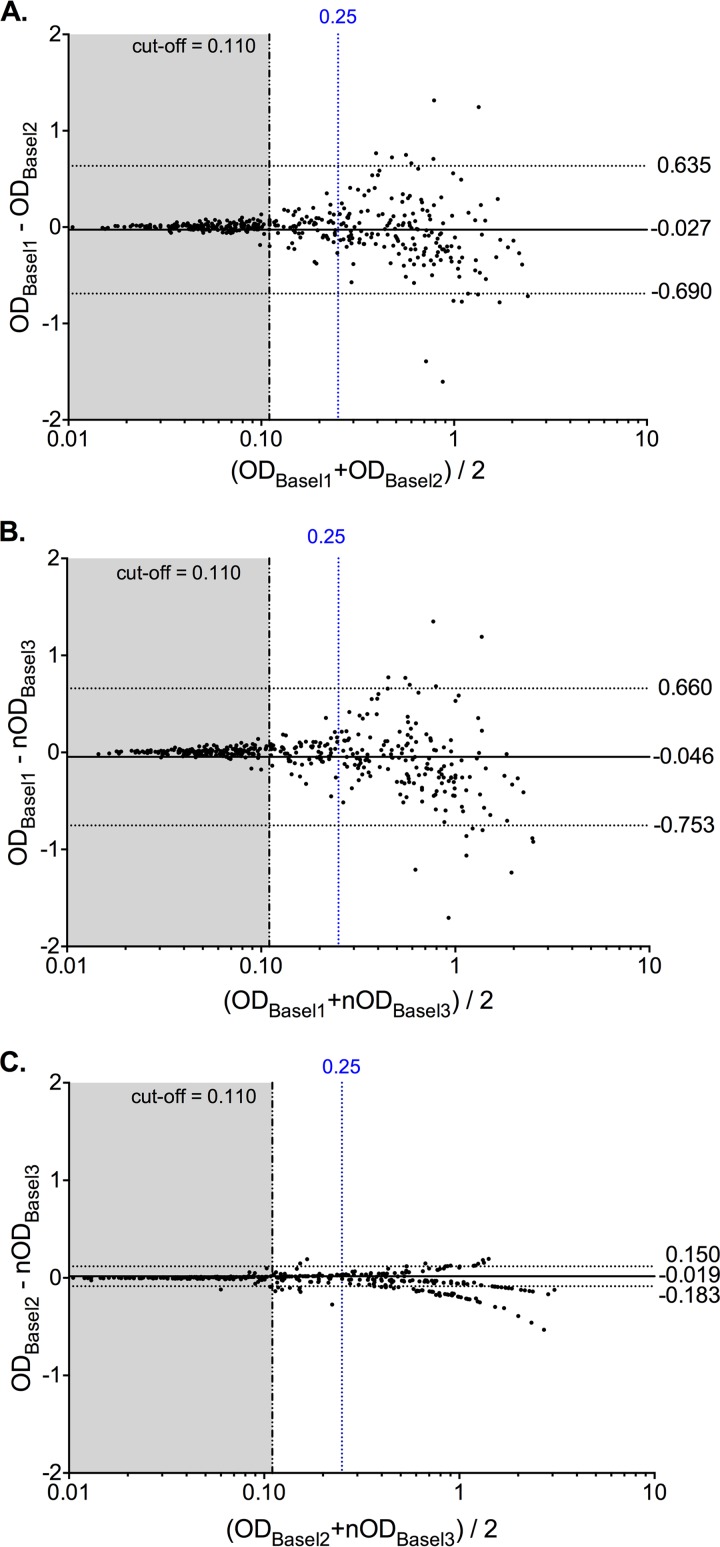
Intralaboratory comparison of JCPyV serology results using Bland-Altman analysis. (A) Basel1 versus Basel2. (B) Basel1 versus Basel3. (C) Basel2 versus Basel3. In each panel, the solid horizontal line represents the overall median bias, and dashed horizontal lines indicate the 95% confidence interval. The black vertical dashed line indicates the assay cutoff at an OD of 0.110, and the blue vertical dashed line indicates an OD of 0.25.
FIG 3
FIG 3
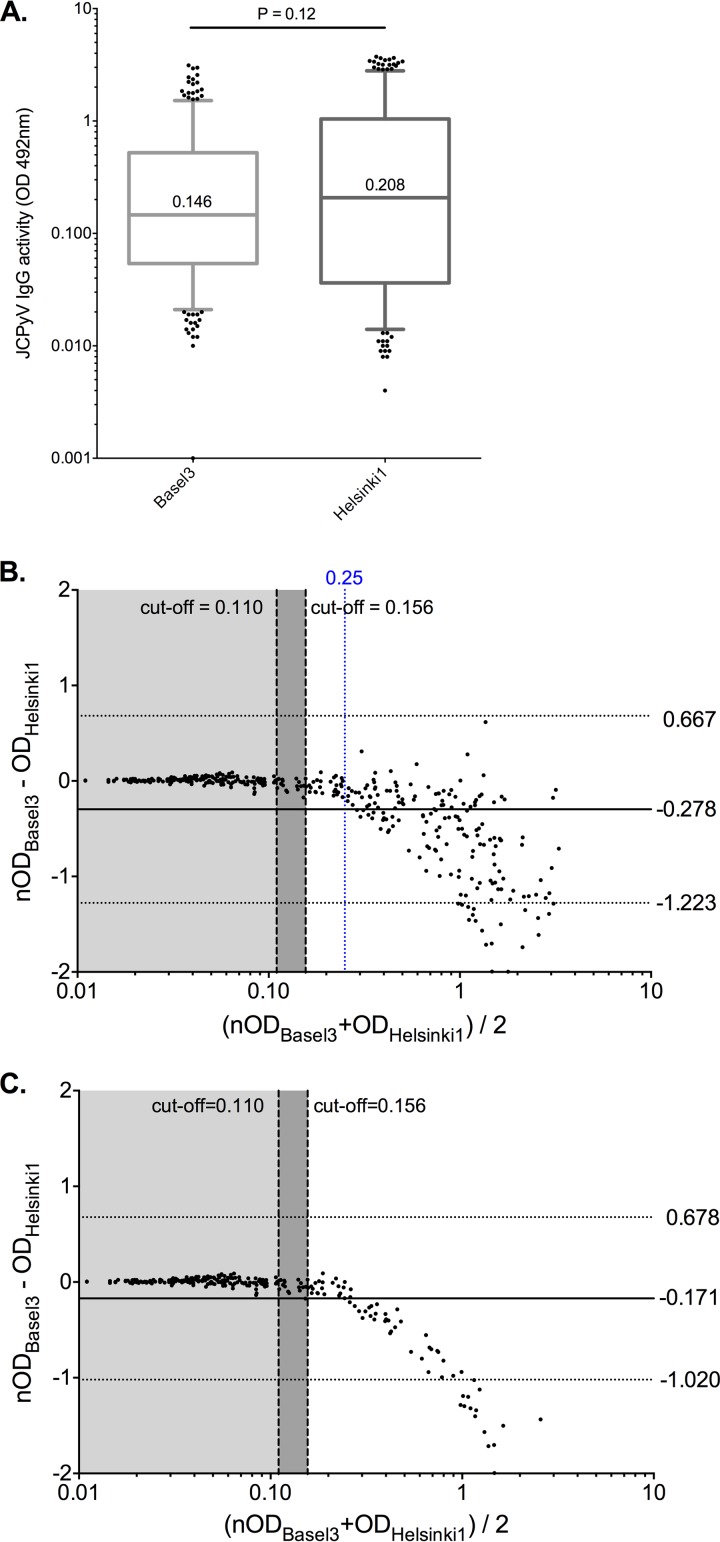
JCPyV serology results using the biotinylated VLPs (Helsinki1). (A) Overall serology results of 398 healthy blood donors (Helsinki1) as described in Materials and Methods and in the legend to Fig. 1. (B) Bland-Altman analysis comparing Basel3 versus Helsinki1. (C) Bland-Altman analysis comparing Basel3 versus Helsinki1 restricted to data points of an OD of <0.25 in the Basel3 assay. The solid horizontal line represents the overall median bias, and dashed horizontal lines indicate the 95% confidence interval. The left vertical black dashed line indicates the assay cutoff OD of 0.110 of the Basel assays, the right vertical black dashed line indicates the assay cutoff OD of 0.156 of the Helsinki1 assay, and the blue vertical dashed line indicates the OD of 0.25.
FIG 4
FIG 4
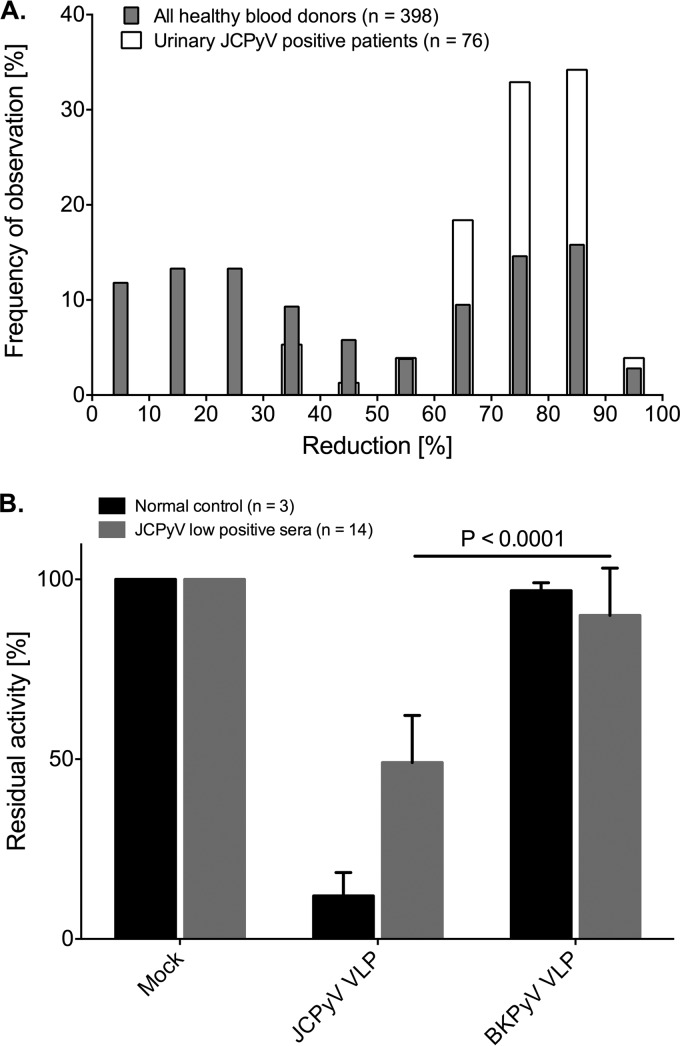
Distribution of OD reductions in healthy blood donors and 76 patients shedding JCPyV in urine after preincubation with JCPyV VLPs and contribution of cross-reactive BKPyV antibodies to JCPyV-specific activity. (A) The histogram indicates the percentage of individuals with the corresponding degree of reduction of IgG activity after preadsorption with JCPyV VLPs as described in Materials and Methods. The results for 76 patients with JCPyV DNA-positive urine samples are shown (white bars), as are the results for 398 healthy blood donors (gray bars). Assuming that all urinary JCPyV DNA-positive patients are also JCPyV seropositive, a 35% reduction was determined for definition of serum samples with JCPyV-specific antibody titers. (B) A bar chart presents the remaining activity of JCPyV-specific antibodies for 14 low-JCPyV sera after preincubation with either JCPyV or BKPyV VLPs. The P value was calculated by t test.

References

    1. Hirsch HH, Kardas P, Kranz D, Leboeuf C. 2013. The human JC polyomavirus (JCPyV): virological background and clinical implications. APMIS 121:685–727. 10.1111/apm.12128. - DOI - PubMed
    1. Egli A, Infanti L, Dumoulin A, Buser A, Samaridis J, Stebler C, Gosert R, Hirsch HH. 2009. Prevalence of polyomavirus BK and JC infection and replication in 400 healthy blood donors. J. Infect. Dis. 199:837–846. 10.1086/597126. - DOI - PubMed
    1. Polo C, Perez JL, Mielnichuck A, Fedele CG, Niubo J, Tenorio A. 2004. Prevalence and patterns of polyomavirus urinary excretion in immunocompetent adults and children. Clin. Microbiol. Infect. 10:640–644. 10.1111/j.1469-0691.2004.00882.x. - DOI - PubMed
    1. Chesters PM, Heritage J, McCance DJ. 1983. Persistence of DNA sequences of BK virus and JC virus in normal human tissues and in diseased tissues. J. Infect. Dis. 147:676–684. 10.1093/infdis/147.4.676. - DOI - PubMed
    1. Ferenczy MW, Marshall LJ, Nelson CD, Atwood WJ, Nath A, Khalili K, Major EO. 2012. Molecular biology, epidemiology, and pathogenesis of progressive multifocal leukoencephalopathy, the JC virus-induced demyelinating disease of the human brain. Clin. Microbiol. Rev. 25:471–506. 10.1128/CMR.05031-11. - DOI - PMC - PubMed

Publication types

MeSH terms