


Social relationships and hypertension in late life: evidence from a nationally representative longitudinal study of older adults
- PMID: 25253728
- PMCID: PMC4368483
- DOI: 10.1177/0898264314551172
Social relationships and hypertension in late life: evidence from a nationally representative longitudinal study of older adults
Abstract
Objective: Social relationships are widely understood to be important for sustaining and improving health and longevity, but it remains unclear how different dimensions of social relationships operate through similar or distinct mechanisms to affect biophysiological markers of aging-related disease over time.
Method: This study utilized longitudinal data on a nationally representative sample of older adults from the National Social Life, Health, and Aging Project (2005-2011) to examine the prospective associations between social integration and social support and change in systolic blood pressure (SBP) and hypertension risk over time.
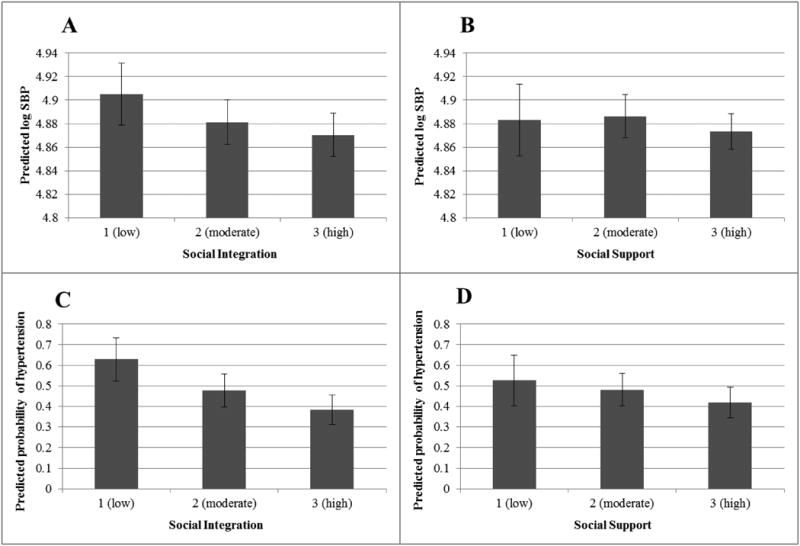
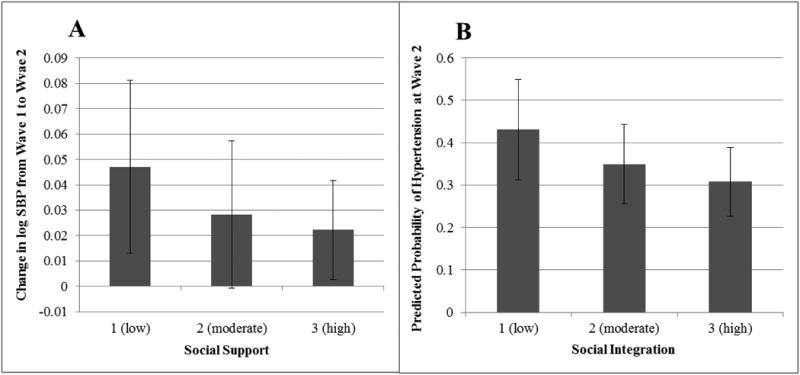
Results: Although both social relationship dimensions have significant physiological impacts, their relative importance differs by outcome. Low social support was predictive of increase in SBP, whereas low social integration was predictive of increase in risk of hypertension.
Discussion: The different roles of relationship characteristics in predicting change in physiological outcomes suggest specific biophysiological stress response and behavioral mechanisms that have important implications for both scientific understandings and effective prevention and control of a leading chronic condition in late life.
Keywords: blood pressure; hypertension; longitudinal analysis; social integration; social support; stress response.
© The Author(s) 2014.
Figures
References
-
- Allison PD. Change scores as dependent variables in regression analysis. Sociological Methodology. 1990:93–114. doi: 10.2307/271083. - DOI
-
- Berkman LF, Syme L. Social Networks, Host Resistance, and Mortality: A Nine-year Follow-up Study of Alameda County Residents. American Journal of Epidemiology. 1979;109(2):186–204. - PubMed
-
- Berkman LF, Vaccarino V, Seeman T. Gender Differences in Cardiovascular Morbidity and Mortality: The Contributions of Social Networks and Support. Annals of Behavioral Medicine. 1993;15(2-3):112–118.
-
- Brummett BH, Barefoot JC, Siegler IC, Clapp-Channing NE, Lytle BL, Bosworth HB, Williams Redford B, Mark DB. Characteristics of socially isolated patients with coronary artery disease who are at elevated risk for mortality. Psychosomatic Medicine. 2001;63(2):267–272. - PubMed
Publication types
MeSH terms
Grants and funding
LinkOut - more resources
Full Text Sources
Other Literature Sources
Medical
