


Self-reported memory complaints: implications from a longitudinal cohort with autopsies
- PMID: 25253756
- PMCID: PMC4189103
- DOI: 10.1212/WNL.0000000000000856
Self-reported memory complaints: implications from a longitudinal cohort with autopsies
Abstract
Objective: We assessed salience of subjective memory complaints (SMCs) by older individuals as a predictor of subsequent cognitive impairment while accounting for risk factors and eventual neuropathologies.
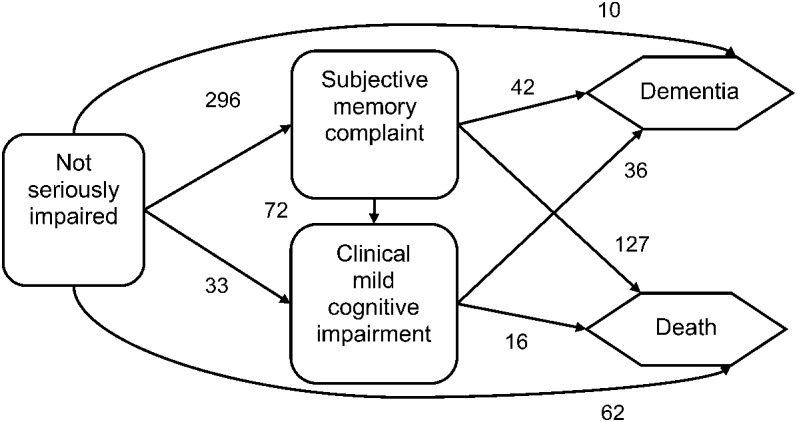
Methods: Subjects (n = 531) enrolled while cognitively intact at the University of Kentucky were asked annually if they perceived changes in memory since their last visit. A multistate model estimated when transition to impairment occurred while adjusting for intervening death. Risk factors affecting the timing and probability of an impairment were identified. The association between SMCs and Alzheimer-type neuropathology was assessed from autopsies (n = 243).
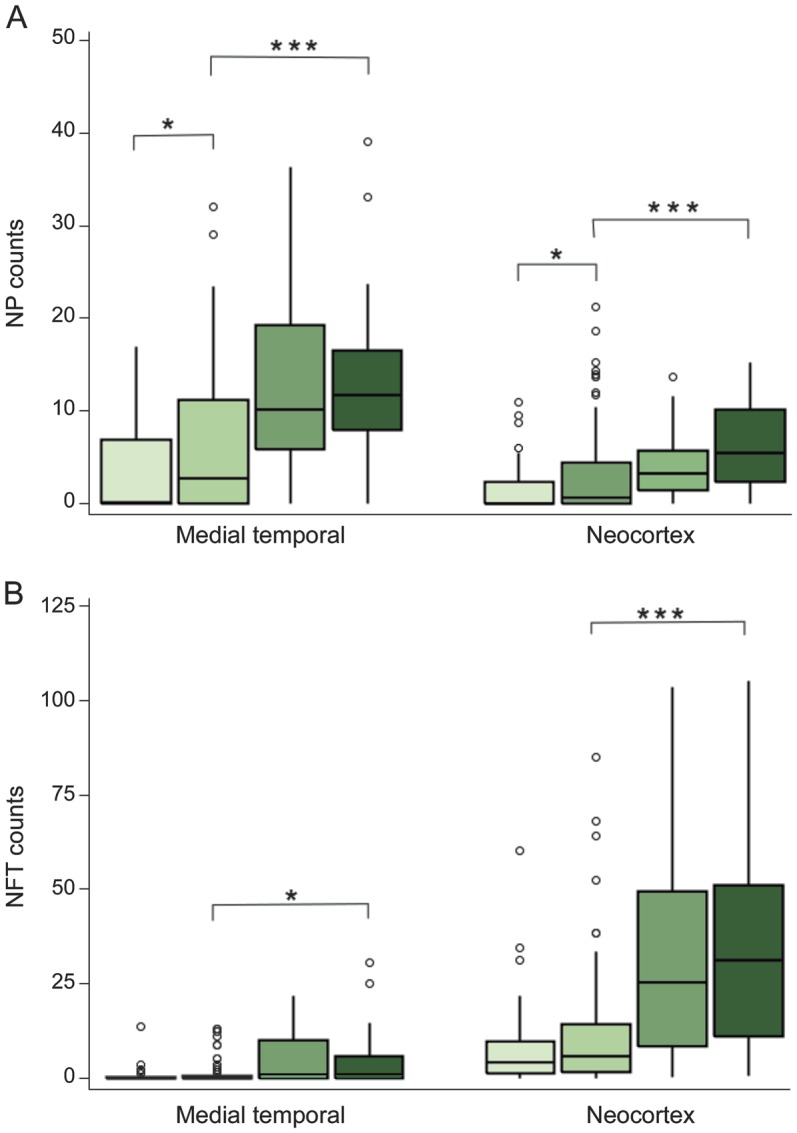
Results: SMCs were reported by more than half (55.7%) of the cohort, and were associated with increased risk of impairment (unadjusted odds ratio = 2.8, p < 0.0001). Mild cognitive impairment (dementia) occurred 9.2 (12.1) years after SMC. Multistate modeling showed that SMC reporters with an APOE ε4 allele had double the odds of impairment (adjusted odds ratio = 2.2, p = 0.036). SMC smokers took less time to transition to mild cognitive impairment, while SMC hormone-replaced women took longer to transition directly to dementia. Among participants (n = 176) who died without a diagnosed clinical impairment, SMCs were associated with elevated neuritic amyloid plaques in the neocortex and medial temporal lobe.
Conclusion: SMC reporters are at a higher risk of future cognitive impairment and have higher levels of Alzheimer-type brain pathology even when impairment does not occur. As potential harbingers of future cognitive decline, physicians should query and monitor SMCs from their older patients.
© 2014 American Academy of Neurology.
Figures
Comment in
-
Self-reported memory complaints: Implications from a longitudinal cohort with autopsies.Neurology. 2015 Jun 9;84(23):2384. doi: 10.1212/WNL.0000000000001677. Neurology. 2015. PMID: 26054896 No abstract available.
-
Author Response.Neurology. 2015 Jun 9;84(23):2384. Neurology. 2015. PMID: 26251864 No abstract available.
References
-
- van Harten AC, Visser PJ, Pijnenburg YA, et al. Cerebrospinal fluid Aβ42 is the best predictor of clinical progression in patients with subjective complaints. Alzheimers Dement 2013;9:481–487 - PubMed
-
- Wang L, Van Belle G, Crane PK, et al. Subjective memory deterioration and future dementia in people aged 65 and older. J Am Geriatr Soc 2004;52:2045–2051 - PubMed
-
- Geerlings MI, Jonker C, Bouter LM, Adèr HJ, Schmand B. Association between memory complaints and incident Alzheimer's disease in elderly people with normal baseline cognition. Am J Psychiatry 1999;156:531–537 - PubMed
-
- Jungwirth S, Zehetmayer S, Weissgram S, Weber G, Tragl KH, Fischer P. Do subjective memory complaints predict senile Alzheimer dementia? Wien Med Wochenschr 2008;158:71–77 - PubMed
Publication types
MeSH terms
Substances
Grants and funding
LinkOut - more resources
Full Text Sources
Other Literature Sources
Medical
Research Materials
Miscellaneous
