. 2014 Sep 24;34(39):13183-94.
doi: 10.1523/JNEUROSCI.0597-14.2014.

The neural correlates of planning and executing actual tool use

Affiliations

The neural correlates of planning and executing actual tool use

Marie-Luise Brandi et al. J Neurosci. .

Abstract

Human tool use is complex, and underlying neural mechanisms seem to be widely distributed across several brain systems; however, neuroimaging studies of actual tool use are rare because of experimental challenges hindering detailed analysis within one acting subject. We developed a "Tool-Carousel" that enabled us to test actual manipulation of different objects during fMRI and investigate the planning and execution of goal-directed actions. Particularly, we focused on the effects of three factors on object manipulations: the type of object manipulated, the type of manipulation, and the hand to be used. The main focus lay on the question of how complex object use compared with unspecific actions are processed and especially how such representations interact with the knowledge about the object in the action-related dorsal stream. We found that object manipulations with both right and left hand recruit a common network strongly lateralized to the left hemisphere especially during planning but also action execution. Specifically, while activity in the ventral stream was involved in processing semantic information and object properties, a dorso-dorsal pathway (i.e., superior occipital gyrus, superior parietal lobule, and dorsal premotor area) was relevant for monitoring the online control of objects and also a ventro-dorsal pathway (i.e., middle occipital gyrus, inferior parietal lobule, and ventral premotor area) was specifically involved in processing known object manipulations, such as tool use. Data further indicate an interaction of ventral stream areas, such as middle temporal gyrus and lateral occipital complex, with both dorsal pathways. These results provide evidence for left-lateralized occipito-temporo-parieto-frontal network of everyday tool use, which may help to characterize specific deficits in patients suffering from apraxia.

Keywords: action execution; action planning; fMRI; tool use.


Figures

Figure 1.
Figure 1.
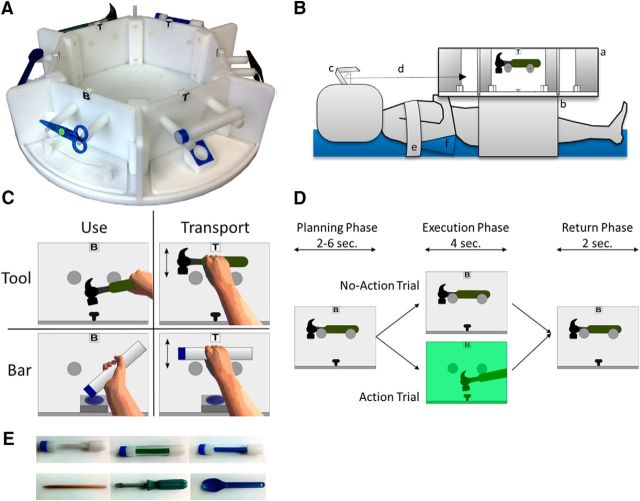
A, The “Tool-Carousel” with six compartments and mountings to hold the tools. B, The experimental setup: a, “Tool-Carousel”; b, adjustable table; c, two-mirror system attached to the head coil; d, visual path to field of vision; e, shoulder belt; f, arm rest. C, Illustration of the four experimental conditions: tool use, tool transport, bar use, and bar transport. All four conditions are performed with the right hand in one and with the left hand in the other run. D, Time course of a trial. Each trial consists of a planning phase (2–6 s long), an execution phase (4 s long), and a return phase (2 s long). In no-action trials, no green light appears; and in action trials, a green light triggers the start of the action. The return phase started when the green light was turned off. No-action trials were used to analyze the planning phase and action trials for the execution phase. E, An exemplary selection of the used stimuli in the experiment; shown are the pen, screwdriver, and spoon and the matched bars.
Figure 2.
Figure 2.
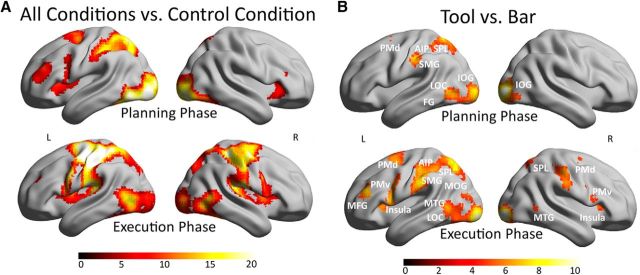
Whole-brain results for the action network in A and the main contrast for the factor object in B. A, The activity maps of the contrast all conditions versus control condition shown for the planning phase in the top and for the execution phase on the bottom. B, The activity map of the contrast tool versus bar is shown for the planning phase in the top and for the execution phase in the bottom. All results of Figure 2 are shown at a threshold of p < 0.05 (FWE corrected) on a rendered brain. The color scale under the brain images indicates the range of the T values from low values in dark red to high values in white. IOG, Inferior occipital gyrus; MOG, middle occipital gyrus.
Figure 3.
Figure 3.
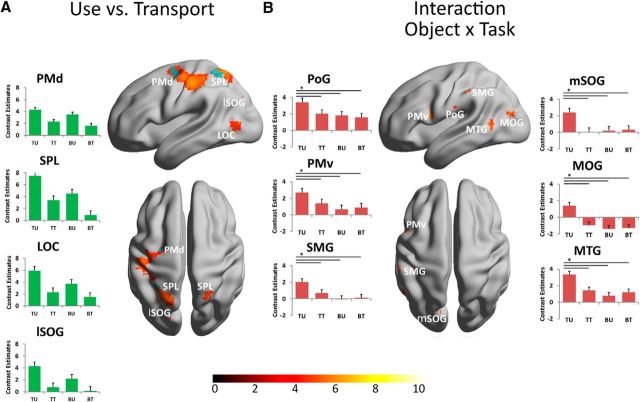
Results showing the influence of the factor task on the action network. A, Activity map of the contrast use versus transport is shown for the execution phase. Bar plots represent the contrast estimates of the peak voxel and 90% CI in the labeled cluster for all four conditions. TU, Tool use; TT, tool transport; BU, bar use; BT, bar transport. The uncorrected activations during the planning phase that did not survive the correction for multiple testing are shown as a blue overlay. B, Activity maps of the interaction between the factor object and task ((tool use vs tool transport) − (bar use vs bar transport)) is superimposed onto a rendered brain for the execution phase. All results of Figure 3 are shown at a threshold of p < 0.05 (FWE corrected). *The three lines across the bar plots indicate that the contrast estimates of the condition tool use is significantly higher than in the other conditions with a threshold of p < 0.001. The color scale under the brain images indicates the range of the T values from low values in dark red to high values in white. MOG, Middle occipital gyrus; PoG, postcentral gyrus.
Figure 4.
Figure 4.
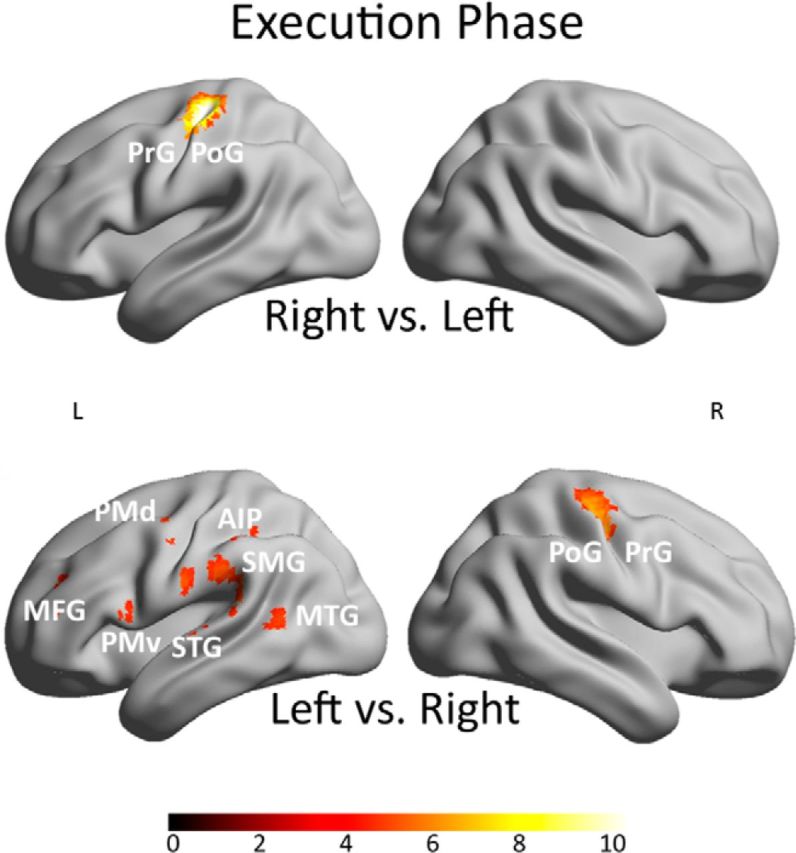
Results showing the influence of the factor hand on the action network. Activation maps of the contrast right hand versus left hand on the top and left hand versus right hand on the bottom for the execution phase. All results of Figure 4 are shown at a threshold of p < 0.05 (FWE corrected) on a rendered brain. The color scale under the brain images indicates the range of the T values from low values in dark red to high values in white. IOG, Inferior occipital gyrus; STG, superior temporal gyrus; PrG, precentral gyrus; PoG, postcentral gyrus.

References

    1. Beauchamp MS, Lee KE, Haxby JV, Martin A. Parallel visual motion processing streams for manipulable objects and human movements. Neuron. 2002;34:149–159. doi: 10.1016/S0896-6273(02)00642-6. - DOI - PubMed
    1. Binkofski F, Buxbaum LJ. Two action systems in the human brain. Brain Lang. 2013;127:222–229. doi: 10.1016/j.bandl.2012.07.007. - DOI - PMC - PubMed
    1. Boronat CB, Buxbaum LJ, Coslett HB, Tang K, Saffran EM, Kimberg DY, Detre JA. Distinctions between manipulation and function knowledge of objects: evidence from functional magnetic resonance imaging. Brain Res Cogn Brain Res. 2005;23:361–373. doi: 10.1016/j.cogbrainres.2004.11.001. - DOI - PubMed
    1. Buxbaum LJ, Kalénine S. Action knowledge, visuomotor activation, and embodiment in the two action systems. Ann N Y Acad Sci. 2010;1191:201–218. doi: 10.1111/j.1749-6632.2010.05447.x. - DOI - PMC - PubMed
    1. Cavina-Pratesi C, Monaco S, Fattori P, Galletti C, McAdam TD, Quinlan DJ, Goodale MA, Culham JC. Functional magnetic resonance imaging reveals the neural substrates of arm transport and grip formation in reach-to-grasp actions in humans. J Neurosci. 2010;30:10306–10323. doi: 10.1523/JNEUROSCI.2023-10.2010. - DOI - PMC - PubMed

Publication types

LinkOut - more resources