Strongyloides stercoralis: systematic review of barriers to controlling strongyloidiasis for Australian indigenous communities
- PMID: 25254655
- PMCID: PMC4177786
- DOI: 10.1371/journal.pntd.0003141
Strongyloides stercoralis: systematic review of barriers to controlling strongyloidiasis for Australian indigenous communities
Abstract
Background: Strongyloides stercoralis infects human hosts mainly through skin contact with contaminated soil. The result is strongyloidiasis, a parasitic disease, with a unique cycle of auto-infection causing a variety of symptoms and signs, with possible fatality from hyper-infection. Australian Indigenous community members, often living in rural and remote settings, are exposed to and infected with S. stercoralis. The aim of this review is to determine barriers to control of strongyloidiasis. The purpose is to contribute to the development of initiatives for prevention, early detection and effective treatment of strongyloidiasis.
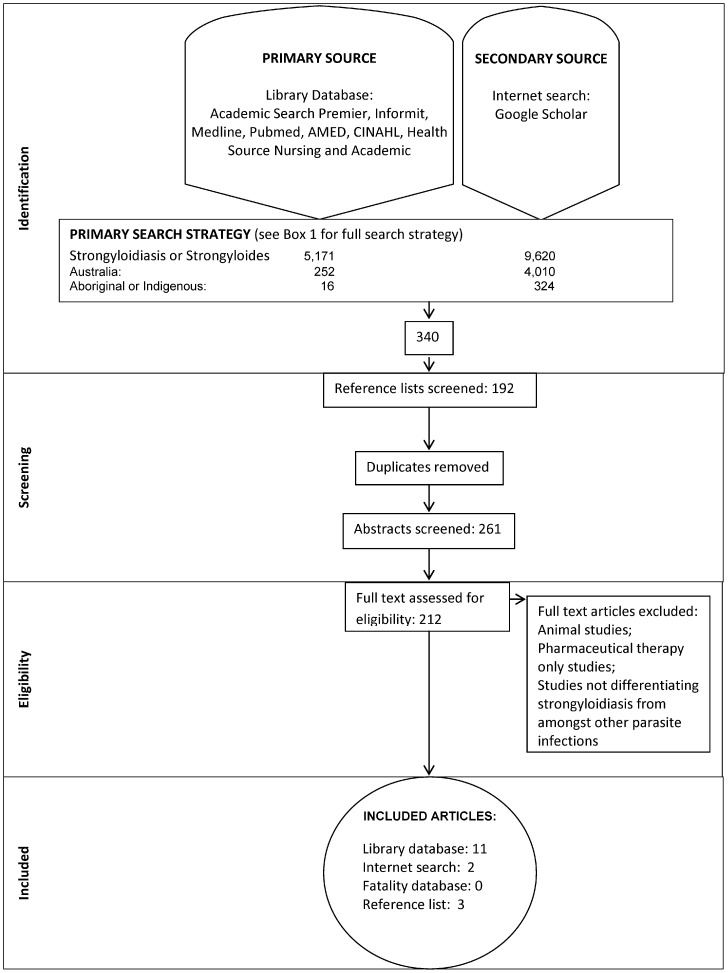
Methodology/principle findings: Systematic search reviewing research published 2012 and earlier was conducted. Research articles discussing aspects of strongyloidiasis, context of infection and overall health in Indigenous Australians were reviewed. Based on the PRISMA statement, the systematic search of health databases, Academic Search Premier, Informit, Medline, PubMed, AMED, CINAHL, Health Source Nursing and Academic was conducted. Key search terms included strongyloidiasis, Indigenous, Australia, health, and community. 340 articles were retrieved with 16 original research articles published between 1969 and 2006 meeting criteria. Review found barriers to control defined across three key themes, (1) health status, (2) socioeconomic status, and (3) health care literacy and procedures.
Conclusions/significance: This study identifies five points of intervention: (1) develop reporting protocols between health care system and communities; (2) test all Indigenous Australian patients, immunocompromised patients and those exposed to areas with S. stercoralis; (3) health professionals require detailed information on strongyloidiasis and potential for exposure to Indigenous Australian people; (4) to establish testing and treatment initiatives within communities; and (5) to measure and report prevalence rates specific to communities and to act with initiatives based on these results. By defining barriers to control of strongyloidiasis in Australian Indigenous people, improved outcomes of prevention, treatment of strongyloidiasis and increased health overall are attainable.
Conflict of interest statement
The authors have declared that no competing interests exist.
Figures
References
-
- Speare R. (1989) Identification of species of strongyloides. In: Grove D, editor. Strongyloidiasis: a major roundworm infection of man. London: Taylor and Francis Ltd. pp.11–83.
-
- Kukuruzovic R, Robins-Browne RM, Anstey NM, Brewster DR (2002) Enteric pathogens, intestinal permeability and nitric oxide production in acute gastroenteritis. Pediatr Infect Dis J 21: 730–739. - PubMed
-
- Aland K, Prociv P, Currie B, Jones H (1996) Worm project at Galiwin'ku. Working Together 6: 10.
-
- Flannery G, White N. (1993) Immunological parameters in northeast Arnhem Land aborigines: Consequences of changing settlement patterns and lifestyles. Urban Ecology and Health in the Third World.Cambridge University Press, Cambridge: 202–220.
-
- Prociv P, Luke R (1993) Observations on strongyloidiasis in Queensland aboriginal communities. Med J Aust 158: 160–163. - PubMed
Publication types
MeSH terms
LinkOut - more resources
Full Text Sources
Other Literature Sources