


Antiangiogenic effects of topically administered multiple kinase inhibitor, motesanib (AMG 706), on experimental choroidal neovascularization in mice
- PMID: 25255037
- PMCID: PMC4286588
- DOI: 10.1089/jop.2014.0023
Antiangiogenic effects of topically administered multiple kinase inhibitor, motesanib (AMG 706), on experimental choroidal neovascularization in mice
Abstract
Purpose: To investigate the effect of topical motesanib, an inhibitor of receptor tyrosine kinase, on experimental choroidal neovascularization (CNV).
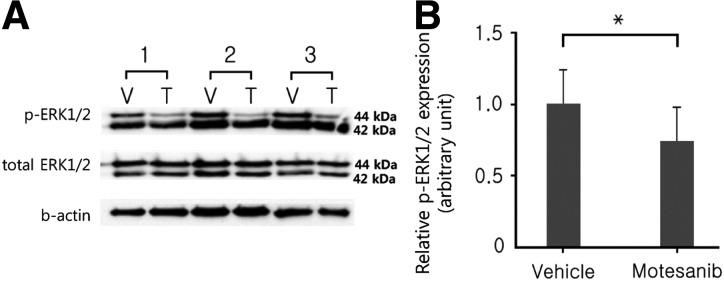
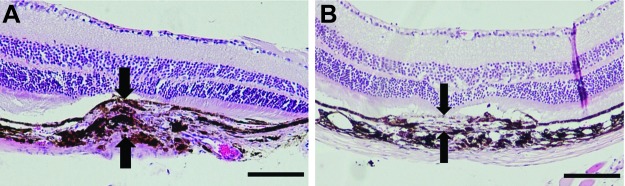
Methods: CNV was induced in 46 nine-week-old male C57BL/6 mice using fundus laser photocoagulation. The right eye of each mouse was treated with motesanib eye drop (4 times daily) and the left eye with vehicle eye drop (4 times daily) for 14 days. To evaluate changes in the CNV lesions, fluorescein angiography, immunofluorescence staining with CD34, and histological examinations were performed 14 days after CNV induction. The expression of phosphorylated extracellular signal-regulated kinase (ERK1/2) in choroidal tissues was determined using western blot analysis to demonstrate the inhibitory effect of topically administered motesanib on intracellular signaling pathways involved in CNV development.
Results: Fluorescein angiography showed that fluorescence leakage in eyes treated with topical motesanib was significantly less than in mice treated with vehicle (P=0.01). On immunofluorescence staining, the CD34-labeled area was smaller in topical motesanib-treated eyes (P<0.001). The expression level of phosphorylated ERK1/2 relative to that of total ERK1/2 decreased in eyes treated with topical motesanib compared with eyes treated with vehicle.
Conclusion: Topical motesanib significantly reduced laser-induced CNV in the experimental mouse model.
Figures


References
-
- Amin R., Puklin J.E., and Frank R.N.Growth factor localization in choroidal neovascular membranes of age-related macular degeneration. Invest. Ophthalmol. Vis. Sci. 35:3178–3188, 1994 - PubMed
-
- Funk M., Karl D., Georgopoulos M., et al. Neovascular age-related macular degeneration: intraocular cytokines and growth factors and the influence of therapy with ranibizumab. Ophthalmology. 116:2393–2399, 2009 - PubMed
-
- Lambooij A.C., van Wely K.H., Lindenbergh-Kortleve D.J., et al. Insulin-like growth factor-I and its receptor in neovascular age-related macular degeneration. Invest. Ophthalmol. Vis. Sci. 44:2192–2198, 2003 - PubMed
-
- Raghav K.P., and Blumenschein G.R.Motesanib and advanced NSCLC: experiences and expectations. Expert Opin. Investig. Drugs 20:859–869, 2011 - PubMed
Publication types
MeSH terms
Substances
LinkOut - more resources
Full Text Sources
Other Literature Sources
Miscellaneous