Clinical Trial
. 2014 Sep 24;106(11):dju268.
doi: 10.1093/jnci/dju268. Print 2014 Nov.

Activated lymphocyte recruitment into the tumor microenvironment following preoperative sipuleucel-T for localized prostate cancer

Affiliations
Clinical Trial

Activated lymphocyte recruitment into the tumor microenvironment following preoperative sipuleucel-T for localized prostate cancer

Lawrence Fong et al. J Natl Cancer Inst. .

Erratum in

  • J Natl Cancer Inst. 2014 Nov;106(11):dju372 doi:10.1093/jnci/dju372

Abstract

Background: Sipuleucel-T is a US Food and Drug Administration-approved immunotherapy for asymptomatic or minimally symptomatic metastatic castration-resistant prostate cancer (mCRPC). Its mechanism of action is not fully understood. This prospective trial evaluated the direct immune effects of systemically administered sipuleucel-T on prostatic cancer tissue in the preoperative setting.

Methods: Patients with untreated localized prostate cancer were treated on an open-label Phase II study of sipuleucel-T prior to planned radical prostatectomy (RP). Immune infiltrates in RP specimens (posttreatment) and in paired pretreatment biopsies were evaluated by immunohistochemistry (IHC). Correlations between circulating immune response and IHC were assessed using Spearman rank order.

Results: Of the 42 enrolled patients, 37 were evaluable. Adverse events were primarily transient, mild-to-moderate and infusion related. Patients developed T cell proliferation and interferon-γ responses detectable in the blood following treatment. Furthermore, a greater-than-three-fold increase in infiltrating CD3(+), CD4(+) FOXP3(-), and CD8(+) T cells was observed in the RP tissues compared with the pretreatment biopsy (binomial proportions: all P < .001). This level of T cell infiltration was observed at the tumor interface, and was not seen in a control group consisting of 12 concurrent patients who did not receive any neoadjuvant treatment prior to RP. The majority of infiltrating T cells were PD-1(+) and Ki-67(+), consistent with activated T cells. Importantly, the magnitude of the circulating immune response did not directly correlate with T cell infiltration within the prostate based upon Spearman's rank order correlation.

Conclusions: This study is the first to demonstrate a local immune effect from the administration of sipuleucel-T. Neoadjuvant sipuleucel-T elicits both a systemic antigen-specific T cell response and the recruitment of activated effector T cells into the prostate tumor microenvironment.


Figures

Figure 1.
Figure 1.
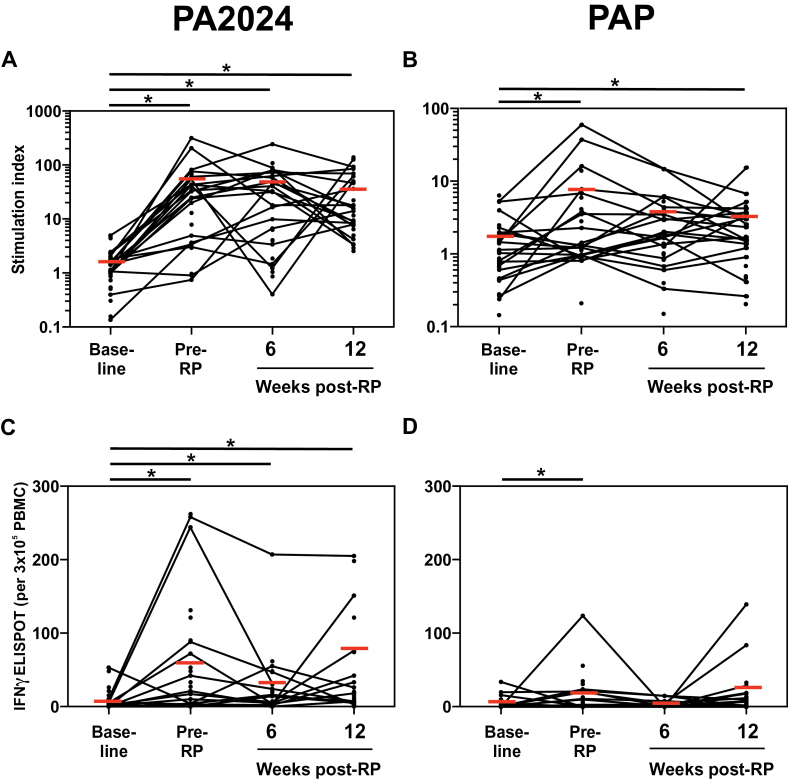
Antigen-specific circulating T cell responses following sipuleucel-T treatment. T cell proliferation to PA2024 (A) and PAP (B) were measured by 3H-thymidine incorporation in cultured PBMC. IFNγ responses to PA2024 (C) and prostatic acid phosphatase (D) were measured by enzyme-linked immunospot (ELISPOT) in cultured peripheral blood mononuclear cells. Each measure is shown at baseline, pre–radical prostatectomy (RP) (following sipuleucel-T infusions), six weeks post-RP, and 12 weeks post-RP. Horizontal bars represent the median values of patients with all four timepoints available. * Denotes two-sided P under .05, Wilcoxon matched pairs test for comparison with baseline. PA2024 = recombinant fusion protein; PAP = prostatic acid phosphatase; RP = radical prostatectomy.
Figure 2.
Figure 2.
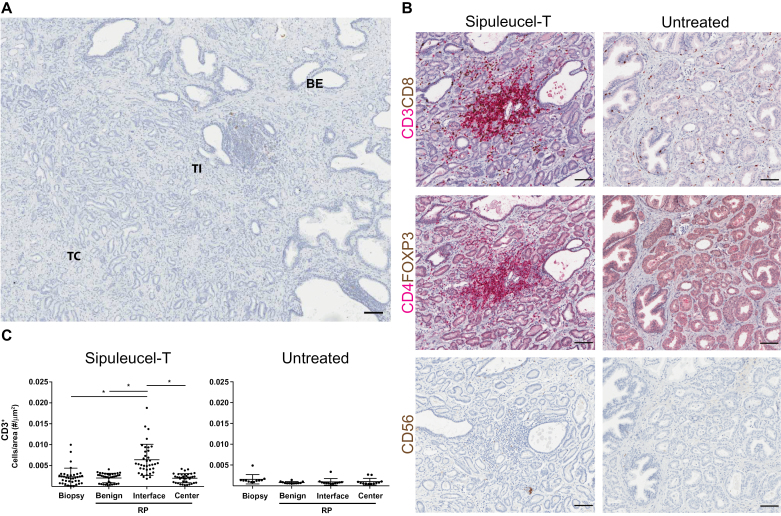
Frequency of intraprostatic T cells in biopsy and radical prostatectomy (RP) sections from patients treated with sipuleucel-T and untreated patients. A) Representative RP section with benign glands, tumor interface, and tumor center are depicted. B) Representative digital micrographs of immunohistochemistry-stained RP sections from patients treated with sipuleucel-T (left panels) and untreated patients (right panels) showing the tumor interface between benign and tumor tissue. Sections are stained for CD3 (red) /CD8 (brown) in the top panels, CD4 (red)/FOXP3 (brown) in the middle panels, and CD56 (brown) in the bottom panels. C) CD3+ T cells were quantitated by digital image analysis in prostate biopsies and in the RP sections. Cell frequencies in the RP sections were quantified in three compartments: benign glands, tumor interface, and tumor center. Means ± 95% confidence interval are shown with horizontal lines. * Denotes P under .05, analysis of variance (ANOVA) methods for repeated measures with post-hoc comparisons with the RP interface compartment. All ANOVA tests were two-sided. Scale bars = 100 μm. BE = benign glands; RP = radical prostatectomy; TC = tumor center; TI = tumor interface.
Figure 3.
Figure 3.
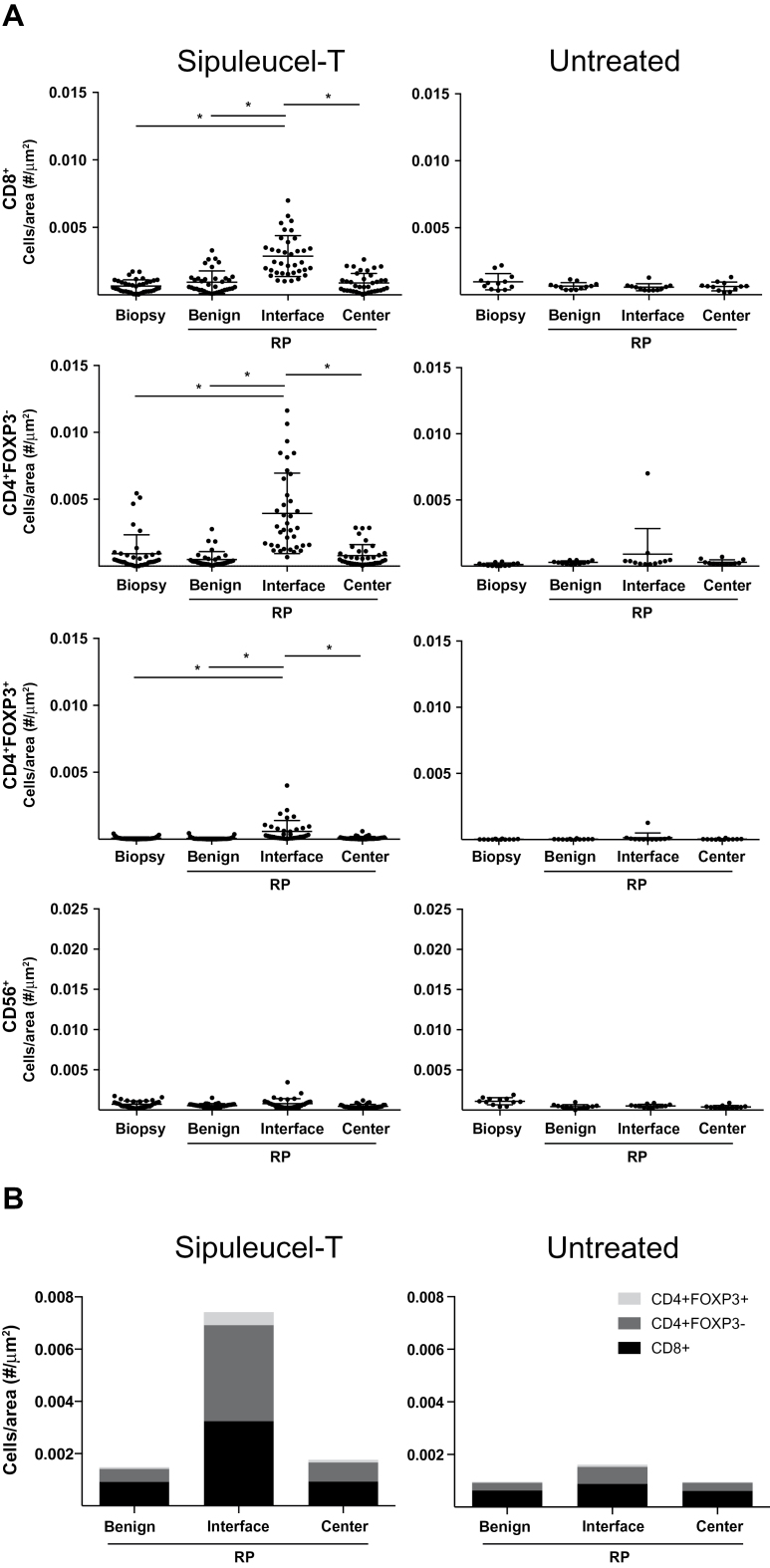
Frequency of intraprostatic T cell subsets in biopsy and radical prostatectomy (RP) sections from patients treated with sipuleucel-T and untreated patients. A) Quantitation of CD8+cytotoxic T cells, effector CD4+ FOXP3- T cells, regulatory CD4+ FOXP3+ T cells, and CD56+ natural killer cells was performed using digital image analysis. Cell frequencies in the RP sections were again quantified in three compartments: benign glands, tumor interface, and tumor center. B) The relative composition of the mean T subset frequencies within the RP is presented. Means ± 95% confidence intervals are shown with horizontal bars. * Denotes P under .05, analysis of variance (ANOVA) methods for repeated measures with post-hoc comparisons with the RP interface compartment. All ANOVA tests were two-sided. RP = radical prostatectomy.
Figure 4.
Figure 4.
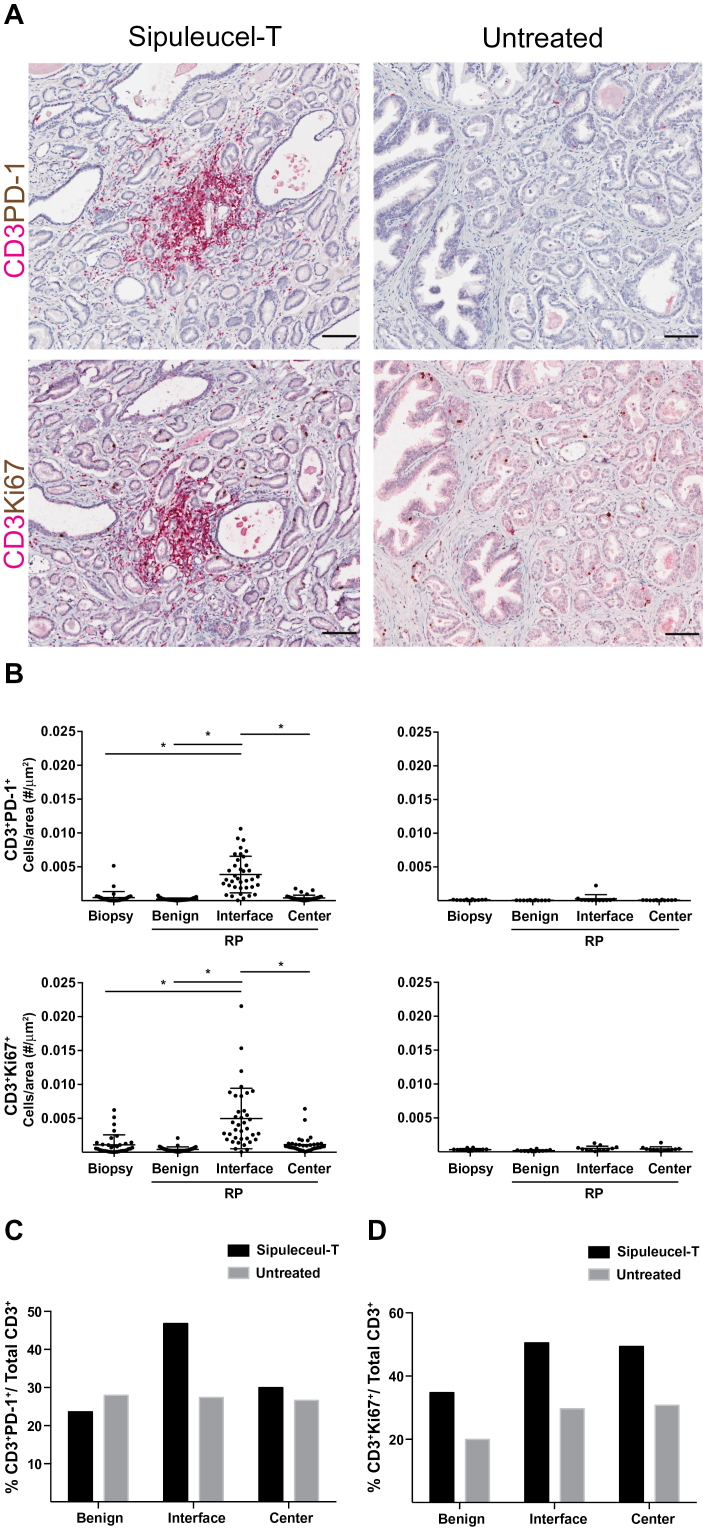
Expression of programmed death 1(PD1) and Ki-67 on CD3+ T lymphocytes in biopsy and radical prostatectomy (RP) sections from patients treated with sipuleucel-T and untreated patients. A) Representative digital micrographs of immunohistochemistry-stained RP sections from sipuleucel-T–treated and –untreated control patients showing expression of PD1 and Ki-67 on CD3+ T lymphocytes at the tumor interface. Scale bars = 100 μm. B) Quantitation of PD1 and Ki-67 expression on CD3+ was performed using digital image analysis on the different tissue compartments. Means ± 95% confidence interval are shown with horizontal lines. The relative composition of the mean PD1+ (C) and Ki-67+ (D) T frequencies within the RP are presented. * P under .05, analysis of variance (ANOVA) methods for repeated measures with post-hoc comparisons with the RP interface compartment. Scale bars = 100 μm. All ANOVA tests were two-sided. RP = radical prostatectomy.

Comment in

  • Rush hour traffic: directing T cells to tumor.
    Neelapu SS, Kwak LW. Neelapu SS, et al. J Natl Cancer Inst. 2014 Sep 24;106(11):dju301. doi: 10.1093/jnci/dju301. Print 2014 Nov. J Natl Cancer Inst. 2014. PMID: 25255804 No abstract available.

References

    1. Small EJ, Schellhammer PF, Higano CS, et al. Placebo-controlled phase III trial of immunologic therapy with sipuleucel-T (APC8015) in patients with metastatic, asymptomatic hormone refractory prostate cancer. J Clin Oncol. 2006;24(19):3089–3094. - PubMed
    1. Kantoff PW, Higano CS, Shore ND, et al. Sipuleucel-T immunotherapy for castration-resistant prostate cancer. N Engl J Med. 2010;363(5):411–422. - PubMed
    1. Sheikh NA, Petrylak D, Kantoff PW, et al. Sipuleucel-T immune parameters correlate with survival: an analysis of the randomized phase 3 clinical trials in men with castration-resistant prostate cancer. Cancer Immunol Immunother. 2013;62(1):137–147. - PMC - PubMed
    1. Cooperberg MR, Pasta DJ, Elkin EP, et al. The University of California, San Francisco Cancer of the Prostate Risk Assessment score: a straightforward and reliable preoperative predictor of disease recurrence after radical prostatectomy. J Urol. 2005;173(6):1938–1942. - PMC - PubMed
    1. Fong L, Brockstedt D, Benike C, et al. Dendritic cell-based xenoantigen vaccination for prostate cancer immunotherapy. J Immunol. 2001;167(12):7150–7156. - PubMed

Publication types

MeSH terms