


Long-term functional results and isokinetic strength evaluation after arthroscopic tenotomy of the long head of biceps tendon
- PMID: 25258498
- PMCID: PMC4168656
- DOI: 10.4103/0973-6042.140114
Long-term functional results and isokinetic strength evaluation after arthroscopic tenotomy of the long head of biceps tendon
Erratum in
-
Erratum: Long-term functional results and isokinetic strength evaluation after arthroscopic tenotomy of the long head of biceps tendon.Int J Shoulder Surg. 2016 Jan-Mar;10(1):54. doi: 10.4103/0973-6042.169807. Int J Shoulder Surg. 2016. PMID: 26980995 Free PMC article.
Abstract
Introduction: The objective of this study is to evaluate the biomechanical function of the upper arm after arthroscopic long head of biceps (LHB) tenotomy at long-term follow-up.
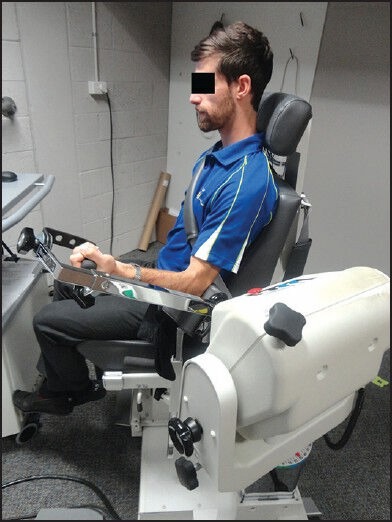
Materials and methods: Twenty-five male subjects ranging from 30 to 63 years old were evaluated at a mean follow-up of 7.0 years after tenotomy. Bilateral isokinetic testing was performed to obtain peak torque values, as well as total work done throughout the full range of elbow flexion and supination.
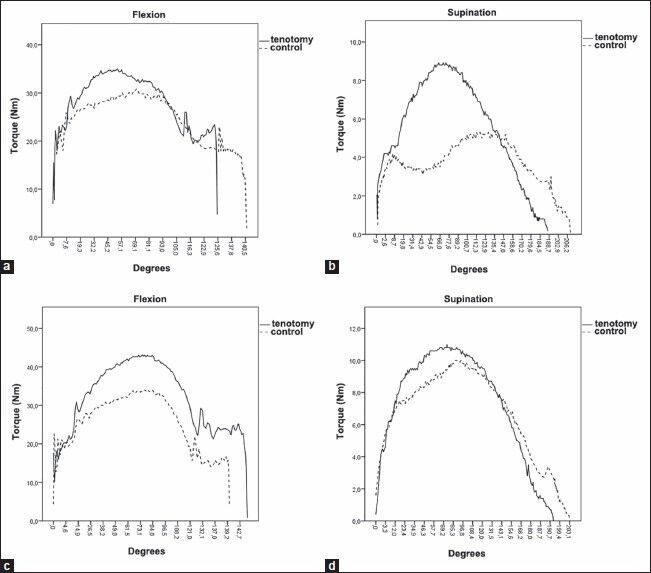
Results: Magnetic resonance imaging scans revealed nine unrecognized LHB ruptures in the contralateral arm, leaving 16 subjects to complete the testing protocol. The mean quickDASH score was 8.1 (standard error [SE] 2.5). The mean oxford elbow score was 97.9 (SE 1.6). The tenotomy arm recorded a decrease in peak flexion torque of 7.0% (confidence interval [CI] 1.2-12.8), and a decrease in the peak supination torque of 9.1% (CI 1.8-16.4) relative to the contralateral arm. The total work carried out through the full range of joint motion was reduced in elbow flexion by 5.1% (CI -1.3-11.4) and in forearm supination by 5.7% (CI-2.4-13.9).
Discussion: Maximum strength in elbow flexion and forearm supination is significantly reduced compared with the contralateral arm. However, this impairment is partially compensated for by relatively greater strength sustained through the latter stages of joint motion. This results in comparable total work measurements between the tenotomised and contralateral side, potentially accounting for ongoing high levels of patient satisfaction and clinical function in the long term after LHB tenotomy.
Level of evidence iv: Case series without comparison group.
Keywords: Biceps tenotomy; isokinetic strength; long-term.
Conflict of interest statement
Figures
References
-
- Boileau P, Ahrens PM, Hatzidakis AM. Entrapment of the long head of the biceps tendon: The hourglass biceps - A cause of pain and locking of the shoulder. J Shoulder Elbow Surg. 2004;13:249–57. - PubMed
-
- Sethi N, Wright R, Yamaguchi K. Disorders of the long head of the biceps tendon. J Shoulder Elbow Surg. 1999;8:644–54. - PubMed
-
- Szabó I, Boileau P, Walch G. The proximal biceps as a pain generator and results of tenotomy. Sports Med Arthrosc. 2008;16:180–6. - PubMed
-
- Duff SJ, Campbell PT. Patient acceptance of long head of biceps brachii tenotomy. J Shoulder Elbow Surg. 2012;21:61–5. - PubMed
-
- Shank JR, Singleton SB, Braun S, Kissenberth MJ, Ramappa A, Ellis H, et al. A comparison of forearm supination and elbow flexion strength in patients with long head of the biceps tenotomy or tenodesis. Arthroscopy. 2011;27:9–16. - PubMed
LinkOut - more resources
Full Text Sources
Other Literature Sources
Research Materials
