. 2014 Oct;10(5):408-15.
doi: 10.1089/chi.2014.0051. Epub 2014 Sep 26.

Home food availability, parental dietary intake, and familial eating habits influence the diet quality of urban Hispanic children

Affiliations

Home food availability, parental dietary intake, and familial eating habits influence the diet quality of urban Hispanic children

Margarita Santiago-Torres et al. Child Obes. 2014 Oct.

Abstract

Background: The home food environment influences children's eating behaviors and potentially affects overall diet quality. The aim of the present study was to evaluate the relationship between the home food environment and Hispanic children's diet quality.

Methods: Hispanic children, 10-14 years of age (n=187), and their parents participated in this cross-sectional study. The Healthy Eating Index (HEI) was used to determine diet quality based on reported dietary intake obtained through a food frequency questionnaire administered to the children. Parents self-reported home food availability, familial eating habits, and their own habitual diet through a home environment survey.

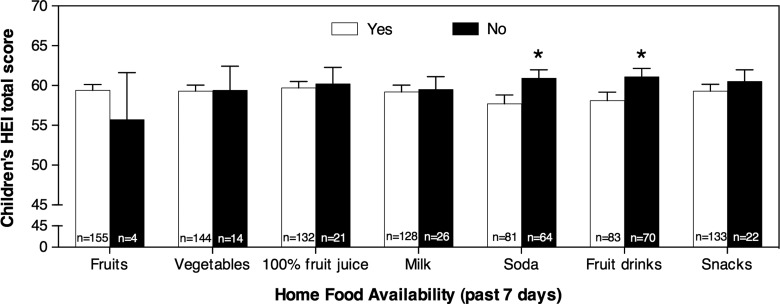
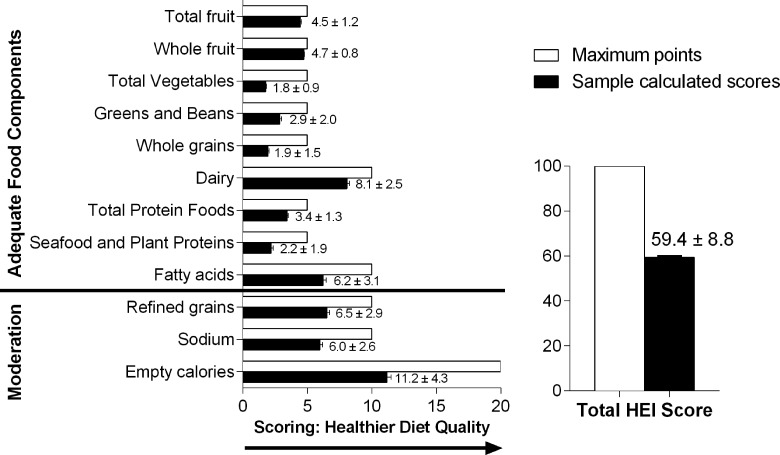
Results: The children's HEI total score was 59.4±8.8. Reported diets did not adhere to the dietary recommendations for total vegetables, greens and beans, whole grains, seafood and plant proteins, fatty acids, refined grains, sodium, solid fats, and added sugars. None of the participants had "good" scores (HEI, >80), 86% had scores that "need improvement" (HEI, 51-80), and 14% had "poor" scores (HEI, <50). Children with lower HEI scores had sugar-sweetened beverages available at home and participated in family meals while watching television more frequently, when compared with children with higher HEI scores.

Conclusions: Home food availability, parental diet, and familial eating habits seem to play an important role in the diet quality of children. Interventions targeting family education on healthful dietary habits at home could have a positive impact on children's diet quality and overall health.


Figures
<b>Figure 1.</b>
Figure 1.
Children's calculated mean (±standard error) HEI food component and total scores. HEI, Healthy Eating Index.
<b>Figure 2.</b>
Figure 2.
Children's calculated mean (±standard error) Healthy Eating Index (HEI) total score by reported home food availability. Univariate linear regression models were used for differences in children's HEI total score by home food availability (dichotomous variable: yes or no). The distribution (n value) of responses is illustrated for each category. *p<0.05. Refer to Supplementary Table 1 for complete regression analyses results (see online supplementary material at www.liebertpub.com/chi).
<b>Figure 3.</b>
Figure 3.
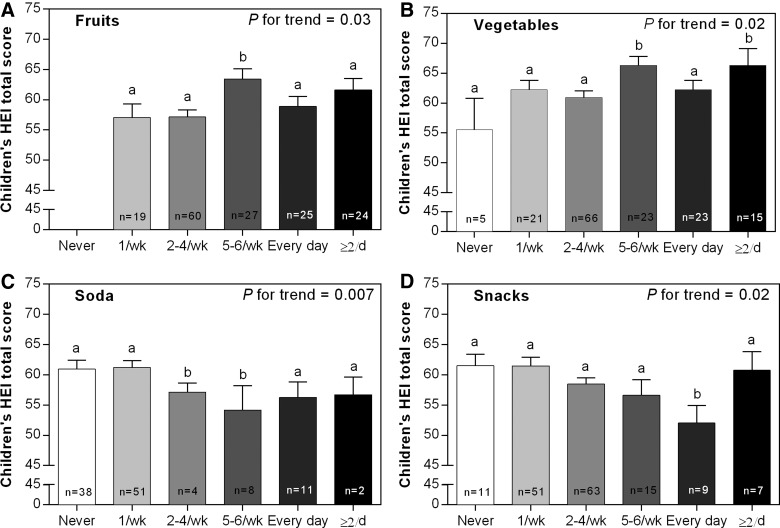
Children's calculated mean (±standard error) Healthy Eating Index (HEI) score in categories of parental reported frequent intake of foods and beverages (panels A–D: fruits, vegetables, soda, and snacks). Univariate linear regression models were used to test for linear trend that used a continuous specification of ordinal variables across parental reported frequent intake (never, once per week, 2–4 times per week, 5–6 times per week, every day, and twice or more per day), and for comparing the reference value (never) with every increased frequency in parental reported intake. None of the parents reported “never” having fruits during the past week; therefore, the reference value for this association was “once per week.” The distribution (n value) of responses is indicated for each category. Bars with different letters are significantly different from the reference value (never). *p<0.05. Refer to Supplementary Table 2 for complete regression analyses results (see online supplementary material at www.liebertpub.com/chi).
<b>Figure 4.</b>
Figure 4.
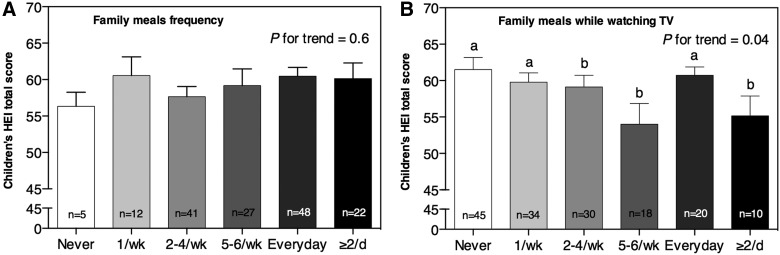
Children's calculated mean (±standard error) Healthy Eating Index (HEI) total score in categories of family meal frequency. (A) Family meal frequency. (B) Family meals while watching television (TV). Univariate linear regression models were used to test for linear trend that used a continuous specification of ordinal variables across family meals reported frequency (never, once per week, 2–4 times per week, 5–6 times per week, every day, and twice or more per day) and for comparing the reference value (never) with every increased frequency in family meals. The distribution (n value) of responses is indicated for each category. Bars with different letters are significantly different from the reference value (never). *p<0.05. Refer to Supplementary Table 3 for complete regression analyses results (see online supplementary material at www.liebertpub.com/chi).

References

    1. Ogden CL, Carroll MD, Flegal KM, et al. Prevalence of obesity and trends in body mass index among US children and adolescents, 1999–2010. JAMA 2012;307:483–490 - PMC - PubMed
    1. Campbell KJ, Crawford DA, Ball K. Family food environment and dietary behaviors likely to promote fatness in 5–6 year-old children. Int J Obes (Lond) 2006;30:1272–1280 - PubMed
    1. Guo X, Warden BA, Paeratakul S, et al. Healthy eating index and obesity. Eur J Clin Nutr 2004;58:1580–1586 - PubMed
    1. McNaughton SA, Bates CJ, Mishra GD. Diet quality is associated with all-cause mortality in adults aged 65 years and older. J Nutr 2012;142:320–325 - PMC - PubMed
    1. Guenther PM, Reedy J, Krebs-Smith SM. Development of the Healthy Eating Index-2005. J Am Diet Assoc 2008;108:1896–1901 - PubMed

Publication types

MeSH terms

LinkOut - more resources