


Feeling bad and looking worse: negative affect is associated with reduced perceptions of face-healthiness
- PMID: 25259802
- PMCID: PMC4178040
- DOI: 10.1371/journal.pone.0107912
Feeling bad and looking worse: negative affect is associated with reduced perceptions of face-healthiness
Abstract
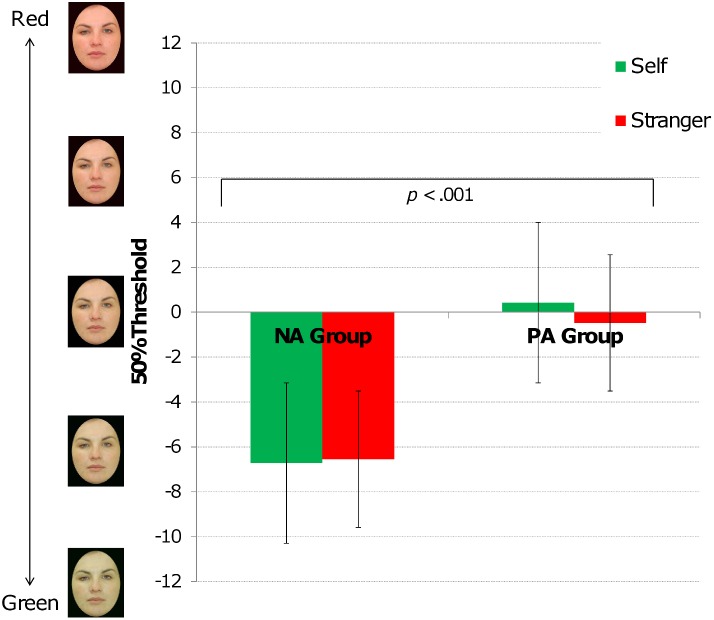
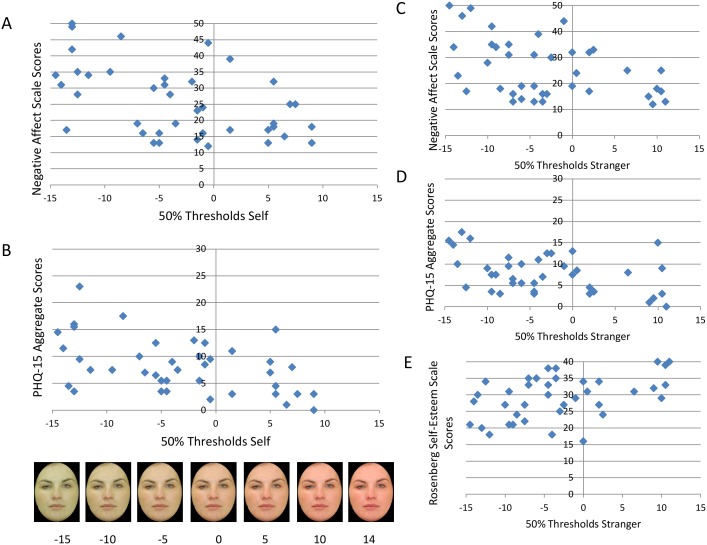
Some people perceive themselves to look more, or less attractive than they are in reality. We investigated the role of emotions in enhancement and derogation effects; specifically, whether the propensity to experience positive and negative emotions affects how healthy we perceive our own face to look and how we judge ourselves against others. A psychophysical method was used to measure healthiness of self-image and social comparisons of healthiness. Participants who self-reported high positive (N = 20) or negative affectivity (N = 20) judged themselves against healthy (red-tinged) and unhealthy looking (green-tinged) versions of their own and stranger's faces. An adaptive staircase procedure was used to measure perceptual thresholds. Participants high in positive affectivity were un-biased in their face health judgement. Participants high in negative affectivity on the other hand, judged themselves as equivalent to less healthy looking versions of their own face and a stranger's face. Affective traits modulated self-image and social comparisons of healthiness. Face health judgement was also related to physical symptom perception and self-esteem; high physical symptom reports were associated a less healthy self-image and high self-reported (but not implicit) self-esteem was associated with more favourable social comparisons of healthiness. Subject to further validation, our novel face health judgement task could have utility as a perceptual measure of well-being. We are currently investigating whether face health judgement is sensitive to laboratory manipulations of mood.
Conflict of interest statement
Figures
References
-
- von Helmholtz H (1866) Concerning the perceptions in general. In: Southall JPC, editor. Treatise on physiological optics, Vol III, 3rd ed (translated 1925. Reprinted New York Dover, 1962.
-
- Pennebaker JW (1982) The Psychology of Physical Symptoms. New York: Springer-Verlang.
-
- Watson D, Clark LA (1984) Negative affectivity: The disposition to experience aversive emotional states. Psychological Bulletin 96: 465–490. - PubMed
-
- Watson D, Clark LA, Tellegen A (1988) Development and validation of brief measures of positive and negative affect: The PANAS scales. Journal of Personality and Social Psychology 54: 1063–1070. - PubMed
-
- Suls J, Howren MB (2012) Understanding the Physical-Symptom Experience: The Distinctive Contributions of Anxiety and Depression. Current Directions in Psychological Science 21: 129–134.
Publication types
MeSH terms
LinkOut - more resources
Full Text Sources
Other Literature Sources
Research Materials
