


Vitamin D receptor-mediated stromal reprogramming suppresses pancreatitis and enhances pancreatic cancer therapy
- PMID: 25259922
- PMCID: PMC4177038
- DOI: 10.1016/j.cell.2014.08.007
Vitamin D receptor-mediated stromal reprogramming suppresses pancreatitis and enhances pancreatic cancer therapy
Abstract
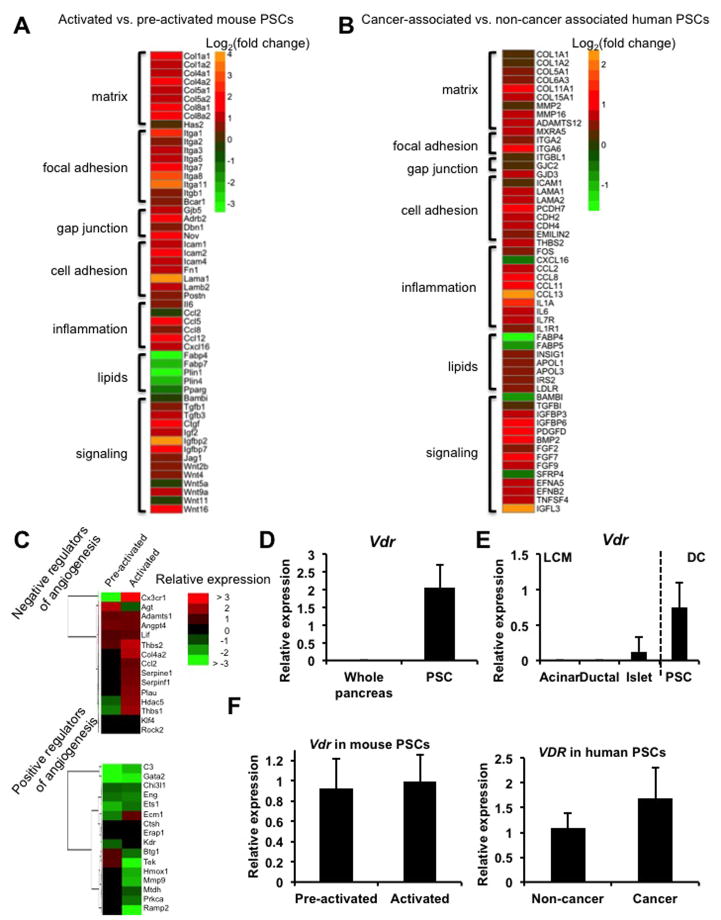
The poor clinical outcome in pancreatic ductal adenocarcinoma (PDA) is attributed to intrinsic chemoresistance and a growth-permissive tumor microenvironment. Conversion of quiescent to activated pancreatic stellate cells (PSCs) drives the severe stromal reaction that characterizes PDA. Here, we reveal that the vitamin D receptor (VDR) is expressed in stroma from human pancreatic tumors and that treatment with the VDR ligand calcipotriol markedly reduced markers of inflammation and fibrosis in pancreatitis and human tumor stroma. We show that VDR acts as a master transcriptional regulator of PSCs to reprise the quiescent state, resulting in induced stromal remodeling, increased intratumoral gemcitabine, reduced tumor volume, and a 57% increase in survival compared to chemotherapy alone. This work describes a molecular strategy through which transcriptional reprogramming of tumor stroma enables chemotherapeutic response and suggests vitamin D priming as an adjunct in PDA therapy. PAPERFLICK:
Copyright © 2014 Elsevier Inc. All rights reserved.
Figures


Comment in
-
Homeostatic restoration of desmoplastic stroma rather than its ablation slows pancreatic cancer progression.Gastroenterology. 2015 Apr;148(4):849-50. doi: 10.1053/j.gastro.2015.02.043. Epub 2015 Feb 25. Gastroenterology. 2015. PMID: 25724458 No abstract available.
References
-
- Aikawa T, Gunn J, Spong SM, Klaus SJ, Korc M. Connective tissue growth factor-specific antibody attenuates tumor growth, metastasis, and angiogenesis in an orthotopic mouse model of pancreatic cancer. Molecular cancer therapeutics. 2006;5:1108–1116. - PubMed
-
- Apte MV, Wilson JS. Dangerous liaisons: pancreatic stellate cells and pancreatic cancer cells. Journal of gastroenterology and hepatology. 2012;27(Suppl 2):69–74. - PubMed
Publication types
MeSH terms
Substances
Associated data
- Actions
Grants and funding
- R01 HL105278/HL/NHLBI NIH HHS/United States
- R24 DK090962/DK/NIDDK NIH HHS/United States
- CA014195/CA/NCI NIH HHS/United States
- DK0577978/DK/NIDDK NIH HHS/United States
- P42 ES010337/ES/NIEHS NIH HHS/United States
- T32 CA009370/CA/NCI NIH HHS/United States
- T32-CA009370/CA/NCI NIH HHS/United States
- HHMI/Howard Hughes Medical Institute/United States
- ES010337/ES/NIEHS NIH HHS/United States
- HL105278/HL/NHLBI NIH HHS/United States
- T32 CA148056/CA/NCI NIH HHS/United States
- P30 CA014195/CA/NCI NIH HHS/United States
- DK090962/DK/NIDDK NIH HHS/United States
- P01 CA163200/CA/NCI NIH HHS/United States
- R37 DK057978/DK/NIDDK NIH HHS/United States
- P30 CA045508/CA/NCI NIH HHS/United States
LinkOut - more resources
Full Text Sources
Other Literature Sources
Medical
Molecular Biology Databases
