. 2014 Sep 25;159(1):94-107.
doi: 10.1016/j.cell.2014.08.026.

The RAG recombinase dictates functional heterogeneity and cellular fitness in natural killer cells

Affiliations

The RAG recombinase dictates functional heterogeneity and cellular fitness in natural killer cells

Jenny M Karo et al. Cell. .

Abstract

The emergence of recombination-activating genes (RAGs) in jawed vertebrates endowed adaptive immune cells with the ability to assemble a diverse set of antigen receptor genes. In contrast, innate lymphocytes, such as natural killer (NK) cells, are not believed to require RAGs. Here, we report that NK cells unable to express RAGs or RAG endonuclease activity during ontogeny exhibit a cell-intrinsic hyperresponsiveness but a diminished capacity to survive following virus-driven proliferation, a reduced expression of DNA damage response mediators, and defects in the repair of DNA breaks. Evidence for this novel function of RAG has also been observed in T cells and innate lymphoid cells (ILCs), revealing an unexpected role for RAG proteins beyond V(D)J recombination. We propose that DNA cleavage events mediated by RAG endow developing adaptive and innate lymphocytes with a cellular "fitness" that safeguards their persistence later in life during episodes of rapid proliferation or cellular stress.


Figures

Figure 1
Figure 1. History of RAG expression delineates heterogeneity within the NK cell population
(A) NK1.1+ TCRβ NK cells from various organs of Rag1Cre x ROSATdRFP mice were analyzed for RFP expression. (B) Flow cytometric analysis of YFP expression was performed on bone marrow of Rag2YFP mice using or FLT3 and CD122 to identify CLP (FLT3+ CD122), pre-NKP (FLT CD122), and rNKP (FLT3 CD122) within the Lin CD27+ CD127+ cell population (top flow plot); and NK1.1 and DX5 were used to identify NKP (NK1.1DX5), iNK (NK1.1+ DX5), and mNK (NK1.1+ DX5+) cells within the Lin CD122+ population (bottom flow plot). Lin (or Lineage-negative) is defined as CD19 CD3 TCRβ CD4 CD8 Ter119. (C) NK1.1+ TCRβ NK cells from various organs of Rag1Cre x ROSATdRFP mice were analyzed for activation and maturation markers (KLRG1 and CD11b). Error bars for all graphs show s.e.m. and all data are representative of n=3–4 mice in three independent experiments. *p < 0.01 (D) Percent lysis of 51Cr-labeled Yac1 target cells by sorted RFP+ (solid line) and RFP (dashed line) NK cells ex vivo. Data representative of three independent experiments performed with n=35 mice. (E) NK1.1+ TCRβ NK cells from various organs of RAG2-YFP reporter mice were analyzed for YFP expression at steady state and compared to TCRβ+ thymocytes. Quantification and a representative histogram are shown. Results shown are representative of three independent experiments (n=3–4 mice).
Figure 2
Figure 2. Lack of RAG produces a cell-intrinsic hyper-responsiveness in NK cells
(A–B) Splenic NK cells from wildtype (WT) and Rag2-deficient (Rag2−/−) mice were analyzed for the activation and maturation markers KLRG1, CD69, CD62L, CD27, and CD11b. (C) Percent lysis of 51Cr-labeled Yac1 and Ba/F3-m157 target cells by WT and Rag2−/− NK cells ex vivo. Data are representative of three independent experiments performed with n=3–5 mice. (D) Percentage of CFSE-labeled β2m-deficient target cells lysed by NK cells in vivo in WT and Rag2−/− mice at indicated time points after transfer. Error bars show s.e.m. and the data depicts 3–5 mice per group, repeated in three independent experiments. *p < 0.05; **p < 0.005. (E) Lethally-irradiated mice were injected with equal numbers of WT (CD45.1) and Rag2−/− (CD45.2) bone marrow cells. Following hematopoietic reconstitution, NK cells were analyzed for the activation markers shown. See also Figure S2.
Figure 3
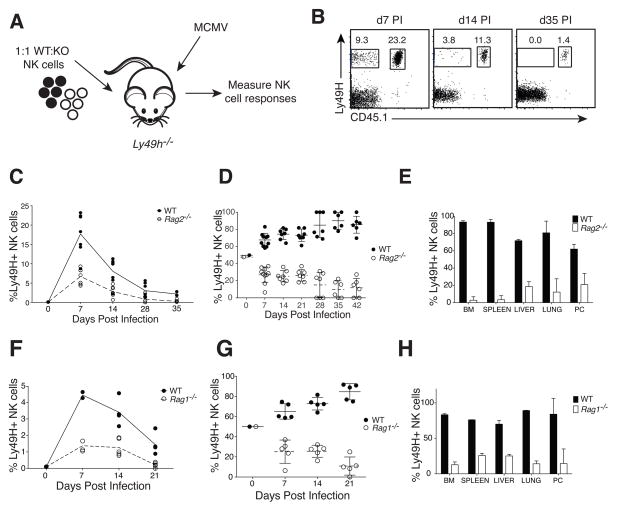
Figure 3. Rag-deficient NK cells fail to expand following MCMV infection
(A) Schematic of experiment. Equal numbers of WT (CD45.1) and Rag2−/− (CD45.2) Ly49H+ NK cells were co-transferred into Ly49H-deficient (Ly49h−/−) mice prior to infection with MCMV. (B–D) The absolute and relative percentages of adoptively transferred WT versus Rag2−/− Ly49H+ NK cells in peripheral blood at various time points following MCMV infection are shown. Data are representative of five independent experiments (n=5–10 mice per time point), with each data point representing an individual mouse. (E) Graph shows percentage of transferred WT and Rag2−/− Ly49H+ NK cells in indicated organs at day 10 PI. Error bars show s.e.m. and the graph is representative of three independent experiments with 4–5 mice per group. (F–G) Equal numbers of WT and Rag1−/− Ly49H+ NK cells were co-transferred into Ly49h−/− mice, and following MCMV infection the relative percentages of adoptively transferred populations in peripheral blood are shown for various time points. Data are representative of three independent experiments (n=3–5 mice per time point). (H) Graph shows percentage of transferred WT and Rag1−/− Ly49H+ NK cells in indicated organs at day 10 PI. Error bars show s.e.m. and the graph is representative of three independent experiments with 4–5 mice per group.
Figure 4
Figure 4. Inability of RAG-deficient NK cells to expand and persist following MCMV infection is cell intrinsic
(A) Splenic Ly49H+ NK cells from mixed WT:Rag2−/−were adoptively transferred and percentages of donor populations are shown at various time points after MCMV infection. Data are representative of three independent experiments each (with 3–7 mice per time point). (B) As in (A) using WT:Rag1−/− bone marrow chimeric mice. (C) Splenic Ly49H+ NK cells from mixed WT:Rag2−/− were adoptively transferred into Rag2−/−xIl2rg−/− hosts and following MCMV, donor NK cell populations were analyzed at day 7 PI. (D) Splenic T and B cells were transferred and parked for 8–12 weeks to reconstitute the lymphopenic compartment of young Rag2−/− mice (designated “Add back” mice). Ly49H+ NK cells from “Add back”, WT, and Rag2−/− mice were adoptively transferred, and NK cell percentages in peripheral blood at various time points following MCMV infection are shown. Results are representative of three independent experiments (n=3–5 mice). (E) RFP+ and RFP NK cells were sorted from RAG fate-mapping mice and equal numbers adoptively co-transferred into Ly49h−/− mice. Percentages of donor populations are shown at various time points after MCMV infection. Data are representative of two independent experiments (with 2 mice per time point). (F) NK cells from various organs of Rag2YFP reporter mice were analyzed for YFP expression at day 2, 4, and 7 after MCMV infection and compared to thymocytes. Quantification and representative histograms are shown. Error bars show s.e.m. and results are representative of three independent experiments (n=3–5 mice).
Figure 5
Figure 5. RAG-deficiency during ontogeny produces NK cells with greater genomic instability due to reduced DNA break repair
(A) Representative plots and graph show FLICA staining (for pan-caspase activation) in splenic Ly49H+ NK cells from uninfected. Error bars show s.e.m. and data are representative of three independent experiments (n=3–5 mice). *p < 0.05; ***p < 0.0005. (B) Rag2−/−:WT mixed bone marrow chimeras were pulsed with BrdU (0.8mg/ml) drinking water, and decrease in percent BrdU+ NK cells at days after “chase” with normal water was determined. Day 0 marks when mice removed from BrdU water and placed on normal water. Error bars show s.e.m. and data are representative of three independent experiments (n=3–5 mice). *p < 0.05. (C) Mean fluorescence intensity (MFI) of γ-H2AX on splenic NK cells from WT and Rag2−/− mice. Data are representative of three independent experiments (n=5–10 mice), with each data point representing an individual mouse. **p < 0.005. (D) WT and Rag2−/− NK cells from mixed bone marrow chimeric mice were irradiated (IR, 10 Gy) and phosphorylation of H2AX was analyzed by flow cytometry at various time points post-IR. Representative histograms show irradiated WT (solid) and Rag2−/− (dashed) NK cells compared to unirradiated cells (0 IR, gray). (E) Prkdc, Xrcc6, Atm, and Chek2 mRNA levels were quantified by qRT-PCR in sorted WT and Rag2−/− NK cells. Gene expression levels are normalized to β-actin. Results shown are representative of three independent experiments. See also Table S1.
Figure 6
Figure 6. Diminished cellular fitness in hyper-responsive NK cells from SCID and Rag1−/− D708A mice
(A) Histograms show expression of activation markers on WT and SCID NK cells. (B) Percent lysis of 51Cr-labeled Ba/F3-m157 (top) and Yac1 (bottom) target cells by WT and SCID NK cells ex vivo. (C) Equal numbers of WT (CD45.1) and SCID (CD45.2) Ly49H+ NK cells were co-transferred into Ly49h−/− mice, and following MCMV infection the relative percentages of adoptively transferred populations in peripheral blood are shown for various time points. Results shown are representative of three independent experiments (n=3–5 mice), with each data point representing an individual mouse. (D) Graph shows percentage of transferred WT and SCID Ly49H+ NK cells in indicated organs at day 21 PI. Error bars show s.e.m. and data are representative of three independent experiments (n=3–4 mice). (E) MFI of γ-H2AX on splenic NK cells from WT and SCID mice. Data are representative of three independent experiments (n=5–8 mice). *p < 0.05. (F) NK cells from various organs of WT (CD45.1) and Rag1−/− D708A (CD45.2) bone marrow chimeric mice were analyzed for the activation and maturation markers shown. Error bars show s.e.m. and data are representative of three independent experiments (n=3–5 mice). *p < 0.05. (G) Ly49H+ NK cells from WT (CD45.1) and Rag1−/− D708A (CD45.2) mixed bone marrow chimeric mice were co-transferred into Ly49h−/− mice, and following MCMV infection the relative percentages of adoptively transferred populations in peripheral blood are shown for various time points. Results shown are representative of three independent experiments (n=3–5 mice). (H) MFI of γ-H2AX on splenic NK cells from WT:Rag1−/− (circles) and WT:Rag1−/− D708A (diamonds) bone marrow chimeric mice. Results are representative of three independent experiments (n=4–5 mice). See also Figure S5.
Figure 7
Figure 7. A novel role for RAG in the cellular fitness of adaptive and innate lymphocytes
(A) CD8+ T cells from OT-1 and OT-1 x Rag2−/− mice were irradiated (10 Gy) and phosphorylation of H2AX was analyzed by flow cytometry at various time points post-IR. Representative histograms show irradiated OT-1 (solid) and OT-1 x Rag2−/− (dashed) CD8+ T cells compared to unirradiated cells (0 IR, gray). (B) Prkdc, Xrcc5, and Atm mRNA levels were quantified by qRT-PCR in sorted CD8+ T cells from OT-1 and OT-1 x Rag2−/− mice. Gene expression levels are normalized to β-actin. Results shown are representative of three independent experiments. (C) Equal numbers of CD8+ T cells from OT-1 (CD45.1×2) and OT-1 x Rag2−/− (CD45.1) mice were adoptively co-transferred into B6 mice (CD45.2) and relative percentage of OT-1 x Rag2−/− cells to OT-1 cells were determined following MCMV-Ova infection. (D–E) Group 2 and 3 innate lymphoid cells (ILC2 and ILC3) were isolated from various organs of RAG fate-mapping mice, and percentage of RFP+ cells was determined by flow cytometry. Gating strategy for intestinal ILC3 (D) and quantified percentages of ILC3 and ILC2 in the indicated tissues are shown (E). See also Figures S6, S7, and Table S1.

Comment in

References

    1. Abramson J, Giraud M, Benoist C, Mathis D. Aire’s partners in the molecular control of immunological tolerance. Cell. 2010;140:123–135. - PubMed
    1. Agrawal A, Schatz DG. RAG1 and RAG2 form a stable postcleavage synaptic complex with DNA containing signal ends in V(D)J recombination. Cell. 1997;89:43–53. - PubMed
    1. Andrews DM, Smyth MJ. A potential role for RAG-1 in NK cell development revealed by analysis of NK cells during ontogeny. Immunol Cell Biol. 2010;88:107–116. - PubMed
    1. Biedermann KA, Sun JR, Giaccia AJ, Tosto LM, Brown JM. scid mutation in mice confers hypersensitivity to ionizing radiation and a deficiency in DNA double-strand break repair. Proceedings of the National Academy of Sciences of the United States of America. 1991;88:1394–1397. - PMC - PubMed
    1. Bjorkstrom NK, Lindgren T, Stoltz M, Fauriat C, Braun M, Evander M, Michaelsson J, Malmberg KJ, Klingstrom J, Ahlm C, et al. Rapid expansion and long-term persistence of elevated NK cell numbers in humans infected with hantavirus. J Exp Med. 2011;208:13–21. - PMC - PubMed

Publication types

MeSH terms