


SIRRACT: An International Randomized Clinical Trial of Activity Feedback During Inpatient Stroke Rehabilitation Enabled by Wireless Sensing
- PMID: 25261154
- PMCID: PMC4375021
- DOI: 10.1177/1545968314550369
SIRRACT: An International Randomized Clinical Trial of Activity Feedback During Inpatient Stroke Rehabilitation Enabled by Wireless Sensing
Abstract
Background: Walking-related disability is the most frequent reason for inpatient stroke rehabilitation. Task-related practice is a critical component for improving patient outcomes.
Objective: To test the feasibility of providing quantitative feedback about daily walking performance and motivating greater skills practice via remote sensing.
Methods: In this phase III randomized, single blind clinical trial, patients participated in conventional therapies while wearing wireless sensors (triaxial accelerometers) at both ankles. Activity-recognition algorithms calculated the speed, distance, and duration of walking bouts. Three times a week, therapists provided either feedback about performance on a 10-meter walk (speed only) or walking speed feedback plus a review of walking activity recorded by the sensors (augmented). Primary outcomes at discharge included total daily walking time, derived from the sensors, and a timed 15-meter walk.
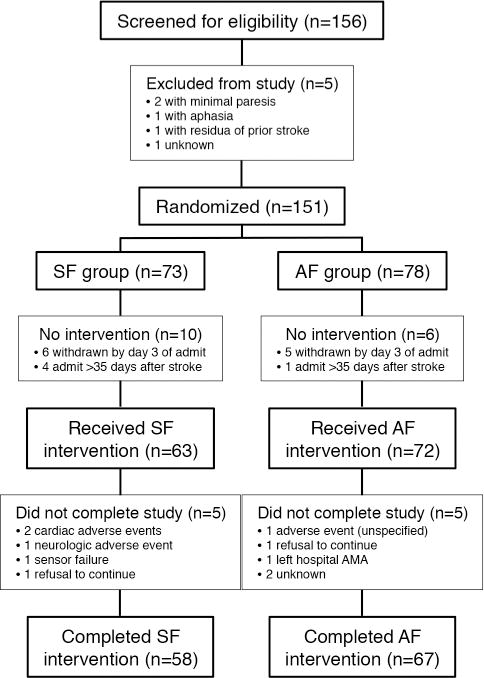
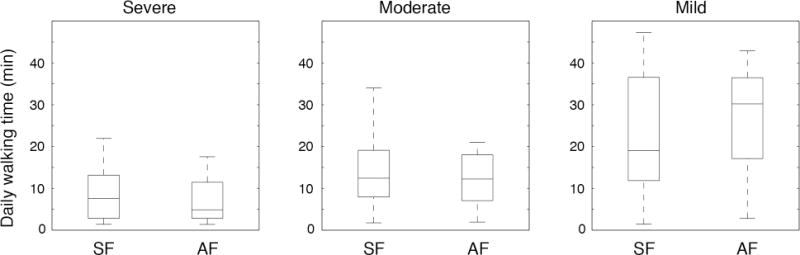
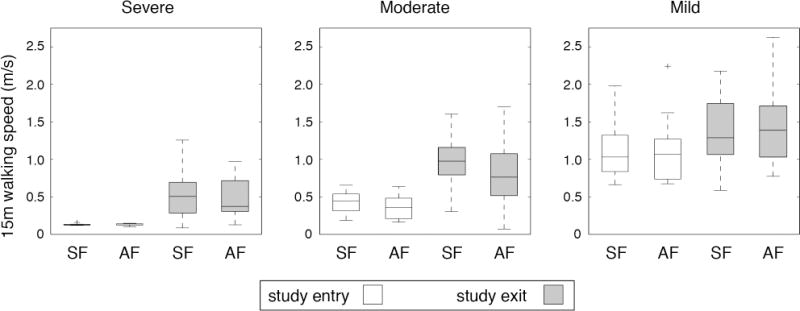
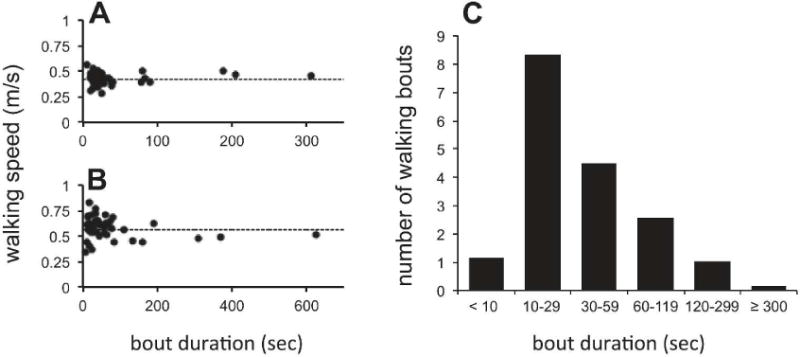
Results: Sixteen rehabilitation centers in 11 countries enrolled 135 participants over 15 months. Sensors recorded more than 1800 days of therapy, 37 000 individual walking bouts, and 2.5 million steps. No significant differences were found between the 2 feedback groups in daily walking time (15.1 ± 13.1 vs 16.6 ± 14.3 minutes, P = .54) or 15-meter walking speed (0.93 ± 0.47 vs 0.91 ± 0.53 m/s, P = .96). Remarkably, 30% of participants decreased their total daily walking time over their rehabilitation stay.
Conclusions: In this first trial of remote monitoring of inpatient stroke rehabilitation, augmented feedback beyond speed alone did not increase the time spent practicing or improve walking outcomes. Remarkably modest time was spent walking. Wireless sensing, however, allowed clinicians to audit skills practice and provided ground truth regarding changes in clinically important, mobility-related activities.
Keywords: accelerometer; rehabilitation; stroke; telemedicine; walking; wireless technology.
© The Author(s) 2014.
Conflict of interest statement
The authors declared no conflicts of interest with respect to the authorship and/or publication of this article.
Figures
Comment in
-
Feedback about walking activity does not increase walking activity levels during inpatient rehabilitation after stroke [synopsis].J Physiother. 2015 Oct;61(4):223. doi: 10.1016/j.jphys.2015.07.008. Epub 2015 Sep 9. J Physiother. 2015. PMID: 26364084 No abstract available.
-
Feedback about walking activity does not increase walking activity levels during inpatient rehabilitation after stroke [commentary].J Physiother. 2015 Oct;61(4):223. doi: 10.1016/j.jphys.2015.07.009. Epub 2015 Sep 9. J Physiother. 2015. PMID: 26364086 No abstract available.
References
-
- Langhorne P, Bernhardt J, Kwakkel G. Stroke rehabilitation. Lancet. 2011;377:1693–1702. - PubMed
-
- Wolf SL, Winstein CJ, Miller JP, et al. Effect of constraint-induced movement therapy on upper extremity function 3 to 9 months after stroke: the EXCITE randomized clinical trial. JAMA. 2006;296:2095–2104. - PubMed
-
- De Wit L, Putman K, Lincoln N, et al. Stroke rehabilitation in Europe: what do physiotherapists and occupational therapists actually do? Stroke. 2006;37:1483–9. - PubMed
Publication types
MeSH terms
Grants and funding
LinkOut - more resources
Full Text Sources
Other Literature Sources
Medical
