. 2015 Feb;16(1):67-80.
doi: 10.1007/s10162-014-0491-7. Epub 2014 Sep 27.

Heat shock protein-mediated protection against Cisplatin-induced hair cell death

Affiliations

Heat shock protein-mediated protection against Cisplatin-induced hair cell death

Tiffany G Baker et al. J Assoc Res Otolaryngol. 2015 Feb.

Abstract

Cisplatin is a highly successful and widely used chemotherapy for the treatment of various solid malignancies in both adult and pediatric patients. Side effects of cisplatin treatment include nephrotoxicity and ototoxicity. Cisplatin ototoxicity results from damage to and death of cells in the inner ear, including sensory hair cells. We showed previously that heat shock inhibits cisplatin-induced hair cell death in whole-organ cultures of utricles from adult mice. Since heat shock protein 70 (HSP70) is the most upregulated HSP in response to heat shock, we investigated the role of HSP70 as a potential protectant against cisplatin-induced hair cell death. Our data using utricles from HSP70 (-/-) mice indicate that HSP70 is necessary for the protective effect of heat shock against cisplatin-induced hair cell death. In addition, constitutive expression of inducible HSP70 offered modest protection against cisplatin-induced hair cell death. We also examined a second heat-inducible protein, heme oxygenase-1 (HO-1, also called HSP32). HO-1 is an enzyme responsible for the catabolism of free heme. We previously showed that induction of HO-1 using cobalt protoporphyrin IX (CoPPIX) inhibits aminoglycoside-induced hair cell death. Here, we show that HO-1 also offers significant protection against cisplatin-induced hair cell death. HO-1 induction occurred primarily in resident macrophages, with no detectable expression in hair cells or supporting cells. Depletion of macrophages from utricles abolished the protective effect of HO-1 induction. Together, our data indicate that HSP induction protects against cisplatin-induced hair cell death, and they suggest that resident macrophages mediate the protective effect of HO-1 induction.


Figures
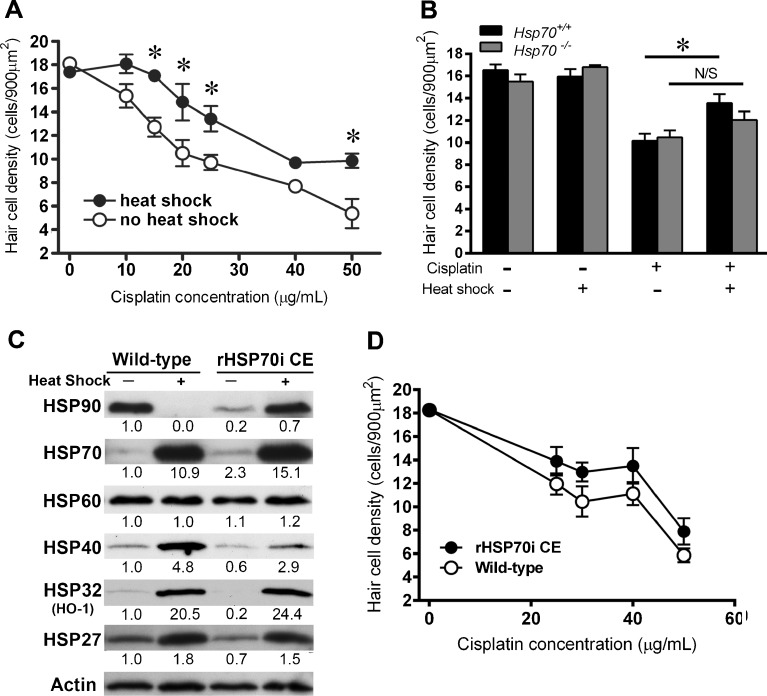
FIG. 1
FIG. 1
HSP70 is necessary but not sufficient for the protective effect of heat shock against cisplatin-induced hair cell death. A Control and heat-shocked utricles were exposed to cisplatin for 24 h. Heat shock resulted in significant protection against cisplatin-induced hair cell death (2-way ANOVA: F 6,160 = 5.78, p = 0.0000). Data points represent the mean ± SEM for n = 5–40 utricles per condition. Asterisks denote significant differences in hair cell density between utricles that were heat shocked and controls. B Control and heat-shocked utricles from adult wild-type and Hsp70 −/− mice were exposed to cisplatin (20 μg/mL) for 24 h. Heat shock inhibited cisplatin-induced hair cell death in HSP70 +/+ utricles (2-way ANOVA: F 1,54 = 8.98, p = 0.004) but not in utricles from HSP70 −/− mice (2-way ANOVA: F 1,39 = 0.03, p = 0.865). Bars represent the mean ± SEM for n = 5–18 utricles per condition. Asterisks denote significant differences in hair cell density in the extrastriolar region. N/S not significant. C Utricles from rHsp70i CE transgenic mice and their wild-type littermates were heat shocked and then recovered for 6 h prior to being processed for Western blotting. Heat shock resulted in upregulation of HSPs 27, 32, 40, and 70 in utricles of both genotypes. In the absence of heat shock, utricles from mice that constitutively overexpress HSP70 had 2.3-fold higher levels of HSP70 than wild-type utricles. D Utricles from rHsp70i CE mice and their wild-type littermates were treated with cisplatin for 24 h. Results reveal a main effect of genotype, indicating that constitutive expression of rHSP70i has an effect against cisplatin-induced hair cell death (2-way ANOVA: F 1,116 = 9.60, p = 0.0024); however, rHSP70i CE genotype did not rescue the epithelium from cisplatin-induced hair cell death (2-way ANOVA: F 4,116 = 1.28, p = 0.2827). Furthermore, post hoc testing indicated that protection by HSP70 was not significant at any individual dose of cisplatin. Data points represent the mean ± SEM for n = 7–24 utricles per condition. Asterisks denote significant differences in hair cell density between rHSP70i CE and wild-type utricles.
FIG. 2
FIG. 2
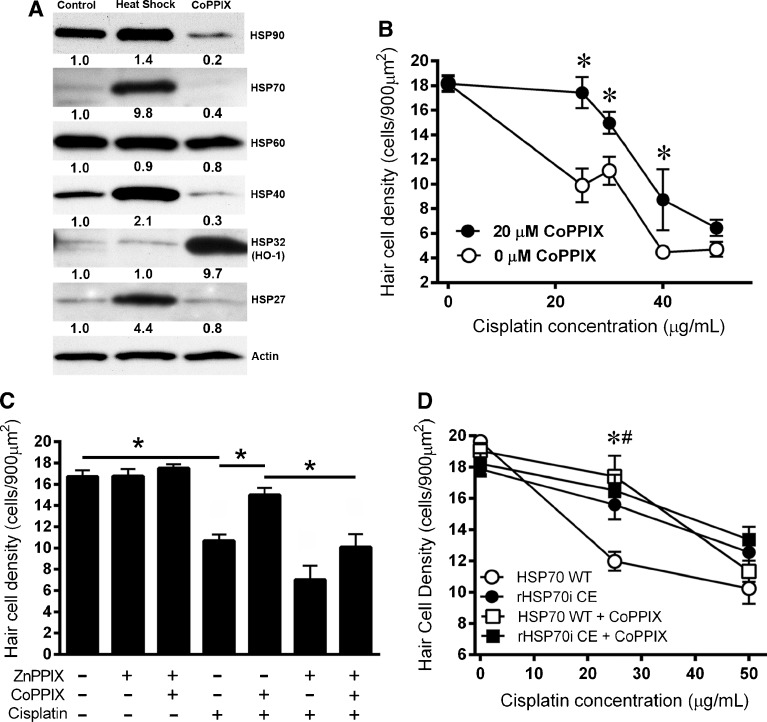
HO-1 protects against cisplatin-induced hair cell death. A Utricles from CBA/J mice were heat shocked or treated with 20 μM CoPPIX prior to being processed for Western blotting. CoPPIX treatment resulted in upregulation of HO-1, with no upregulation of other HSPs. B Control and CoPPIX-treated utricles were exposed to cisplatin for 24 h. CoPPIX resulted in robust protection against cisplatin-induced hair cell death (2-way ANOVA: F 4,69 = 4.24, p = 0.004). Data points represent the mean ± SEM for n = 5–7 utricles per condition. Asterisks denote significant differences in hair cell density between utricles that received CoPPIX and those that did not. C Utricles were treated with the HO-1 inhibitor ZnPPIX for 36 h in the presence of CoPPIX and/or cisplatin. ZnPPIX abolished the protective effect of CoPPIX against cisplatin-induced hair cell death (Tukey’s multiple comparison test: p < 0.001). Bars represent the mean ± SEM for n = 7–12 utricles per condition. Asterisks denote significant differences between groups indicated. D Utricles from rHSP70i CE mice and their wild-type littermates were treated with CoPPIX for 12 h, followed by treatment with cisplatin for 24 h. No synergistic effect was noted between rHSP70i CE and CoPPIX (3-way ANOVA: F 1,106 = 0.74, p = 0.39). Data points represent the mean ± SEM for n = 4–14 utricles per condition. Asterisks denote significant differences in hair cell density between HSP70 WT utricles that received CoPPIX and those that did not. Number sign denotes significant differences between hair cell density of HSP70 WT versus rHSP70i CE utricles.
FIG. 3
FIG. 3
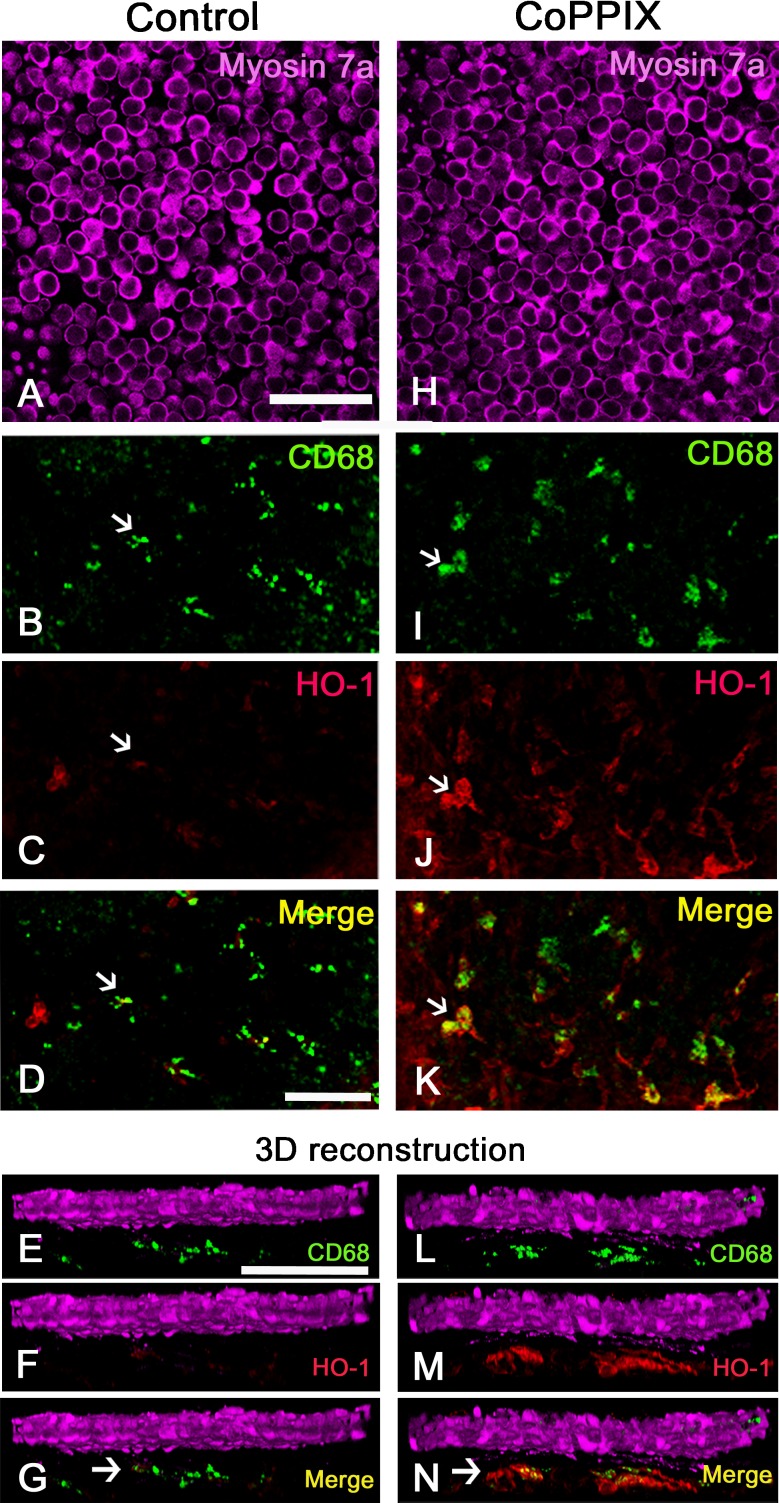
HO-1 is upregulated in resident macrophages. Utricles were treated with or without CoPPIX. Utricles were stained for the hair cell marker myosin 7a, the macrophage marker CD68, and HO-1. Hair cells and supporting cells did not exhibit HO-1 immunoreactivity in control or CoPPIX-treated utricles. CD68+ macrophages did exhibit HO-1 immunoreactivity in response to CoPPIX treatment. Arrows indicate cells that are both CD68 and HO-1 positive. The orthogonal views (EN) demonstrate that the hair cell and supporting cell layers are HO-1 negative, and the CD68+/HO-1+ double-labeled cells lie beneath the sensory epithelium. Confocal micrographs are presented. Scale bars represent 50 μm.
FIG. 4
FIG. 4
Macrophages are required for HO-1-mediated protection. A CX3CR1 GFP/+ utricles were treated with LC for 48 h. Liposomal clodronate (2, 4, and 8 mM) depleted macrophages from the utricular epithelium (1-way ANOVA: F 6,30 = 6.82, p = 0.0001). B Liposomal clodronate had no significant effect on hair cell density (1-way ANOVA: F 6,31 = 0.16, p = 0.99). Bars represent the mean ± SEM for n = 4–10 utricles per condition. Asterisks denote significant differences in cell numbers compared to control. C Utricles were treated with LC to deplete macrophages, and then treated with CoPPIX to induce HO-1. LC did not result in hair cell death (Tukey’s multiple comparison test: p > 0.05), but cisplatin resulted in significant hair cell death (Tukey’s multiple comparison test: p < 0.001). LC did not alter cisplatin-induced hair cell death (Tukey’s multiple comparison test: p > 0.05). CoPPIX inhibited cisplatin-induced hair cell death (Tukey’s multiple comparison test: p < 0.01), and depletion of macrophages using LC abolished the protective effect of CoPPIX (Tukey’s multiple comparison test: p < 0.01). All statistical analyses are 1-way ANOVA with Tukey’s multiple comparison test: p > 0.05. Bars represent the mean ± SEM for n = 4–6 utricles per condition. Asterisks denote significant differences in hair cell density between the groups indicated by the horizontal line.

References

    1. Beere HM, Wolf BB, Cain K, Mosser DD, Mahboubi A, Kuwana T, Tailor P, Morimoto RI, Cohen GM, Green DR. Heat-shock protein 70 inhibits apoptosis by preventing recruitment of procaspase-9 to the Apaf-1 apoptosome. Nat Cell Biol. 2000;2:469–475. - PubMed
    1. Bird JE, Daudet N, Warchol ME, Gale JE. Supporting cells eliminate dying sensory hair cells to maintain epithelial integrity in the avian inner ear. J Neurosci. 2010;30:12545–12556. - PMC - PubMed
    1. Blancou P, Tardif V, Simon T, Remy S, Carreno L, Kalergis A, Anegon I. Immunoregulatory properties of heme oxygenase-1. Methods Mol Biol. 2011;677:247–268. - PubMed
    1. Brandon CS, Voelkel-Johnson C, May LA, Cunningham LL (2012) Dissection of adult mouse utricle and adenovirus-mediated supporting-cell infection. J Vis Exp - PMC - PubMed
    1. Caronia D, Patino-Garcia A, Milne RL, Zalacain-Diez M, Pita G, Alonso MR, Moreno LT, Sierrasesumaga-Ariznabarreta L, Benitez J, Gonzalez-Neira A. Common variations in ERCC2 are associated with response to cisplatin chemotherapy and clinical outcome in osteosarcoma patients. Pharmacogenomics J. 2009;9:347–353. - PubMed

Publication types