


Signaling pathways leading to ischemic mitochondrial neuroprotection
- PMID: 25262285
- PMCID: PMC4861652
- DOI: 10.1007/s10863-014-9574-8
Signaling pathways leading to ischemic mitochondrial neuroprotection
Abstract
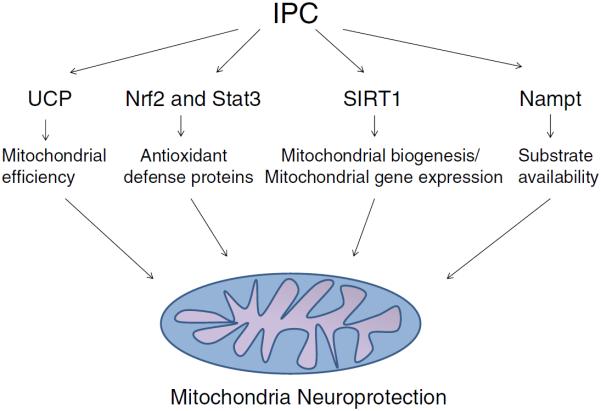
There is extensive evidence that ischemic/reperfusion mediated mitochondrial dysfunction is a major contributor to ischemic damage. However data also indicates that mild ischemic stress induces mitochondrial dependent activation of ischemic preconditioning. Ischemic preconditioning is a neuroprotective mechanism which is activated upon a brief sub-injurious ischemic exposure and is sufficient to provide protection against a subsequent lethal ischemic insult. Current research demonstrates that mitochondria are not only the inducers of but are also an important target of ischemic preconditioning mediated protection. Numerous proteins and signaling pathways are activated by ischemic preconditioning which protect the mitochondria against ischemic damage. In this review we examine some of the proteins activated by ischemic precondition which counteracts the deleterious effects of ischemia/reperfusion thereby maintaining normal mitochondrial activity and lead to ischemic tolerance.
Figures
References
-
- Alan L, Smolkova K, Kronusova E, Santorova J, Jezek P. Absolute levels of transcripts for mitochondrial uncoupling proteins UCP2, UCP3, UCP4, and UCP5 show different patterns in rat and mice tissues. J Bioenerg Biomembr. 2009;41:71–78. - PubMed
-
- Alano CC, Tran A, Tao R, Ying W, Karliner JS, et al. Differences among cell types in NAD(+) compartmentalization: a comparison of neurons, astrocytes, and cardiac myocytes. J Neurosci Res. 2007;85:3378–3385. - PubMed
-
- Andrews ZB, Diano S, Horvath TL. Mitochondrial uncoupling proteins in the CNS: in support of function and survival. Nat Rev Neurosci. 2005;6:829–840. - PubMed
Publication types
MeSH terms
Grants and funding
LinkOut - more resources
Full Text Sources
Other Literature Sources
