


A prospective study of maternal prenatal weight and offspring cardiometabolic health in midchildhood
- PMID: 25263237
- PMCID: PMC4254266
- DOI: 10.1016/j.annepidem.2014.08.002
A prospective study of maternal prenatal weight and offspring cardiometabolic health in midchildhood
Abstract
Purpose: To examine the relations of maternal prepregnancy body mass index (ppBMI) and gestational weight gain (GWG) with offspring cardiometabolic health.
Design: We studied 1090 mother-child pairs in Project Viva, a Boston-area prebirth cohort. We measured overall (dual x-ray absorptiometry total fat; body mass index z-score) and central adiposity (dual x-ray absorptiometry trunk fat), and systolic blood pressure in offspring at 6 to 10 years. Fasting bloods (n = 687) were assayed for insulin and glucose (for calculation of homeostatic model assessment of insulin resistance), triglycerides, leptin, adiponectin, high sensitivity C-reactive protein, and interleukin 6. Using multivariable linear regression, we examined differences in offspring outcomes per 1 SD maternal ppBMI and GWG.
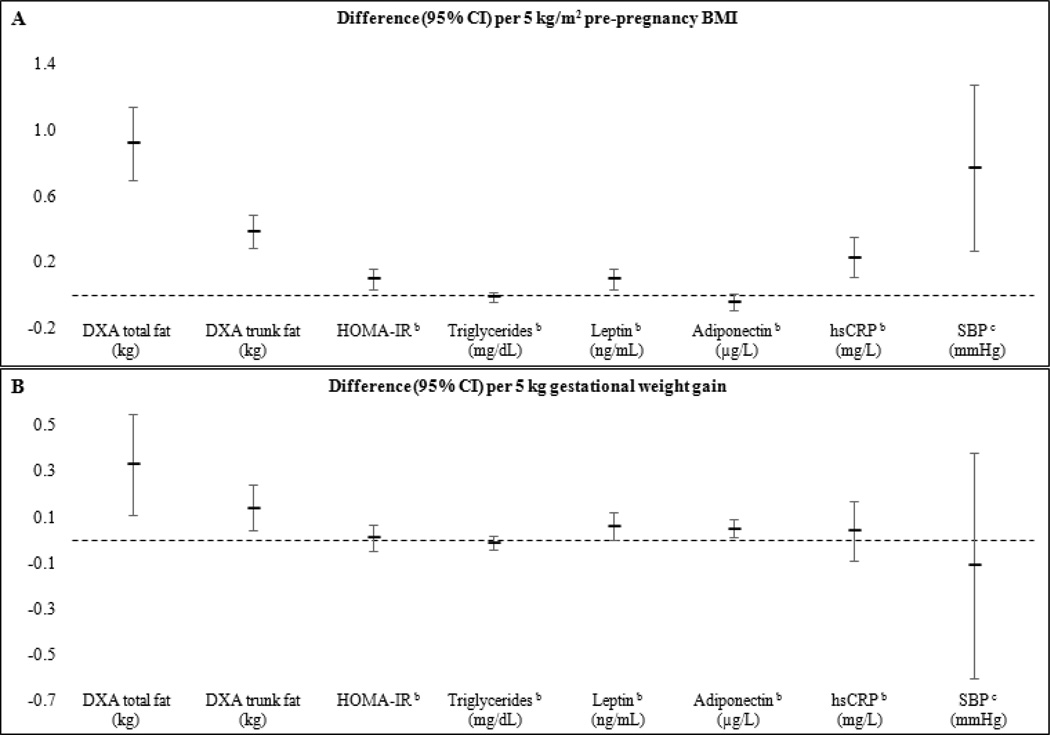
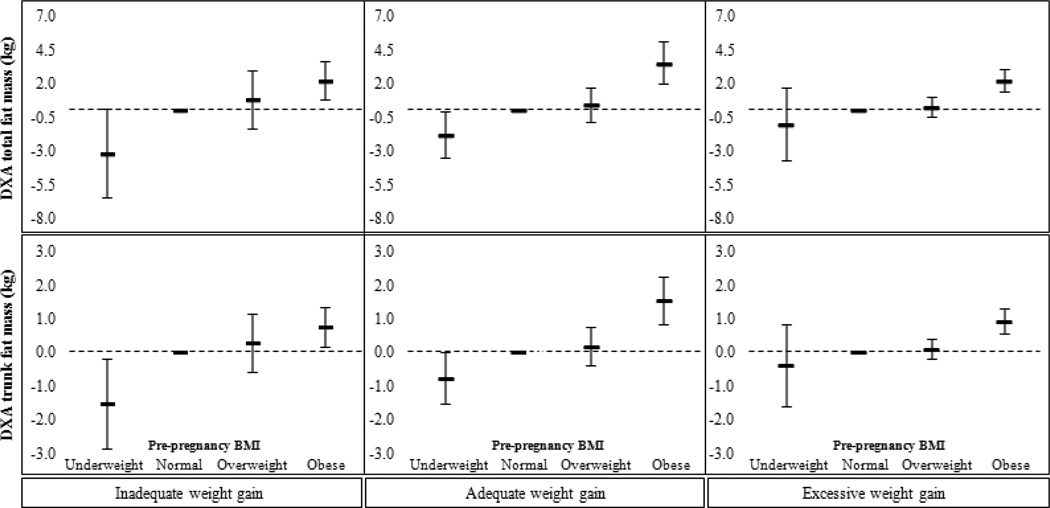
Results: After adjustment for confounders, each 5 kg/m² higher ppBMI corresponded with 0.92 kg (95% confidence interval, 0.70-1.14) higher total fat, 0.27 BMI z-score (0.21-0.32), and 0.39 kg (0.29-0.49) trunk fat. ppBMI was also positively associated with homeostatic model assessment of insulin resistance, leptin, high sensitivity C-reactive protein, interleukin 6, and systolic blood pressure; and lower adiponectin. Each 5 kg of GWG predicted greater adiposity (0.33 kg [0.11-0.54] total fat; 0.14 kg [0.04-0.23] trunk fat) and higher leptin (6% [0%-13%]) in offspring after accounting for confounders and ppBMI.
Conclusions: Children born to heavier mothers have more overall and central fat and greater cardiometabolic risk. Offspring of women with higher GWG had greater adiposity and higher leptin.
Keywords: Adiposity; Cardiometabolic health; Childhood obesity; Dual x-ray absorptiometry; Gestational weight gain; Lean mass; Prenatal.
Copyright © 2014 Elsevier Inc. All rights reserved.
Conflict of interest statement
Figures
References
-
- Kim J, Peterson KE, Scanlon KS, et al. Trends in overweight from 1980 through 2001 among preschool-aged children enrolled in a health maintenance organization. Obesity. 2006;14:1107–1112. - PubMed
-
- Begum G, Davies A, Stevens A, et al. Maternal undernutrition programs tissue-specific epigenetic changes in the glucocorticoid receptor in adult offspring. Endocrinology. 2013 - PubMed
-
- Samuelsson AM, Matthews PA, Argenton M, et al. Diet-induced obesity in female mice leads to offspring hyperphagia, adiposity, hypertension, and insulin resistance: a novel murine model of developmental programming. Hypertension. 2008;51:383–392. - PubMed
Publication types
MeSH terms
Substances
Grants and funding
LinkOut - more resources
Full Text Sources
Other Literature Sources
Medical
Research Materials
