


Similar transplantation outcomes for acute myeloid leukemia and myelodysplastic syndrome patients with haploidentical versus 10/10 human leukocyte antigen-matched unrelated and related donors
- PMID: 25263628
- PMCID: PMC4343203
- DOI: 10.1016/j.bbmt.2014.08.013
Similar transplantation outcomes for acute myeloid leukemia and myelodysplastic syndrome patients with haploidentical versus 10/10 human leukocyte antigen-matched unrelated and related donors
Abstract
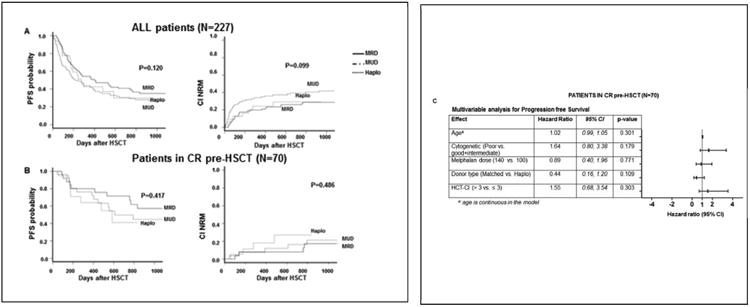
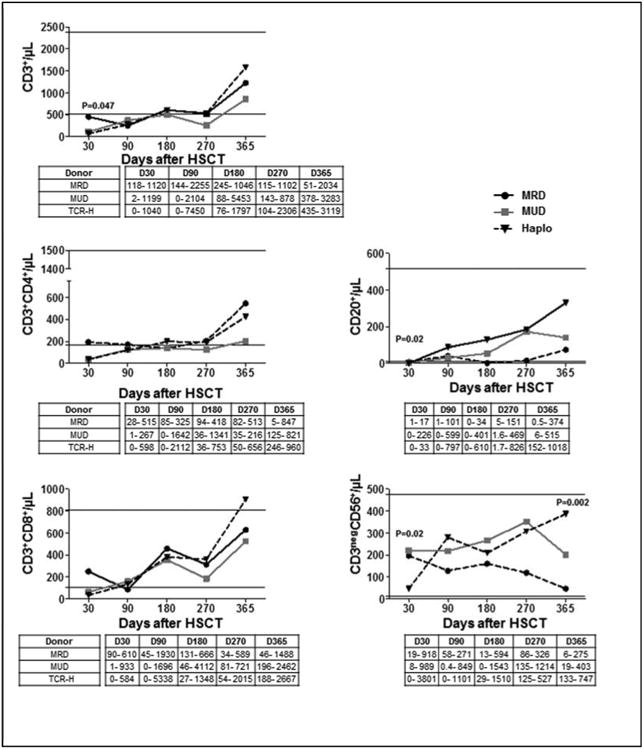
Allogeneic stem cell transplantation for patients with acute myeloid leukemia (AML) and myelodysplastic syndromes (MDS) has been performed primarily with an HLA-matched donor. Outcomes of haploidentical transplantation have recently improved, and a comparison between donor sources in a uniform cohort of patients has not been performed. We evaluated outcomes of 227 patients with AML/MDS treated with melphalan-based conditioning. Donors were matched related (MRD) (n = 87, 38%), matched unrelated (MUD) (n = 108, 48%), or haploidentical (n = 32, 14%). No significant differences were found between haploidentical and MUD transplantation outcomes; however, there was a trend for improved outcomes in the MRD group, with 3-year progression-free survival for patients in remission of 57%, 45%, and 41% for MRD, MUD, and haploidentical recipients, respectively (P = .417). Recovery of T cell subsets was similar for all groups. These results suggest that haploidentical donors can safely extend transplantation for AML/MDS patients without an HLA-matched donor. Prospective studies comparing haploidentical and MUD transplantation are warranted.
Keywords: Acute myeloid leukemia; Fludarabine-melphalan; Haploidentical transplantation; Hematopoietic stem cell transplantation; Myeloablative reduced-intensity conditioning regimen; Myelodysplastic syndromes; Post-transplantation cyclophosphamide.
Copyright © 2014 American Society for Blood and Marrow Transplantation. Published by Elsevier Inc. All rights reserved.
Conflict of interest statement
Figures
Comment in
-
Haploidentical versus matched donor stem cell transplantations for acute myeloid leukemia/myelodysplastic syndrome patients.Biol Blood Marrow Transplant. 2014 Dec;20(12):1875-6. doi: 10.1016/j.bbmt.2014.10.005. Epub 2014 Oct 13. Biol Blood Marrow Transplant. 2014. PMID: 25307420 No abstract available.
References
-
- Thomas ED, Buckner CD, Banaji M, et al. One hundred patients with acute leukemia treated by chemotherapy, total body irradiation, and allogeneic marrow transplantation. Blood. 1977;49(4):511–533. - PubMed
-
- Copelan EA. Hematopoietic stem-cell transplantation. New Engl J Med. 2006;354(17):1813–1826. - PubMed
-
- Aoudjhane M, Labopin M, Gorin NC, et al. Comparative outcome of reduced intensity and myeloablative conditioning regimen in HLA identical sibling allogeneic haematopoietic stem cell transplantation for patients older than 50 years of age with acute myeloblastic leukaemia: a retrospective survey from the Acute Leukemia Working Party (ALWP) of the European group for Blood and Marrow Transplantation (EBMT) Leukemia. 2005;19(12):2304–2312. - PubMed
-
- Giralt S, Thall PF, Khouri I, et al. Melphalan and purine analog-containing preparative regimens: reduced-intensity conditioning for patients with hematologic malignancies undergoing allogeneic progenitor cell transplantation. Blood. 2001;97(3):631–637. - PubMed
Publication types
MeSH terms
Substances
Grants and funding
LinkOut - more resources
Full Text Sources
Other Literature Sources
Medical
Research Materials
Miscellaneous
