. 2014 Oct 20;24(20):2406-10.
doi: 10.1016/j.cub.2014.08.037. Epub 2014 Sep 25.

FMRFamide-like FLP-13 neuropeptides promote quiescence following heat stress in Caenorhabditis elegans

Affiliations

FMRFamide-like FLP-13 neuropeptides promote quiescence following heat stress in Caenorhabditis elegans

Matthew D Nelson et al. Curr Biol. .

Abstract

Among the most important decisions an animal makes is whether to engage in active movement and feeding behavior or to become quiescent. The molecular signaling mechanisms underlying this decision remain largely unknown. The nematode Caenorhabditis elegans displays sleep-like quiescence following exposures that result in cellular stress. The neurosecretory ALA neuron is required for this stress-induced recovery quiescence, but the mechanisms by which ALA induces quiescence have been unknown. We report here that quiescence induced by heat stress requires ALA depolarization and release of FMRFamide-like neuropeptides encoded by the flp-13 gene. Optogenetic activation of ALA reduces feeding and locomotion in a FLP-13-dependent manner. Overexpression of flp-13 is sufficient to induce quiescent behavior during normally active periods. We have here identified a major biological role for FMRFamide-like neuropeptides in nematodes, and we suggest that they may function in a similar capacity in other organisms.


Figures

Figure 1
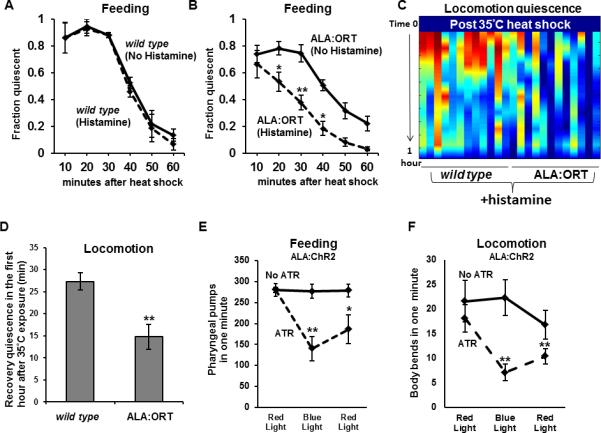
Figure 1. ALA depolarization is required for heat-induced quiescence
(A) After a 30-minute 35°C heat shock (Protocol 1), wild-type animals cultivated either with (dashed line) or without (solid line) histamine showed equivalent degrees of feeding quiescence (N=18-20 worms per trial, 3 trials, Student's t-test. Error bars are SEM in this and all subsequent figures). (B) After a 30-minute 35°C heat shock (Protocol 1), worms that expressed Ort in the ALA neuron cultivated in the presence of histamine (dashed line) displayed reduced feeding quiescence than their transgenic sisters that were not exposed to histamine (N=18-20 worms per trial, 8 trials, 3 extrachromosomal lines analyzed, *p<.05, **p<.005, Students t-test). (C) Heat map showing quiescence (red is most quiescent) in the hour after a 35°C heat shock (protocol 1) of 12 individual wild-type worms and 12 individual worms expressing ORT in ALA. (D) Average locomotion quiescence is reduced in animals expressing ORT in ALA in comparison to wild-type animals, all cultivated on histamine (N=12 for each genotype, **p<.005, Students t-test). (EF) Activation of ChR2 in the ALA neuron causes a reduction in feeding (E) and locomotion (F) in a manner that depends on the wavelength of light and on the ChR2 essential cofactor all trans retinal (ATR). (No ATR condition N=10, ATR condition N=12, *p<.05 **p<.005, Wilcoxon rank sum test, comparing the initial red light condition to the blue light condition, and comparing the initial to the terminal red light conditions). Note that in A-D, we are reporting quiescence measures whereas in E and F, we are reporting activity measures. See also Figure S1.
Figure 2
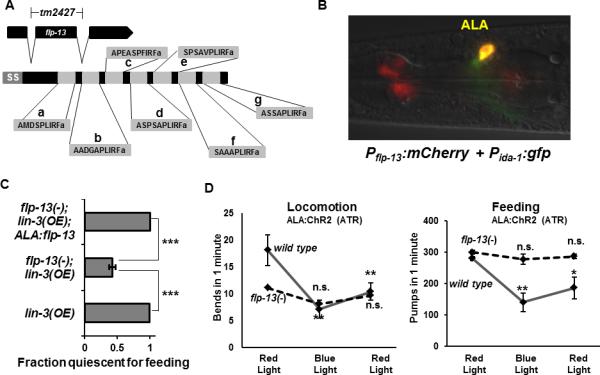
Figure 2. flp-13 is expressed in the ALA neuron and is required for ALA-induced quiescence
(A) The gene flp-13 encodes for a preproprotein that is processed into 7 distinct neuropeptides, FLP-13a-g, each of which is amidated at the C-terminus. The tm2427 deletion removes all of exon 2, which results in a frame shift mutation. “ss” denotes signal sequence. (B) flp-13 is expressed in the ALA neuron. mCherry is expressed under the control of the flp-13 promoter and GFP is expressed in the ALA neuron under the control of the ida-1 promoter. (C) Over-expression of LIN-3/EGF in the wild-type genetic background results in a feeding quiescence phenotype two hours after induction of the lin-3 transgene. In the flp-13(tm2427) background, fewer animals are quiescent during lin-3 over-expression (N=18-20 worms per trial, 4 trials, ***P<.0005, Student's t test). flp-13 expressed in ALA using the ida-1 promoter restores the ability of LIN-3 to induce quiescence (N=21 animals per trial, 2 trials, ***P<.0005, Student's t test). (D) flp-13(tm2427) mutation impairs the suppression of locomotion (left) and feeding (right) caused by activating ChR2 in the ALA neuron with blue light in the presence of all trans retinal. (N=10 animals per condition, *p<.05 **p<.005, Wilcoxon rank sum test, comparing initial red to blue and initial red to final red conditions). See also Figure S2.
Figure 3
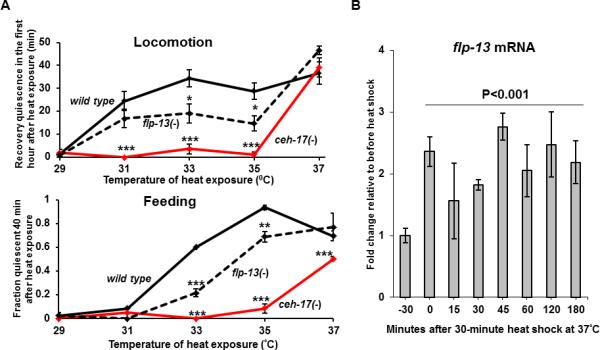
Figure 3. flp-13 is required for heat shock-induced behavioral quiescence and is transcriptionally-induced by heat shock
(A) ceh-17 (red line) and flp-13 (dashed line) are required for quiescence of locomotion (top) and of feeding (bottom) after exposure to heat at various temperatures (Protocol 2—preheated plates). (B) The level of flp-13 mRNA is increased in response to a heat shock of 37°C. (N=3 biological replicates, one way ANOVA). See also Figure S3.
Figure 4
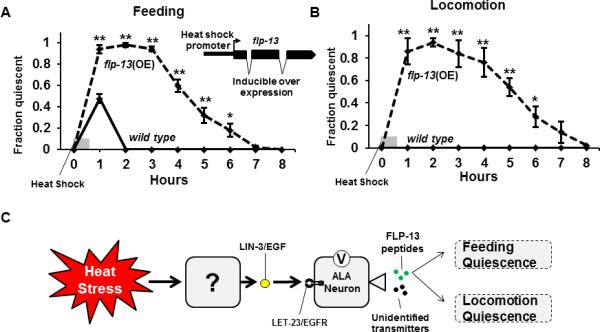
Figure 4. flp-13 over-expression is sufficient to induce behavioral quiescence
The flp-13 gene is placed under the control of the inducible heat-shock promoter of the gene hsp-16.2. (A) Wild-type animals (solid line) display feeding quiescence in response to a 30-minute 33°C heat shock but recover after an hour. Animals that over express flp-13 (dashed line) stop feeding and do not fully recover until eight hours after the start of the heat shock (average of 5 trials, N≥10 animals/trial, *p<.05, **p<.005, Student's t-test). (B) Animals that over express flp-13 (dashed line) stop moving and do not fully recover until eight hours after the start of the heat shock (average of 5 trials, N≥10 animals/trial, *p<.05, **p<.005, Student's t-test). (C) A model for the regulation of behavioral quiescence in response to heat stress. Heat exposure causes an unknown cell to release LIN-3/EGF, which signals through its receptor, LET-23, on the ALA neuron. This, at least in part, leads to a membrane depolarization and the release of FLP-13 neuropeptides as well as unidentified co-transmitters. The FLP-13 neuropeptides then promote feeding and locomotion quiescence.

Comment in

  • Sleep: Let sleeping worms lie.
    Bray N. Bray N. Nat Rev Neurosci. 2014 Nov;15(11):697. doi: 10.1038/nrn3849. Epub 2014 Oct 15. Nat Rev Neurosci. 2014. PMID: 25315392 No abstract available.

References

    1. Hill A, Mansfield R, Lopez JM, Raizen DM, Van Buskirk C. Cellular Stress Induces a Protective Sleep-like State in C. elegans. Current biology : CB. In Press. - PMC - PubMed
    1. Sanders J, Nagy S, Fetterman G, Wright C, Treinin M, Biron D. The Caenorhabditis elegans interneuron ALA is (also) a high-threshold mechanosensor. BMC neuroscience. 2013;14:156. - PMC - PubMed
    1. White JG, Southgate E, Thomson JN, Brenner S. The structure of the nervous system of the nematode Caenorhabditis elegans. Philosophical transactions of the Royal Society of London. Series B, Biological sciences. 1986;314:1–340. - PubMed
    1. Van Buskirk C, Sternberg PW. Epidermal growth factor signaling induces behavioral quiescence in Caenorhabditis elegans. Nature neuroscience. 2007;10:1300–1307. - PubMed
    1. Pokala N, Liu Q, Gordus A, Bargmann CI. Inducible and titratable silencing of Caenorhabditis elegans neurons in vivo with histamine-gated chloride channels. Proceedings of the National Academy of Sciences of the United States of America. 2014;111:2770–2775. - PMC - PubMed

Publication types

MeSH terms

LinkOut - more resources