


Screening for increased cardiometabolic risk in primary care: a systematic review
- PMID: 25267047
- PMCID: PMC4173724
- DOI: 10.3399/bjgp14X681781
Screening for increased cardiometabolic risk in primary care: a systematic review
Abstract
Background: Many programmes to detect and prevent cardiovascular disease (CVD) have been performed, but the optimal strategy is not yet clear.
Aim: To present a systematic review of cardiometabolic screening programmes performed among apparently healthy people (not yet known to have CVD, diabetes, or cardiometabolic risk factors) and mixed populations (apparently healthy people and people diagnosed with risk factor or disease) to define the optimal screening strategy.
Design and setting: Systematic review of studies performed in primary care in Western countries.
Method: MEDLINE, Embase, and CINAHL databases were searched for studies screening for increased cardiometabolic risk. Exclusion criteria were studies designed to assess prevalence of risk factors without follow-up or treatment; without involving a GP; when fewer than two risk factors were considered as the primary outcome; and studies constrained to ethnic minorities.
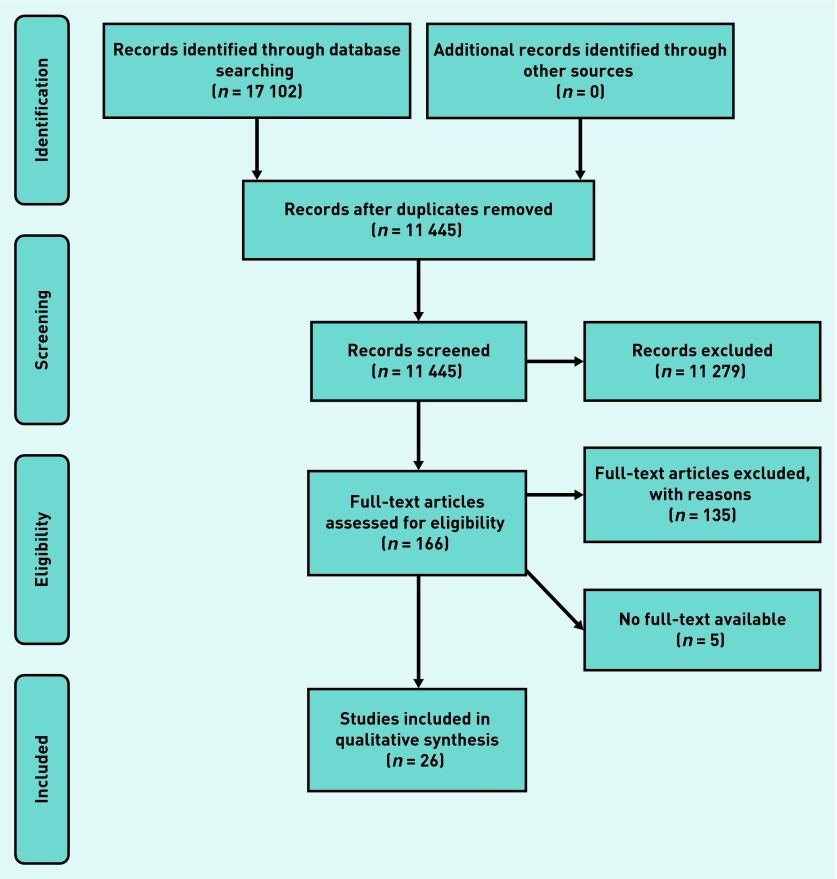
Results: The search strategy yielded 11 445 hits; 26 met the inclusion criteria. Five studies (1995-2012) were conducted in apparently healthy populations: three used a stepwise method. Response rates varied from 24% to 79%. Twenty-one studies (1967-2012) were performed in mixed populations; one used a stepwise method. Response rates varied from 50% to 75%. Prevalence rates could not be compared because of heterogeneity of used thresholds and eligible populations. Observed time trends were a shift from mixed to apparently healthy populations, increasing use of risk scores, and increasing use of stepwise screening methods.
Conclusion: The optimal screening strategy in primary care is likely stepwise, in apparently healthy people, with the use of risk scores. Increasing public awareness and actively involving GPs might facilitate screening efficiency and uptake.
Keywords: cardiometabolic risk factors; primary health care; screening.
© British Journal of General Practice 2014.
References
-
- World Health Organization . The Global Burden of Disease: 2004 Update. Geneva, Switzerland: WHO; 2008.
-
- Pike LA. A screening programme for the elderly in a general practice. Practitioner. 1969;203(218):805–812. - PubMed
Publication types
MeSH terms
LinkOut - more resources
Full Text Sources
Other Literature Sources
Medical
Miscellaneous
